
Beyond Traditional Metallurgy: Caltech’s HIAM Method Creates Stronger, Custom-Tailored Alloys
For centuries, metallurgy has primarily relied on conventional methods: extracting raw ore, followed by intensive thermal and chemical refinement processes to yield desired metals or alloys. While effective for mass production, this approach often presents inherent limitations in achieving precise control over a material’s internal structure and chemical composition. As materials science professor Julia R. Greer aptly notes, “If you look at how metallurgy has been done for centuries, in broad strokes, you nearly always start with a raw ore, which is then thermally and/or chemically treated and refined, to produce the desired metal or alloy.” She further explains the consequence of this traditional paradigm: “And basically, the mechanical properties of the metals produced this way are limited.” This constraint on mechanical properties has long presented a bottleneck for developing advanced materials tailored for specific high-performance applications.
However, researchers at Caltech have embarked on a groundbreaking journey, developing a novel metallurgical approach that promises to fundamentally transform how metallic materials are designed and manufactured. This innovative method grants unprecedented, precise control over both the chemical composition and the intricate microstructure of metallic materials, leading to a significant enhancement in their mechanical resilience and overall performance. At the heart of this advancement is the integration of cutting-edge 3D printing techniques, particularly building upon pioneering work led by Greer in 2018, where her team first explored using additive manufacturing to construct complex metal microstructures. This revolutionary process, known as Hydrogel-Infusion Additive Manufacturing (HIAM), is meticulously described in their published paper as “a microscale printing technique distinguished by its forming of parts throughout phase transformations and crystal growth.” The latest breakthrough pushes HIAM capabilities even further: researchers have mastered the ability to infuse more than one metal simultaneously. This critical advancement now allows them to fabricate sophisticated alloys, such as copper–nickel composites, with meticulously custom-tailored ratios of each constituent element. These precise variations in elemental composition and microstructure subsequently lead to profound and desirable changes in the material’s mechanical properties, opening doors to a new era of material design.
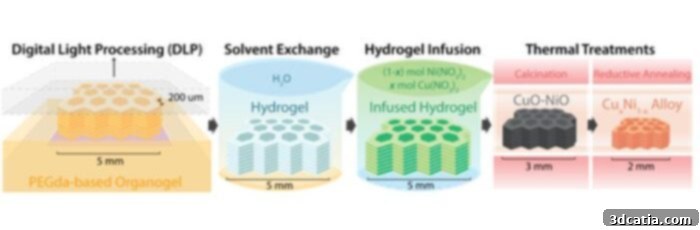
A visual representation of the Hydrogel-Infusion Additive Manufacturing (HIAM) process for creating advanced copper-nickel alloys.
Understanding the HIAM Process: A Paradigm Shift in Material Fabrication
The HIAM process distinguishes itself through its intricate complexity and remarkable precision, offering a stark contrast to conventional metal processing. It initiates with the creation of a soft, gel-like scaffold through the precise 3D printing of an organic hydrogel. For this crucial initial step, the Caltech researchers employed digital light processing (DLP), an advanced additive manufacturing technique known for its high resolution and ability to produce intricate geometries. DLP utilizes a projector to flash entire layers of a photo-curable resin, solidifying them rapidly. Hydrogels are particularly well-suited for this application due to their porous nature, biocompatibility, and ability to hold shape while also allowing for the diffusion of substances. This meticulously designed hydrogel scaffold acts as the foundational template, dictating the ultimate macro-scale shape and micro-scale features of the final metallic material.
Once the hydrogel scaffold is precisely printed and cured, the next pivotal step involves the careful application of a liquid solution containing metallic salts. This solution is introduced to the scaffold, allowing metal ions to meticulously infuse and permeate throughout the porous polymeric structure. The concentration and specific types of metallic salts are precisely controlled to achieve the desired final elemental composition within the alloy. Following this infusion, the structure undergoes calcination – a high-temperature thermal treatment where the printed object is burned in the presence of oxygen. This crucial step serves to meticulously burn away all the organic hydrogel material, leaving behind a delicate, porous structure composed entirely of metal oxides. The precise control over temperature and oxygen atmosphere during calcination is vital to prevent structural collapse and ensure the formation of the desired oxide network.
The final transformative stage of the HIAM process is reductive annealing. In this step, the metal oxide structure is exposed to exceptionally high temperatures within a carefully controlled, hydrogen-rich environment. During this annealing phase, the hydrogen gas reacts vigorously with the oxygen atoms bound within the metal oxides, causing most of the oxygen to diffuse out of the solid material. This chemical reaction results in the formation of water vapor, which is then removed from the system. This carefully orchestrated series of thermal steps and phase transformations is what ultimately gives rise to the formation of intricate, highly controlled microstructures within the now-metallic, 3D-printed gels. The complex interplay between temperature, gas atmosphere, and chemical reactions during these stages determines the final crystal grain size, orientation, and overall homogeneity of the material. Ultimately, HIAM successfully produces a metallic structure that faithfully replicates the intended shape of the initial hydrogel scaffold, now transformed into an advanced alloy precisely composed of the two (or more) infused metals. This multi-stage process provides an unparalleled level of control over the material’s internal architecture, a feat largely unattainable with traditional metallurgical techniques.
Advanced Microstructural Analysis and Key Discoveries
Once the intricate alloys are fabricated through the HIAM process, scientists at Caltech employ advanced characterization techniques to rigorously analyze their microstructure. This comprehensive analysis includes scrutinizing the orientation of individual crystal grains, the boundaries separating them, and the overall crystallographic texture. Such detailed examination is crucial because these microstructural features profoundly dictate a material’s mechanical performance, including its strength, ductility, and fatigue resistance. Concurrently, the materials undergo a series of mechanical tests, yielding critical insights into how the unique HIAM process directly influences the alloy’s performance under various stresses and strains. This integrated approach of microstructural characterization and mechanical testing is fundamental to understanding and optimizing the HIAM-produced materials.
Rebecca Gallivan, one of the dedicated researchers, highlights the profound implications of their work: “This lays the groundwork for thinking about 3D-printed alloy design in a unique way from other microscale additive manufacturing techniques.” She further emphasizes the distinct outcomes achieved through their methodology: “We see that the processing environment leads to very different microstructures in comparison to other methods.” This distinction underscores HIAM’s potential to create materials with properties unattainable through existing additive manufacturing or conventional metallurgical routes, offering a new paradigm for alloy engineering.
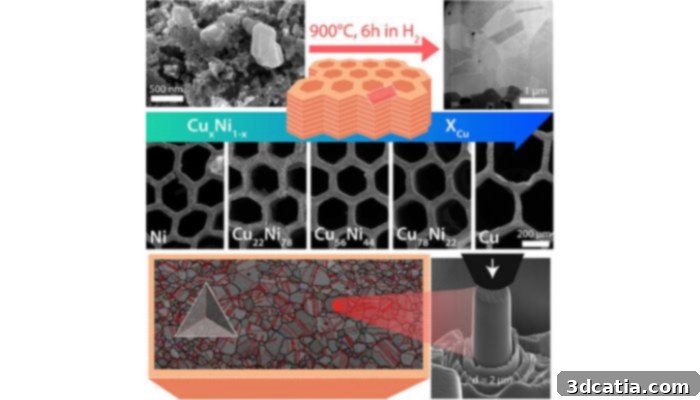
A detailed graphic visualization illustrating the various stages of the HIAM process.
Insights from Transmission Electron Microscopy
To delve deeper into the atomic and sub-nanometer scale features, the Caltech researchers utilized a transmission electron microscope (TEM). This powerful analytical tool revealed that alloys produced using the HIAM method form significantly more homogeneously compared to those made with traditional techniques. Furthermore, these HIAM-produced alloys exhibit remarkably higher degrees of symmetry throughout their crystal structures. Lead author Thomas T. Tran explains that the precise shape, size, and crystallographic orientation of the metal grains are profoundly influenced by the critical transition from metal oxide to pure metal during the reductive annealing phase. As temperatures escalate during this process, the generated water vapor meticulously escapes the material, leaving behind a network of tiny pores. These pores play a crucial role in slowing down the overall grain growth kinetics, thereby enabling the formation of finer, more controlled grain structures. Moreover, the specific types of oxides initially present in the metallic precursors also exert a significant influence on the subsequent grain growth and final microstructure, demonstrating another layer of tunable control within the HIAM process.
One of the study’s most notable findings directly challenges conventional metallurgical thinking, which has historically posited that the strength of alloys is predominantly determined by their grain size—a principle encapsulated by the Hall-Petch effect. While grain size remains an important factor, the Caltech research demonstrates that the strength of alloys created through HIAM depends not only on this metric but also critically on their precise chemical composition and the unique processing history. Furthermore, the HIAM process inherently leaves behind tiny, strategically dispersed oxide inclusions within the metallic matrix. These nanoscale oxide inclusions are not impurities but rather active contributors to the alloys’ exceptional mechanical strength and hardness. As Tran elaborates, “Because of the complex ways in which metal is formed during this process, we find nanoscale structures rich with metal–oxide interfaces that contribute to the hardening of our alloys by up to a factor of four.” These metal–oxide interfaces act as potent barriers to dislocation movement—the atomic-level defects responsible for plastic deformation—thereby dramatically enhancing the material’s resistance to yielding and fracture. This phenomenon, often referred to as dispersion strengthening or precipitation hardening, is precisely controlled and leveraged within the HIAM methodology, paving the way for the creation of ultra-strong, lightweight metallic materials for demanding engineering applications.
Broadening the Horizons: Applications and Future Directions
The implications of Caltech’s HIAM process extend far beyond the laboratory. By offering unparalleled control over material microstructure and chemical composition, this technology paves the way for designing custom-tailored alloys with performance characteristics previously considered impossible. Imagine aerospace components that are simultaneously lighter and stronger, biomedical implants with superior biocompatibility and mechanical durability, or energy sector materials capable of withstanding extreme temperatures and corrosive environments. The ability to precisely tune properties like strength, ductility, and fatigue resistance at the microscale opens up vast opportunities for innovation across numerous industries. Future research will likely focus on exploring even more complex multi-metallic alloys, scaling up the HIAM process for industrial production, and further reducing manufacturing costs to make these advanced materials more accessible. This paradigm shift in metallurgy, driven by additive manufacturing and meticulous materials science, represents a significant leap towards a future where materials are not just selected, but precisely engineered for their ultimate purpose.
This pioneering research was made possible through the generous support of the US Department of Energy’s Basic Energy Sciences program, along with a crucial National Science Foundation graduate fellowship. To delve deeper into the fascinating specifics of this breakthrough, the full Caltech study, titled “Multiscale Microstructural and Mechanical Characterization of Cu–Ni Binary Alloys Reduced During Hydrogel Infusion-Based Additive Manufacturing (HIAM),” is available for review here.
What are your thoughts on the groundbreaking HIAM process and its potential to revolutionize materials science? We invite you to share your insights in a comment below or join the conversation on our LinkedIn and Facebook pages! Don’t forget to sign up for our free weekly Newsletter here to receive the latest 3D printing news directly in your inbox. You can also explore all our insightful videos on our YouTube channel for more engaging content.
*All Photo Credits: Thomas Tran/Caltech