
Top AI Software for 3D Printing: Enhancing Design, Management, and Quality Control
Artificial intelligence (AI) has rapidly become a transformative force across numerous industries, and 3D printing, or additive manufacturing, is no exception. While discussions around the ethical implications of AI continue, its undeniable potential to revolutionize and streamline complex processes is clear. In the realm of 3D printing, AI is emerging as a powerful tool that significantly improves efficiency, accuracy, and accessibility from the initial design phase through to production management and stringent quality control. This integration of AI empowers both seasoned professionals and enthusiastic hobbyists to overcome traditional challenges, reduce errors, and accelerate innovation.
The applications of AI in additive manufacturing are vast and varied. From intelligently calibrating machines to predicting and preventing print failures, and even assisting in the generative design of intricate parts, AI solutions are reshaping how we approach 3D printing. As the technology matures, an increasing number of sophisticated software platforms are becoming available on the market, each offering unique capabilities designed to enhance different aspects of the 3D printing workflow. To illuminate the current landscape, we have compiled a comprehensive list of leading AI software solutions specifically tailored for 3D printing, covering everything from smart calibration and real-time monitoring to advanced generative design tools. Discover the innovations that are already making a significant impact on this dynamic industry.
Software for Management and Maintenance
Efficient management and meticulous maintenance are crucial for successful 3D printing operations. AI-powered software solutions are transforming these areas by automating complex tasks, predicting potential issues, and ensuring optimal machine performance. These tools reduce human intervention, minimize errors, and maximize uptime, making 3D printing more reliable and cost-effective.
InTinker Uses AI for Better 3D Printing Calibration
Co-founded by Trevor Haas and Matt Milanek, inTinker is an innovative software that leverages AI to simplify and optimize the often-daunting process of 3D printer calibration. This solution caters to a broad audience, from large original equipment manufacturers (OEMs) to individual hobbyists, aiming to lower the entry barrier to high-quality 3D printing. InTinker achieves this through customized, pre-configured downloadable calibration files and intelligent suggestions for slicer settings, dramatically improving print outcomes.
The core of inTinker’s intelligence lies in its self-learning algorithm. It continuously draws on anonymized data and feedback submitted by users who test various settings. As more data is gathered, the algorithm grows smarter, allowing it to provide increasingly precise and personalized calibration recommendations in real-time while parts are being printed. Given the critical role of accurate calibration in preventing common printing errors such as stringing, warping, or layer shifting, inTinker stands out as an invaluable tool. It empowers both novices struggling with initial setup and experts seeking to fine-tune their desktop 3D printers for consistent, high-fidelity results, ultimately saving time and material waste.
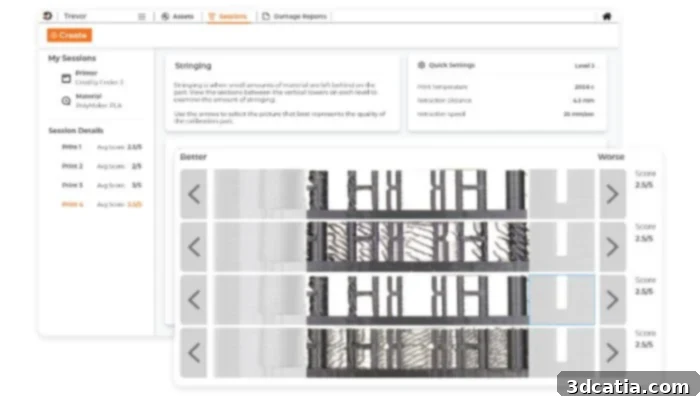
Photo Credits: inTinker
PrintSyst.ai: Predictive Analytics for Additive Manufacturing
PrintSyst.ai represents a cutting-edge artificial intelligence-based management software solution specifically engineered to elevate the quality and reliability of 3D printing. This innovative platform distinguishes itself by conducting pre-tests on digital additive manufacturing models, proactively identifying and rectifying potential performance issues before a single layer is printed. By doing so, PrintSyst.ai ensures the functional integrity of final parts, significantly streamlining the entire 3D printing process and minimizing costly rework.
Harnessing the immense power of AI combined with a remarkably user-friendly interface, PrintSyst.ai generates comprehensive reports. These reports contain critical design and material information, offering invaluable recommendations that drastically reduce the need for iterative trial and error. This translates into substantial savings in both time and material resources. Furthermore, users benefit from accurate cost estimates, which enable them to maximize profit margins and confidently anticipate the success and performance of their printed components. Targeted towards high-stakes industries such as aerospace, defense, and automotive, PrintSyst.ai empowers businesses to unlock the full potential of 3D printing. By markedly improving the consistency and reliability of final parts, this intelligent tool provides companies with a significant competitive advantage in demanding markets.
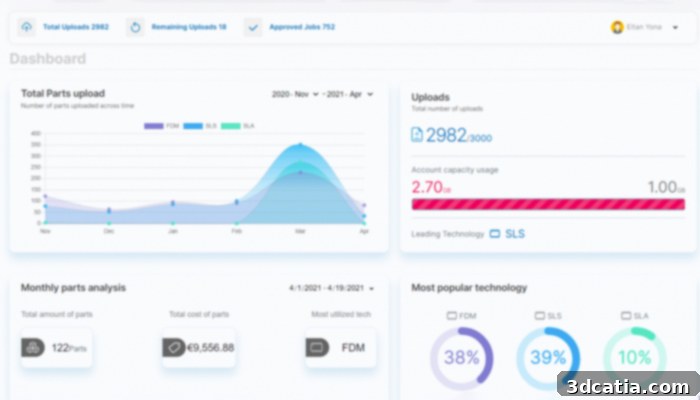
Photo credits: PrintSyst
PrintNanny: Uninterrupted Quality Control for 3D Printing
PrintNanny is an advanced AI-powered monitoring and automation software solution designed to provide continuous, vigilant oversight for 3D printing operations. It effectively removes the necessity for constant human supervision by offering “quality control that never sleeps.” This intelligent system proactively watches over print jobs, ensuring they meet predefined quality standards. If a print job deviates from these standards or is deemed to be failing, PrintNanny takes immediate action. Users can configure the software to either send instant notifications to their devices or initiate automatic pauses, preventing further material waste and machine wear.
Operating as an intuitive operating system for 3D printing, PrintNanny OS can be effortlessly installed on a Raspberry Pi, allowing seamless integration with users’ preferred 3D printing tools and existing setups. Its over-the-air update mechanism ensures that all integrated tools and the system itself remain up-to-date without the hassle of manually re-imaging SD cards, guaranteeing access to the latest features and security patches. With flexible pricing options and custom packages tailored for enterprise-level deployments, PrintNanny offers a comprehensive and scalable solution. It streamlines 3D printing operations, enhances efficiency, and provides peace of mind through its robust, automated quality assurance capabilities, making it a valuable asset for any serious 3D printing endeavor.
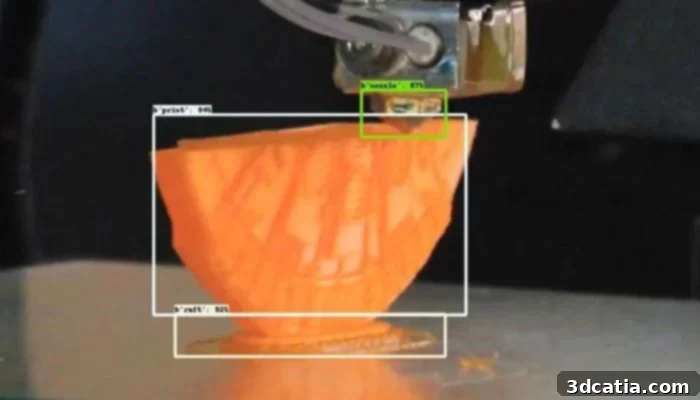
PrintNanny automatically halts failed 3D print jobs (Photo credits: PrintNanny)
Obico.io: Remote Monitoring and AI-Powered Failure Detection
Obico.io, formerly recognized as The Spaghetti Detective, is a leading platform dedicated to providing users with seamless and remote control over their 3D printers. Designed with the specific needs of the 3D printing community in mind, this open-source solution integrates advanced artificial intelligence to offer intelligent monitoring and failure detection capabilities. The platform’s primary strength lies in its ability to meticulously analyze all initiated print jobs, leveraging its AI system to promptly identify any instances of potential print failure.
Once a potential anomaly or failure is detected, Obico’s intelligent tool immediately dispatches an alert to the user’s phone. This timely intervention is crucial, as it allows users to address issues quickly, preventing further material wastage and potentially costly damage to the printer or workpiece. This proactive approach not only conserves valuable resources for manufacturers but also offers significant peace of mind throughout the part manufacturing process, especially for long or unattended prints. Obico’s AI system has demonstrated impressive reliability, having successfully detected nearly a million print failures, solidifying its reputation as an effective and essential tool for ensuring smooth and successful 3D printing experiences for a global user base.
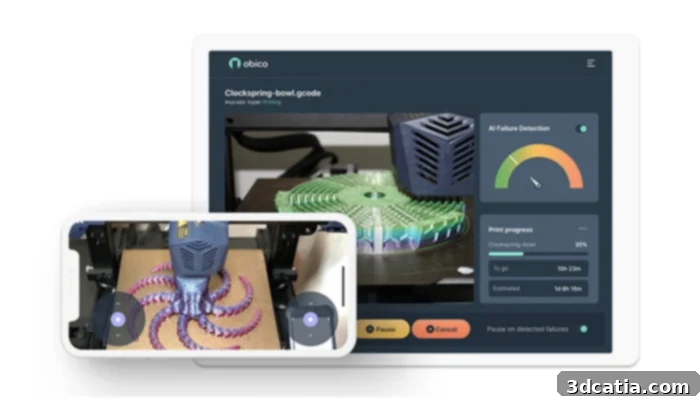
Photo credits: Obico
PrintWatch by Printpal.io: Real-Time Error Detection and Autonomous Optimization
Printpal.io is dedicated to advancing the accessibility and efficiency of 3D printing through its cutting-edge AI software solution, PrintWatch. This robust software is powered by sophisticated Artificial Intelligence technology, granting it the remarkable ability to detect errors and defects in real-time as a 3D print progresses. Beyond just detection, PrintWatch also focuses on optimizing autonomous printing, thereby streamlining the entire manufacturing process, saving invaluable time, and significantly reducing material wastage. Its intelligence ensures that printers operate at peak performance with minimal supervision.
One of PrintWatch’s most compelling attributes is its exceptional accuracy in error detection. Printpal.io proudly claims an impressive detection rate of over 93% for each specific printer, material, and color configuration. This high level of precision means users can have confidence that potential issues, no matter how subtle, will be promptly identified, enabling swift intervention and preventing the escalation of minor flaws into costly defects. Furthermore, PrintWatch enhances user convenience through its remote 3D printing management capabilities. Users are instantly alerted the moment an error occurs, facilitating quick troubleshooting and corrective action from anywhere. The software is available across three pricing tiers, including a standard version that is offered free of charge, making PrintWatch an accessible and powerful tool for a diverse range of users committed to optimizing their 3D printing processes for superior outcomes.
AiSync by Ai Build: Accelerating Additive Manufacturing Excellence
AiSync, an advanced AI-powered solution developed by the acclaimed London-based SAAS company Ai Build, is at the forefront of revolutionizing additive manufacturing processes. Its core mission is to dramatically enhance speed, elevate quality, improve scalability, and ensure unparalleled process reproducibility across the board. AiSync achieves this by offering accessible and user-friendly features that simplify the entire printing process while simultaneously boosting operational efficiency.
The software streamlines print order parameter input through an intuitive chat window, where specifications are seamlessly entered in text form. This allows AiSync to intelligently create a precise programming path, eliminating the laborious and error-prone process of manual coding. Visual programming takes center stage, making printer parameter input clear and straightforward, thus empowering users to effortlessly access and control advanced printer tools for optimal process management. Utilizing a digital twin for highly accurate visual simulation, AiSync supports an extensive array of 3D formats, including OBJ, STEP, STL, 3MF, and GLTF, ensuring broad compatibility. The advanced version, AiSync PRO, further elevates the user experience with real-time control functionalities. By integrating seamlessly with physical machines and continuously analyzing the printing process, users receive timely notifications on print quality, enabling them to monitor progress and make critical adjustments at any given moment.
Primarily designed for industrial production, AiSync solutions cater to a diverse range of demanding sectors such as aerospace, automotive, construction, and shipbuilding. Overwhelmingly positive customer feedback attests to the remarkable benefits of AiSync, with users reporting print setup times reduced by an astounding 86% and total production time slashed by 90%. As the industry increasingly adopts AiSync, additive manufacturing is poised to take a significant leap forward, delivering unprecedented efficiency and superior output quality, cementing its role as a pivotal technology for Industry 4.0.
PrintRite3D by Sigma: Centralized Quality Control for Additive Manufacturing
Addressing one of the most persistent and significant challenges in the additive manufacturing sector – ensuring consistent quality – Sigma has developed PrintRite3D. This robust quality control tool is poised to revolutionize the industry by focusing intensely on in-process quality assurance. PrintRite3D meticulously monitors and manages machine status, process parameters, and part status, centralizing and correlating essential data within a single, intuitive platform. This comprehensive integration of real-time sensor values dramatically enhances the reliability of error detection, significantly aids in meticulous cause analysis, and effectively minimizes potential damages and costly rework.
Functioning as a sophisticated real-time monitoring and analytics tool, PrintRite3D boasts an advanced analysis solution that is ideally suited for modern 3D metal and polymer additive manufacturing technologies. Throughout the entire manufacturing process, it diligently detects defects and anomalies as they occur, allowing for immediate corrective action. This proactive approach plays a crucial role in mitigating error-related costs and substantially elevating overall production efficiency and cost-effectiveness. A key strength of PrintRite3D is its remarkable versatility and seamless integration capabilities. It works harmoniously with a wide array of printers, regardless of their brand or specific technology. Compatible with all major metal and polymer printers, the tool becomes an indispensable asset for additive manufacturing companies striving to establish, maintain, and continuously uphold stringent quality standards across their production lines.
As Sigma continues its mission to elevate metal and polymer 3D printing to new heights of precision and reliability, PrintRite3D emerges as a critical catalyst. It empowers the industry to effectively overcome long-standing quality assurance hurdles and unlock the full, transformative potential of additive manufacturing, driving toward a future of defect-free and highly reliable production.
Sigma’s PrintRite3D tool analyzes the printing process in real time, enabling anomalies to be corrected directly, saving time and money (Photo credits: Sigma Additive Solutions).
Grey-1 from Matta: Self-Learning AI for Proactive Error Correction
Matta, a pioneering London-based company, has harnessed the profound capabilities of deep learning software to fundamentally revolutionize the 3D printing process. They introduce the Grey-1 self-learning AI platform, which establishes an entirely new benchmark by not only detecting errors in real-time but also proactively correcting them and intelligently identifying their underlying root causes. This innovative approach is driven by swift and precise control algorithms that allow for instant adjustments of incorrect parameters, thereby ensuring a consistently superior print quality throughout the entire build.
The Grey-1 AI platform proves to be an absolute game-changer when working with new or previously unfamiliar materials. Within mere seconds, the AI rapidly learns and adapts to print these diverse materials flawlessly by autonomously determining their optimal processing parameters. This unparalleled adaptability guarantees exceptional performance and high-quality results, irrespective of the material’s inherent complexity or unique properties, significantly expanding the scope of materials usable in 3D printing. Furthermore, Matta’s Grey-1 platform offers robust and comprehensive quality control capabilities. It meticulously detects printing errors and concurrently generates a precise digital twin of the part. This innovative digital representation allows for detailed quality measurements to be accurately projected onto each extracted layer, ensuring that stringent quality standards are met and verified at every stage of the printing process. With the platform’s waiting list now open for registration, the industry eagerly anticipates the transformative potential of Matta’s Grey-1 AI platform, which promises to usher in a new era for 3D printing characterized by unprecedented efficiency, accuracy, and material versatility.
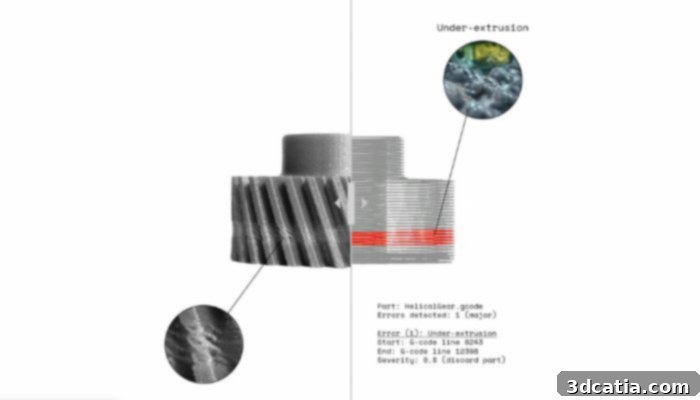
Photo credits: Matta
DeepCube: Industry 4.0 for Additive Manufacturing
DeepCube® AI Software is redefining additive manufacturing with its groundbreaking deep-learning capabilities. At its core, a pioneering inference accelerator dramatically enhances performance on existing additive manufacturing hardware, pushing the boundaries of what’s possible. The software is engineered to enable real-time error detection and correction, surpassing human capabilities by identifying even imperceptible defects that would otherwise compromise part quality. This meticulous level of scrutiny inevitably leads to significantly improved part quality, enhanced reliability, and increased yield rates, directly impacting profitability.
DeepCube’s proprietary algorithms are designed for rapid data analysis speeds, optimizing memory usage and effectively overcoming traditional infrastructure limitations. This efficiency allows for seamless integration into edge devices, empowering machines to actively control and adapt production processes autonomously. Beyond individual machine optimization, DeepCube envisions a future of distributed global automation. It transforms standalone 3D printers into a comprehensive, interconnected solution for Industry 4.0, enabling coordinated operations and knowledge sharing across an entire network of manufacturing assets. This holistic approach fosters a smarter, more resilient manufacturing ecosystem where every printer contributes to and benefits from collective intelligence, driving unprecedented levels of efficiency and innovation in additive manufacturing.

Photo credits: DeepCube
BambuLab’s Micro Lidar: Integrated AI for First-Layer Perfection
Bambu Lab, a prominent manufacturer of advanced 3D printers, has distinguished its Bambu Lab X1 series by integrating cutting-edge artificial intelligence through its proprietary Bambu Micro Lidar system. This innovative sensor operates autonomously, providing a thorough and precise inspection of the initial printed layer – a critical stage where most print failures originate. The Micro Lidar is highly effective at identifying a variety of defects, notably including the detection of dreaded “spaghetti monsters,” a common and frustrating failure where extruded filament fails to adhere and forms a tangled mess.
Beyond defect detection, the integrated AI system employs advanced algorithms to meticulously check and adjust the nozzle height, ensuring optimal first-layer adhesion and print quality. This automatic adjustment capability is vital for consistency across different materials and print jobs. Additionally, the Micro Lidar provides an extra layer of calibration assurance, verifying the printer’s setup before a significant amount of material is committed. By intelligently safeguarding the integrity of the first layer and continually optimizing nozzle parameters, Bambu Lab’s Micro Lidar significantly enhances print success rates, reduces user frustration, and ensures that even complex prints begin with a solid foundation, showcasing the power of embedded AI in modern 3D printing hardware.
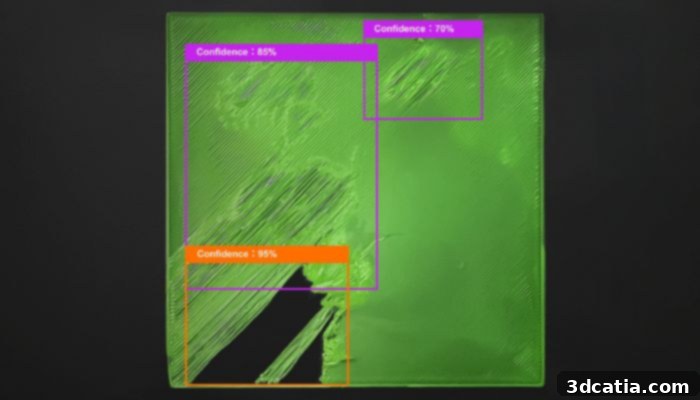
Photo credits: Bambu Lab
AutoOED: User-Friendly Experimental Design with AI
AutoOED serves as sophisticated experimental design software, harnessing the powerful capabilities of an artificial intelligence system, much like other innovative solutions found on this list. It proves to be an exceptionally potent tool for systematically enhancing design parameters across a wide array of experimental settings, making it invaluable for research, development, and process optimization in 3D printing. What truly sets AutoOED apart is its meticulously crafted user-friendly and straightforward design, making it highly accessible even to users with little to no prior knowledge or experience in experimental design or AI. This ease of use democratizes advanced optimization techniques.
The software proudly embraces an open-source approach, which is a significant advantage. This allows for extensive customization, enabling users to tailor the software to their specific needs and even develop and integrate novel algorithms, fostering a collaborative and evolving ecosystem. While the optimization speed of AutoOED may inherently vary based on the particular algorithm chosen for a given task, it is noteworthy that a significant number of its available algorithms execute with impressive swiftness and efficiency. This balance of power, flexibility, and user accessibility makes AutoOED an attractive option for anyone looking to intelligently explore and optimize experimental parameters in additive manufacturing without requiring deep technical expertise in AI or coding.
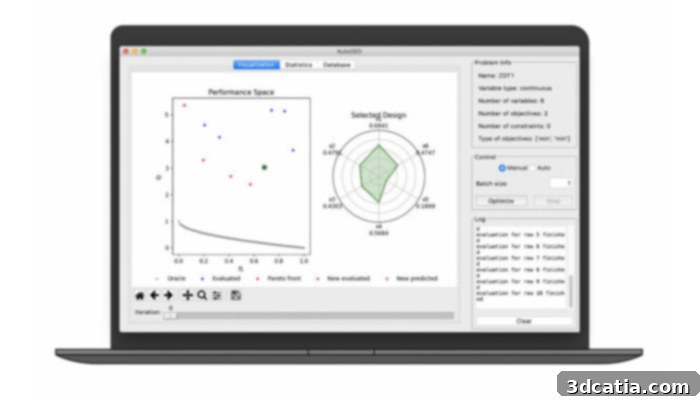
Photo credits: AutoOED
Software for Design
Generative AI is revolutionizing the design phase of 3D printing, enabling rapid iteration, complex geometries, and optimized structures that would be challenging or impossible to create manually. These tools empower designers to explore vast design spaces, creating highly functional and innovative models with unprecedented speed and creativity.
NVIDIA Picasso: Generative AI for Visual and 3D Content Creation
NVIDIA Picasso stands as an innovative cloud service meticulously engineered for the creation and deployment of generative AI-powered visual applications, encompassing images, videos, and crucially, 3D content. This exceptionally powerful service empowers enterprises, independent software creators, and service providers to fully harness the groundbreaking capabilities of generative AI in their respective fields. With NVIDIA Picasso, users are afforded remarkable flexibility: they can run inference on their own custom-trained models, train NVIDIA Edify foundation models using proprietary data for specialized applications, or begin with pre-trained models to generate compelling visual content directly from text prompts. This versatility makes it a potent tool for rapid prototyping and conceptual design in 3D printing.
The service is fully optimized for NVIDIA’s cutting-edge GPUs, meticulously streamlining the processes of training, optimization, and inference on NVIDIA DGX Cloud, ensuring maximum performance and efficiency. By integrating NVIDIA Picasso, organizations can supercharge their design and development applications with advanced generative AI. This offers the significant advantages of custom model creation, enabling highly interactive design experiences, and delivering cost-saving inference optimizations crucial for large-scale operations. Furthermore, strategic partnerships with industry titans such as Adobe, Getty Images, and Shutterstock open up entirely new possibilities for creators and marketers alike. These collaborations accelerate workflows and provide access to ethically sourced, licensed data for training highly specialized generative models. NVIDIA Picasso has already showcased remarkable success stories with pioneering companies like Runway, Cuebric, and WOMBO, collectively empowering users to explore new frontiers of creativity and visual content generation, directly impacting how 3D models are conceived and brought to life for additive manufacturing.

Photo credits: NVIDIA Corporation
DreamFusion: Text-to-3D Model Generation
DreamFusion is a groundbreaking software that ingeniously transforms textual descriptions into fully realized 3D printable models. This revolutionary capability is achieved by harnessing an advanced AI-driven text-to-image model, specifically Imagen, to meticulously optimize a 3D scene. The core of its functionality relies on a sophisticated technique known as Score Distillation Sampling (SDS). Through SDS, DreamFusion generates high-quality samples based on a diffusion model, which facilitates optimization within a highly flexible and rich parameter space, such as a complex 3D environment.
For the crucial mapping of this optimized 3D scene, DreamFusion employs a 3D scene parameterization akin to Neural Radiance Fields (NeRFs), which are renowned for their ability to render novel views of complex 3D scenes from a sparse set of 2D images. To further refine the output and enhance geometrical integrity, the software incorporates additional regularizers. The culmination of these advanced techniques results in trained 3D models that exhibit remarkable consistency, boasting high-quality surface geometry and precise depth information. This capability drastically reduces the design cycle for 3D printable objects, empowering designers and engineers to rapidly conceptualize and generate complex shapes and structures with unprecedented ease, directly from simple text prompts, opening up vast possibilities for rapid prototyping and custom manufacturing.

Photo credits: DreamFusion
The integration of Artificial Intelligence into 3D printing is no longer a futuristic concept but a present-day reality that is fundamentally reshaping the industry. From the nuanced calibration of 3D printers and real-time defect detection to the revolutionary generative design of complex geometries, AI software is proving to be an indispensable tool. These intelligent solutions empower users with greater precision, efficiency, and control, significantly reducing material waste, cutting down production times, and enhancing the overall quality and reliability of printed parts.
As we continue to witness rapid advancements in machine learning and data processing, the symbiotic relationship between AI and 3D printing is only expected to deepen. This synergy will unlock even more sophisticated capabilities, such as fully autonomous manufacturing workflows, predictive maintenance on an unprecedented scale, and the ability to design highly optimized, custom parts for an ever-expanding range of applications. The software highlighted in this list represents just a glimpse of the innovative potential that AI brings to additive manufacturing, promising a future where 3D printing is more accessible, efficient, and capable than ever before.
Do you have any experience with these AI software for 3D printing? We’d love to hear your insights! Share your thoughts in a comment below or connect with us on ourLinkedIn,Facebook, andTwitter pages. Don’t forget to sign up for our free weeklyNewsletter here to get the latest 3D printing news delivered straight to your inbox! You can also find all our videos on ourYouTube channel.