
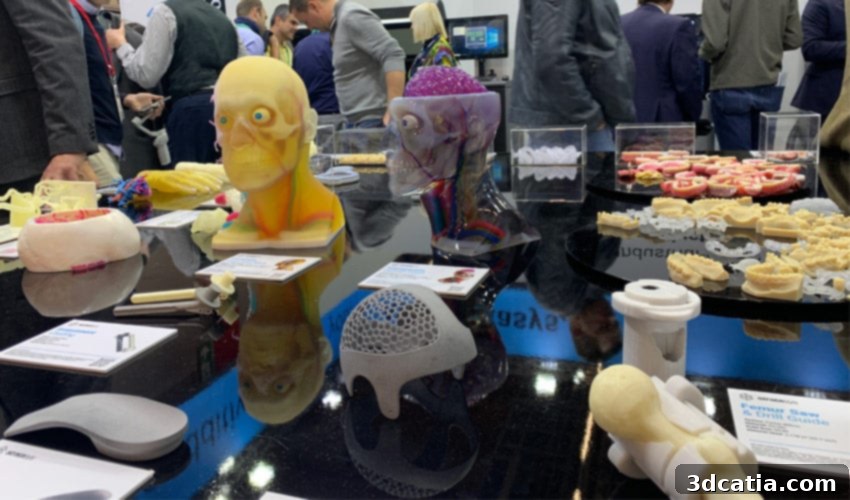
Formnext 2023: Unveiling the Future of Healthcare Through Additive Manufacturing
As the vibrant additive manufacturing landscape converged at Formnext 2023 in Frankfurt, our attention was naturally drawn to one of the most transformative and rapidly evolving market verticals for 3D technologies: the medical sector. This industry has embraced additive manufacturing for several years, and its exponential growth is a testament to the unparalleled advantages that 3D printing offers. From the groundbreaking ability to create highly customized medical devices perfectly tailored to each patient’s unique anatomy, to the use of biocompatible materials that enhance patient safety and integration, the benefits are clear. Furthermore, the capacity to precisely reproduce the intricate mechanisms and delicate textures of the human body for surgical planning, training, and prosthetic development underscores why 3D printing is not just an advantage, but a necessity in modern healthcare. Walking through the bustling aisles of Formnext 2023, we encountered a wealth of innovative medical applications, with numerous exhibitors specializing in this dynamic market, particularly highlighting advancements in dentistry.
Driving Medical Innovation: Manufacturers at Formnext 2023
The medical sector stands as a vital vertical market actively addressed by a diverse range of 3D printer manufacturers, material developers, and service providers. Additive manufacturing has evolved into an increasingly indispensable tool for countless healthcare professionals worldwide, prompting many market players to develop highly specialized and tailored offerings. At Formnext 2023, we had the opportunity to engage with German manufacturer Orthonative 3D, a prime example of this specialization. They introduced us to their innovative MAX3D FDM/FFF Medical 3D printer, specifically engineered for orthodontists. The Orthonative 3D team emphasized that these healthcare specialists require solutions that are not only easy to operate but also offer exceptional repeatability and unwavering reliability. As clinicians, not necessarily printer operators, their paramount need is a straightforward, efficient, and dependable process that seamlessly integrates into their workflow, allowing them to focus on patient care rather than complex machine management. This focus on user-friendliness combined with medical-grade precision highlights a significant trend among manufacturers.
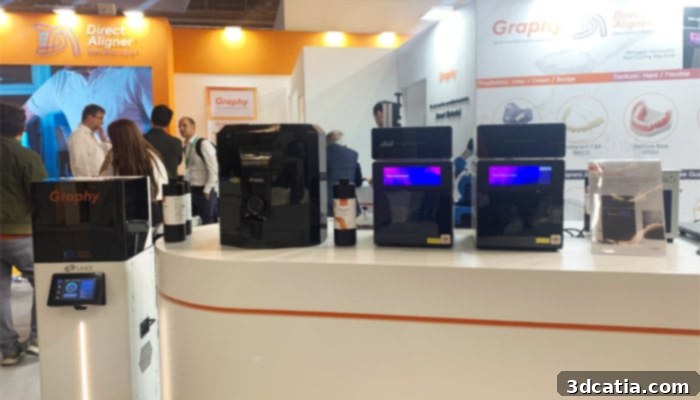
Graphy’s solutions on display at Formnext
Within the dental sector, the sheer volume of dedicated machines and solutions presented at Formnext this year was truly remarkable. Leading companies like Italy’s DWS, showcasing its advanced D-Fab solution, and Rapidshape, renowned for its extensive range of high-performance resin 3D printers, were prominently featured. Asiga, another stalwart in precision additive manufacturing for dental applications, also demonstrated its latest innovations. These manufacturers are pushing the boundaries of what’s possible in orthodontics and prosthodontics, offering higher resolution, faster print times, and greater material versatility. Material manufacturers, crucial enablers of these advancements, were equally abundant, presenting a vast array of specialized resins predominantly tailored for diverse dental applications, as expected. Among them, Korean company Graphy particularly captivated our attention. Graphy has engineered the groundbreaking Tera Harz TC-85 resin, which facilitates the direct 3D printing of clear aligners, entirely eliminating the need for the traditional, time-consuming thermoforming process. This innovation not only streamlines production but also promises greater precision and efficiency. Complementing their material innovation, Graphy also offers its own integrated LCD 3D printing machines and comprehensive post-processing solutions, providing a complete ecosystem for advanced dental manufacturing.
Beyond the burgeoning field of dentistry, our exploration uncovered several pioneering manufacturers of specialized filaments dedicated to broader medical applications. LugoLabs, a Korean company, stood out for its innovative approach to mimicking human bone structures. They produce advanced filaments that closely approximate natural bone, offering three distinct formulations currently available. These formulations enable the precise reproduction of bone density, color, and crucial behavior within medical imaging modalities, such as X-rays and CT scans. Such materials are invaluable for surgical planning, creating realistic anatomical models for educational purposes, and developing patient-specific implants. Similarly, the French company Lattice Medical showcased its diverse range of filaments tailored for various medical applications. A particularly compelling innovation from Lattice Medical is RODIN, an implantable and absorbable medical device designed for the intricate reconstruction of soft skin tissue. RODIN represents a significant leap forward in regenerative medicine, offering solutions for complex tissue defects and potentially improving patient outcomes in reconstructive surgery. These material advancements are critical for expanding the scope and efficacy of 3D printing in personalized medicine.
Breakthroughs in Patient Care: Dedicated Medical Applications at Formnext 2023
Formnext 2023 was a showcase for an astonishing array of 3D-printed medical devices, patient-specific implants, and highly detailed surgical models, reflecting the profound impact of additive manufacturing on healthcare. Industry leaders and innovators alike presented their cutting-edge applications, demonstrating the vast potential of this technology. Giants such as Trumpf, Stratasys, HP, Arburg, EOS, and 3D Systems exhibited a comprehensive spectrum of medical solutions. These included meticulously crafted plagiocephaly helmets designed to correct skull deformities in infants, customized 3D-printed spinal implants offering improved anatomical fit and patient comfort, and a wide variety of personalized prostheses and orthoses that provide superior functionality and aesthetic integration. The exhibition also highlighted incredibly realistic anatomical models, essential tools for pre-surgical planning, medical education, and training. These models allow surgeons to practice complex procedures in a risk-free environment, significantly enhancing precision and reducing operating room time. Furthermore, Lynxter’s booth featured an exciting collaboration with the young startup Odapt, which specializes in designing 3D-printed silicone ostomy disks. This application exemplifies the power of 3D printing to create highly personalized, comfortable, and discreet solutions for patients with specific and sensitive medical needs, greatly improving their quality of life.
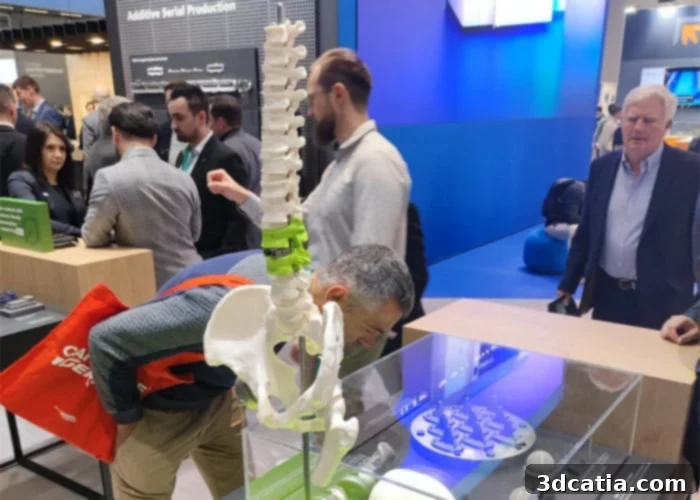
Medical applications on display at the Trumpf booth
One particularly compelling exhibitor was MEDICAL IP, a visionary Korean company that has pioneered a comprehensive suite of medical imaging analysis technologies, powered by advanced AI and cutting-edge 3D technologies. Their flagship product, MEDIP PRO, is a sophisticated 3D modeling software package designed to create precise digital twins of patient anatomy. This software supports a wide array of industry-standard file formats, including STL, OBJ, and 3MF, ensuring seamless integration into existing medical workflows. MEDIP PRO empowers clinicians with unparalleled insights for diagnosis, treatment planning, and simulation, revolutionizing the way medical professionals visualize and interact with patient data. Complementing this digital innovation, MEDICAL IP also offers a remarkable solution called ANATDEL. ANATDEL provides meticulously accurate 3D-printed models derived from patient scans, serving as invaluable tools for surgical planning, simulation, and medical research across various specialties, including neurosurgery, orthopedics, cardiology, and dermatology. These physical models offer a tangible, haptic experience that enhances understanding and preparation, particularly for complex procedures.
Finally, our exploration would be incomplete without highlighting Pure Dyne, a company making significant strides in the nascent yet profoundly promising field of bioprinting. Pure Dyne has developed highly specialized print heads engineered for the precise and controlled deposition of hydrogels. These innovative print heads leverage a sophisticated stepper motor system to ensure accurate volumetric distribution of biomaterials, ranging from low to high viscosity. This capability is crucial for creating intricate biological structures, cell scaffolds, and even functional tissues. Bioprinting, enabled by technologies like Pure Dyne’s, holds immense potential for regenerative medicine, drug discovery, and the future development of patient-specific organoids and tissues, moving us closer to repairing or replacing damaged biological structures. The precision and control offered by their technology are fundamental to advancing the feasibility and success of bioprinting applications.

Photo credits: Pure Dyne
The innovations showcased at Formnext 2023 undeniably underscore the transformative power of additive manufacturing across the entire medical sector. From personalized surgical guides and custom implants to revolutionary bioprinting capabilities, 3D printing is not just a tool, but a catalyst for profound advancements in patient care, medical research, and device development. The future of healthcare is being shaped by these technologies, promising more effective, efficient, and patient-centric solutions. What are your thoughts on the pivotal role of the medical sector as presented at Formnext 2023? We invite you to share your insights in a comment below or join the conversation on our LinkedIn, Facebook, and Twitter pages! Don’t forget to sign up for our free weekly Newsletter here to receive the latest 3D printing news straight to your inbox! You can also explore all our compelling videos on our YouTube channel.
*All photo credits: 3Dnatives (unless otherwise stated)