

Driving Innovation: Ford and Red Bull Revolutionize Formula 1 with Advanced 3D Printing for 2026 Regulations
A new era of Formula 1 racing is on the horizon, marked by a groundbreaking partnership that promises to redefine performance and sustainability on the track. In 2023, Ford Motor Company announced its return to the prestigious world of Formula 1 after a hiatus of more than two decades, teaming up with Red Bull Powertrains. This strategic alliance is not merely about brand presence; it signifies a deep collaboration aimed at developing the next-generation hybrid power unit for two of motorsport’s most formidable teams: Oracle Red Bull Racing and Scuderia AlphaTauri. The timing of this partnership is crucial, as Red Bull Racing’s vehicles will be engineered to comply with the stringent new standards set by the FIA (International Automobile Federation for Formula 1), slated to take effect in 2026. These regulations demand a significant leap forward in vehicle design, requiring cars to be more aerodynamic, lighter, and crucially, powered by carbon-neutral fuels. At the heart of Ford’s ambitious plan to meet these formidable demands lies a cutting-edge technology: additive manufacturing, more commonly known as 3D printing.
For the past two years, Ford has been leveraging the transformative capabilities of 3D printing to meticulously enhance its race cars, ensuring they are perfectly adapted to the evolving technical landscape dictated by the FIA. This strategic adoption of advanced manufacturing has already yielded impressive results, with Ford producing over 1,000 unique 3D printed components specifically for Red Bull Powertrains. While Red Bull Powertrains currently collaborates with Honda, Ford is poised to become the official power unit partner from 2026 through to 2030. Together, these two automotive giants are engaged in a monumental task: to completely re-engineer and optimize the power units of Red Bull Racing team vehicles from the ground up. This holistic approach to design and manufacturing, underpinned by additive manufacturing, is essential for creating components that are not only lighter and more efficient but also capable of withstanding the extreme stresses of Formula 1 competition, ultimately pushing the boundaries of what’s possible in motorsport engineering.
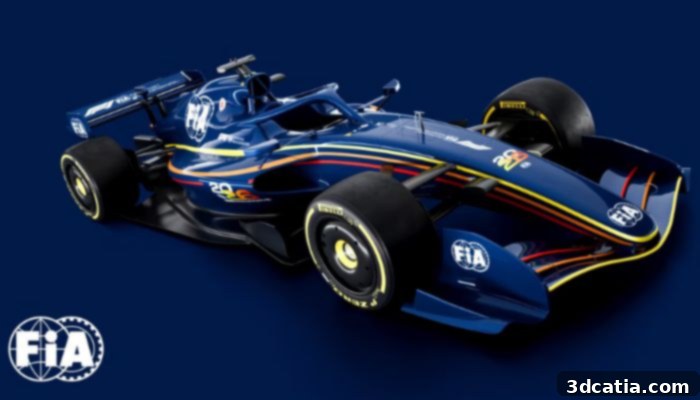
In 2024, FIA unveiled the new 2026 Technical Regulations and the first images of what the next generation of F1 cars should look like. (Photo credit: FIA)
FIA’s Transformative New Standards for Formula 1
The FIA’s 2026 technical regulations represent a significant paradigm shift, designed to make Formula 1 racing more sustainable, technologically advanced, and thrilling for its global audience. These high standards demand that every competing automaker achieves a radical transformation in their vehicle design by 2026. Compared to current measurements, the cars will need to be approximately 30 kg lighter, 20 cm shorter, and 10 cm narrower. This reduction in size and weight is crucial for enhancing agility and increasing the potential for closer, more dynamic racing. Furthermore, to facilitate more overtaking opportunities—especially on challenging city tracks like Monaco and Baku—each car must be equipped with a sophisticated dual system of active aerodynamics, featuring both rear and front elements. This innovative system will replace the current Drag Reduction System (DRS), allowing for more precise control over airflow and downforce, adapting in real-time to race conditions and driver input.
Beyond structural changes, the future of F1 also hinges on a commitment to environmental responsibility. The new regulations mandate the use of 100% sustainable, carbon-neutral fuels, a pioneering move that will significantly reduce the sport’s environmental footprint. Power units, too, are undergoing a fundamental redesign: they must reduce their endothermic (internal combustion engine) power while substantially increasing their electric power output. This shift towards a greater emphasis on electric energy highlights F1’s dedication to cutting-edge hybrid technology and its relevance to the broader automotive industry’s electrification trend. In essence, Formula 1 aims to deliver not only more exciting races—driven by increased demand for aerodynamics designed to encourage overtaking—but also greener ones, aligning with global sustainability goals. To meet these incredibly demanding requirements, Ford and Red Bull Powertrains are forging a powerful alliance, leveraging advanced technologies such as additive manufacturing, Oracle’s robust cloud computing infrastructure, and Siemens Xcelerator industrial software suite to optimize every aspect of their design, development, and production processes.
Precision Engineering: X-ray and CT Scanning for Component Inspection
The more than 1,000 3D printed components that Ford has produced for Red Bull are not just any parts; they are critical, high-performance elements essential for Formula 1 vehicles. These components are crafted from advanced materials like specialized metals and high-performance polymers, selected for their exceptional strength-to-weight ratios and ability to withstand extreme operating conditions. In Formula 1, cars frequently reach speeds exceeding 300 km/h, generating immense forces and intense thermal loads. Consequently, every single part must be rigorously tested for its mechanical strength, hardness, and absolute geometric conformity to ensure unwavering reliability and peak performance under pressure. Among the sophisticated components Ford has produced are battery cold plates and cooling plates, vital systems for managing the thermal properties of the hybrid power unit. These parts, designed to optimize energy efficiency and prevent overheating, have been subjected to an intensive battery of inspections, including advanced X-ray and Computed Tomography (CT) scans.
X-rays and CT scans are indispensable tools for conducting highly analytical evaluations of components, particularly their innermost structures, which are inaccessible through traditional visual inspection. By creating detailed digital models from the collected data, these scanning technologies enable engineers to peer inside parts with unprecedented clarity. Specifically, CT scans are invaluable for detecting hidden imperfections such as voids, porosities, or internal cracks within a printed part. They can also identify areas subject to delamination, where the layers created by the additive manufacturing process have separated, potentially compromising structural integrity. This precise, non-destructive inspection allows for a more efficient and targeted approach to problem-solving, quickly identifying any issues that may arise during the various mechanical and environmental tests parts are subjected to. As a result, this advanced diagnostic capability significantly optimizes and speeds up the production cycle. When combined with advanced 3D inspection procedures, additive manufacturing ensures the production of high-performance, safe, and reliable parts for the demanding environment of Formula 1. It’s important to note, however, that Ford’s commitment to quality extends beyond 3D printed parts; scans and additional rigorous testing protocols are applied to inspect all manufactured components, regardless of their production method, underscoring a comprehensive dedication to engineering excellence.
Ford’s Additive Manufacturing Leadership Beyond Formula 1
Ford’s embrace of additive manufacturing extends far beyond the specialized requirements of Formula 1, reflecting a long-term strategic commitment to this transformative technology across its global operations. The company has been integrating 3D printing for various purposes for many years, showcasing its versatility and efficiency in diverse applications. A significant milestone was achieved in 2023 with the opening of the state-of-the-art Cologne Electrification Center in Germany. This facility is a testament to Ford’s leadership in sustainable mobility, specializing in 3D printing to robustly support the production of its first series of 100% electric vehicles manufactured in Europe. Within this cutting-edge center, twelve high-tech 3D printers operate continuously, producing an extensive variety of polymer and metal parts. These components range dramatically in size and weight, from intricate parts just a few centimeters long weighing as little as 30 grams, to much larger structures reaching up to 2.4 meters in length and weighing a substantial 15 kilograms. This broad capability underscores the role of additive manufacturing in enabling rapid prototyping, customized tooling, and efficient production of complex, lightweight components essential for modern electric vehicles.
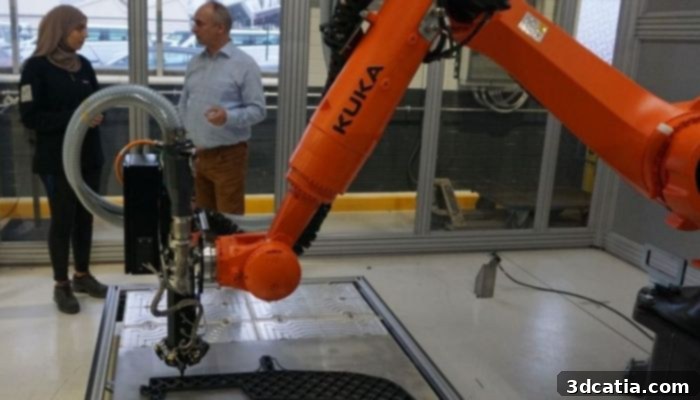
The Cologne Electrification Center, Ford’s plant in Germany. (Photo credit: Ford Media Center)
Ford’s history with 3D printing in Germany dates back to the 1990s, highlighting its pioneering spirit in adopting advanced manufacturing techniques. Engineers at the Merkenich development center began using 3D printing to create parts for test vehicles and prototypes, significantly accelerating design iterations and reducing development cycles. This early adoption laid the groundwork for future innovations. In 2019, at the Ford Research and Innovation Center in Michigan, the company achieved another remarkable feat: producing the largest metal part ever made using 3D printing at the time. A dedicated team successfully reproduced an intricate aluminum intake manifold for the engine of a Ford F-150, demonstrating the potential of additive manufacturing for robust, high-performance engine components. Furthermore, Ford’s commitment to operational efficiency is evident at its Valencia, Spain, plant, where a comprehensive catalog of 5,000 3D-printable parts was created. This initiative provides innovative solutions for various stages of the plant’s production process, from customized tools and jigs to specialized fixtures, streamlining assembly lines and enhancing ergonomic workflows. By 2021 alone, this program resulted in a total of 20,000 printed parts, showcasing the tangible benefits of on-demand manufacturing. Ultimately, Ford is not just using 3D printing for components; it is strategically deploying the technology to automate and optimize entire production processes, driving significant efficiencies and flexibility across its manufacturing ecosystem.
As the automotive and motorsport industries continue their rapid evolution, Ford’s strategic partnership with Red Bull Powertrains and its broad commitment to additive manufacturing position the company at the forefront of innovation. We eagerly anticipate the unveiling of the new cars in 2026, eager to witness the revolutionary vehicles born from this collaboration speeding around the Formula 1 circuits. In the meantime, Ford will continue to relentlessly leverage additive manufacturing, enhancing efficiency and driving the development of high-performance parts not only for its F1 ambitions but across its entire range of groundbreaking automotive innovations, from electric vehicles to advanced production systems.
What are your thoughts on the collaboration between Ford and Red Bull Powertrains and the role of 3D printing? Let us know in a comment below or on our LinkedIn, Facebook, and Twitter pages! For more on automotive 3D printing, click here. Don’t forget to sign up for our free weekly Newsletter here, bringing the latest 3D printing news straight to your inbox! You can also find all our videos on our YouTube channel.
*All Photo Credits: Ford Media Center