
Top 5 Revolutionary 3D Printing Innovations: A Look at This Week’s Must-Watch Videos
Welcome to our weekly dive into the fascinating world of 3D printing! As additive manufacturing continues to push boundaries across countless industries, we’ve meticulously curated a selection of the most groundbreaking and inspiring videos from the past week, just for you. This collection highlights significant advancements, from transforming office spaces and enabling space exploration to pioneering sustainable materials and simplifying complex processes. Join us as we explore these five must-watch videos that showcase the incredible potential and ongoing evolution of 3D printing technology. Don’t forget to share your favorite video in the comments below or connect with us on our Facebook and Twitter pages – we love hearing your thoughts!
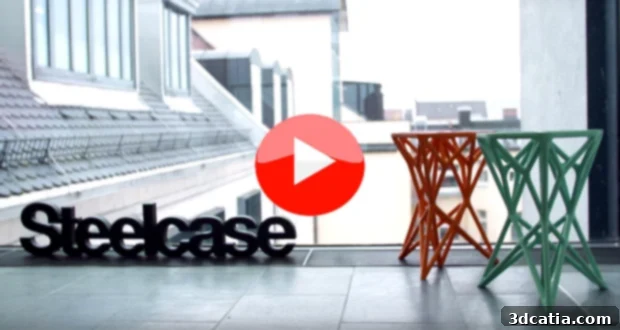
TOP 1 – Revolutionizing Office Design with 3D Printed Furniture by Steelcase
In a world increasingly focused on dynamic and adaptable workspaces, Steelcase, a recognized global leader in innovative office furniture solutions, is at the forefront of leveraging 3D printing to redefine design and functionality. This compelling video offers an exclusive insight into how Steelcase is integrating additive manufacturing into its design and production processes, dramatically altering our perception of modern office environments. The Director of Steelcase eloquently articulates the company’s vision, demonstrating how 3D printing allows for rapid prototyping, complex geometries, and unparalleled customization options that were once prohibitively expensive or impossible with traditional manufacturing methods.
The adoption of 3D printing by Steelcase signifies a monumental shift, enabling them to explore ergonomic designs, create lightweight yet robust structures, and respond to unique client demands with unprecedented agility. From conceptual models to functional prototypes, 3D printing accelerates the design cycle, reducing time-to-market and fostering a culture of continuous innovation. This technology also plays a crucial role in sustainability efforts by optimizing material usage and reducing waste. Watch this video to witness how Steelcase is not just designing furniture, but actively shaping the future of work-life environments through cutting-edge 3D printing applications, making offices more responsive, comfortable, and efficient than ever before.
TOP 2 – Made In Space: Pioneering 3D Printing Beyond Earth’s Gravity
Prepare to have your mind launched into orbit with our second top video, featuring the groundbreaking work of “Made In Space.” This visionary company has achieved what many once considered science fiction: developing the world’s first operational 3D printer specifically engineered for zero-gravity environments, currently deployed on the International Space Station (ISS). This incredible feat of engineering fundamentally changes the paradigm for space exploration and habitation.
The ability to 3D print tools, replacement parts, and even complex structures in space offers unparalleled advantages. It drastically reduces the need to launch every conceivable item from Earth, saving immense costs and precious cargo space. Astronauts can now manufacture essential equipment on demand, repair critical components, and even create custom tools tailored to specific mission needs, enhancing self-sufficiency and mission resilience. This innovation paves the way for longer-duration missions, deep-space exploration, and even the eventual establishment of lunar or Martian outposts, where manufacturing on-site will be crucial for sustainability. The video delves into the challenges of microgravity manufacturing, the ingenious solutions developed by Made In Space, and the profound implications their technology holds for the future of humanity’s presence beyond our home planet. Discover how their printer isn’t just a machine, but a cornerstone for future space discoveries and sustained extraterrestrial life.
TOP 3 – Dissolvable Supports: Streamlining Metal 3D Printing at ASU
Metal 3D printing stands as a cornerstone of advanced manufacturing, yet it often presents a significant hurdle: the laborious and time-consuming process of support structure removal. These supports are crucial for anchoring parts during printing and dissipating heat, but their removal, particularly for complex geometries, can add substantial post-processing costs and introduce potential damage to the final product. Our third video spotlights revolutionary research from Arizona State University (ASU) that promises to fundamentally change this aspect of metal additive manufacturing.
Researchers at ASU have ingeniously developed a method for creating dissolvable support structures for metal 3D printed objects. This innovation eliminates the need for mechanical or manual removal, which can be a bottleneck in production lines. The video intricately demonstrates how this technology works, showcasing the chemical process by which these supports simply vanish after printing, leaving behind a pristine metal object. The benefits are profound: reduced labor costs, accelerated production times, improved surface finish on complex internal channels and features, and enhanced design freedom for engineers who no longer have to worry about inaccessible support removal. This breakthrough has significant implications for industries like aerospace, medical, and automotive, where high-precision metal parts with intricate designs are commonplace. Imagine the possibilities for lightweighting components, creating customized implants, or developing next-generation engine parts when post-processing is dramatically simplified. This development marks a major step forward in making metal 3D printing more efficient, cost-effective, and accessible.
TOP 4 – The Transparency of Innovation: 3D Printing Glass with Standard Equipment
For decades, 3D printing glass seemed like a distant dream, primarily due to glass’s extreme properties – its high melting point, viscosity, and brittleness. However, the future is now transparent with our fourth featured video, which showcases an astounding breakthrough: researchers have found a novel way to 3D print glass using what they describe as a “standard 3D printer.” This innovation shatters previous limitations and opens up a new realm of possibilities for designers, engineers, and scientists alike.
This captivating video meticulously details the ingenious process involved, which often includes using a specialized resin infused with glass nanoparticles, cured by UV light (similar to stereolithography, SLA), followed by a high-temperature firing process to sinter the glass particles and achieve transparency. The result is a fully dense, transparent glass object with intricate details that would be impossible to achieve with traditional glass manufacturing techniques like blowing or molding. The implications of 3D printed glass are immense and diverse. Imagine custom optical lenses for scientific instruments or consumer electronics, intricate architectural elements that play with light, unique artistic creations, or even specialized laboratory equipment with complex internal channels. This technology offers unprecedented design freedom for creating transparent structures, potentially revolutionizing fields from telecommunications and medical diagnostics to decorative arts and advanced lighting solutions. Witness firsthand how this incredible advancement is making the previously unprintable, clear as day.
TOP 5 – Cultivating Creativity: 3D Printing with Plant-Based Materials
Our final video presents a truly ecological marvel from the innovative minds at Oak Ridge National Laboratory, who are actively pioneering sustainable manufacturing by exploring new ways to 3D print using materials derived directly from the natural world around us. In an era where environmental responsibility is paramount, their research into plant-based 3D printing offers a refreshing and vital alternative to traditional petroleum-based plastics.
This inspiring video highlights their efforts to develop and utilize plant-derived biopolymers, such as cellulose and lignin, as primary feedstocks for 3D printing. These renewable resources not only reduce reliance on fossil fuels but also introduce the potential for biodegradable and recyclable 3D printed designs. The scientists at Oak Ridge National Laboratory are showcasing how these eco-friendly materials can be transformed into beautiful, intricate, and functional creations. This extends beyond mere aesthetics, encompassing applications in sustainable packaging, eco-conscious consumer goods, and even components for green architecture. By harnessing the power of plants, they are creating a pathway towards a circular economy where products can be designed, printed, used, and then returned to the earth without harm. This groundbreaking work doesn’t just promise aesthetic appeal; it offers a tangible solution for reducing our environmental footprint while expanding the versatility and sustainability of additive manufacturing. Explore their incredible work below and see how nature is inspiring the next generation of 3D printed objects.
And there you have it – another remarkable week in the world of 3D printing! From the practical applications of office furniture to the boundless possibilities of space exploration, the refined efficiency of metal post-processing, the artistic and scientific potential of glass, and the vital push towards ecological sustainability with plant-based materials, these videos underscore the dynamic and ever-expanding impact of additive manufacturing. We hope these insights have not only informed but also inspired you about the incredible innovations shaping our future. Stay tuned for more cutting-edge discoveries, and remember to engage with us on social media to share your thoughts on these incredible advancements!