
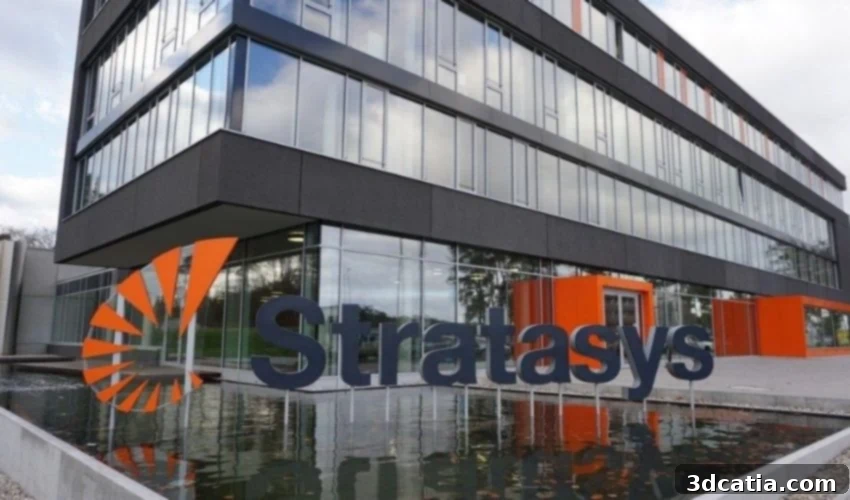
Stratasys Paves the Way: A Comprehensive Sustainability Strategy for Additive Manufacturing
In an era where environmental stewardship and corporate responsibility are paramount, sustainability has emerged as a defining challenge and opportunity for businesses across all sectors. For a global leader in additive manufacturing like Stratasys, a proactive approach to this issue is not merely commendable but essential for future growth and societal impact. The Israel-based 3D printing powerhouse has, therefore, unveiled a robust action plan designed to cultivate a more sustainable future. This ambitious commitment centers around three pivotal pillars: fostering a circular economy, taking decisive climate action, and maximizing positive social impact.
Demonstrating its serious dedication to these goals, Stratasys recently appointed Rosa Coblens as its Vice President of Sustainability, a strategic move underlining the company’s intent to embed sustainability at the highest levels of its operations. Under her leadership, the company has meticulously selected four specific United Nations Sustainable Development Goals (SDGs) to prioritize and execute upon within its 2022 focus areas and beyond. This focused approach ensures measurable progress and alignment with global efforts for sustainable development. Dr. Yoav Zeif, CEO of Stratasys, eloquently articulates the broader context: “The new global economy requires companies to adapt and overcome unexpected challenges while maintaining a commitment to environmental stewardship. Stratasys is well-positioned to provide production and manufacturing solutions that are resilient, empower local supply chains, and most importantly save lives.” This statement not only highlights the company’s dedication to environmental responsibility but also underscores the transformative potential of additive manufacturing in building robust, localized, and life-saving production capabilities in an ever-changing world.

United Nations Sustainable Development Goals.
Unpacking Stratasys’ Commitment to the UN Sustainable Development Goals
The United Nations Sustainable Development Goals provide a universal framework for addressing the world’s most pressing environmental, social, and economic challenges. By aligning its business objectives with specific SDGs, Stratasys ensures its sustainability efforts contribute meaningfully to global progress. The four SDGs chosen by Stratasys—Responsible Production and Consumption (SDG 12), Industry, Innovation, and Infrastructure (SDG 9), Climate Action (SDG 13), and Quality Education (SDG 4)—reflect a holistic understanding of how additive manufacturing can drive sustainable development.
**SDG 12: Responsible Consumption and Production** is at the core of additive manufacturing’s promise. Stratasys aims to revolutionize manufacturing processes to minimize waste, optimize material usage, and promote a circular approach. This includes developing more sustainable materials, enhancing the recyclability of print waste and end-of-life products, and enabling on-demand production that reduces overstocking and material obsolescence. The ability of 3D printing to create complex geometries with minimal material waste, often using only the necessary amount of raw material, represents a significant stride towards more resource-efficient manufacturing. Furthermore, enabling local, distributed manufacturing networks can dramatically reduce the carbon footprint associated with global supply chains and transportation.
**SDG 9: Industry, Innovation, and Infrastructure** directly resonates with Stratasys’ pioneering role in additive manufacturing. By continuously innovating its 3D printing technologies, materials, and software, Stratasys empowers industries to build more resilient and sustainable infrastructure. This includes developing advanced manufacturing solutions that are more energy-efficient, enable localized production, and facilitate the creation of next-generation products that are lighter, stronger, and more durable. The very essence of 3D printing is innovation, fostering new designs and production methodologies that transcend traditional limitations and pave the way for a more robust and adaptive industrial landscape.
**SDG 13: Climate Action** is a critical global imperative, and Stratasys recognizes its role in mitigating climate change. Through various initiatives, the company focuses on reducing its operational carbon footprint, improving energy efficiency in its manufacturing processes and product lines, and developing materials with lower environmental impact. This also extends to enabling customers to produce parts closer to the point of use, thereby minimizing shipping emissions and contributing to a significant reduction in overall supply chain carbon intensity. Efforts to use renewable energy sources and to design products for optimal energy consumption during their lifecycle are integral to this commitment.
Finally, **SDG 4: Quality Education** underscores Stratasys’ belief in empowering the next generation of engineers, designers, and manufacturers with the knowledge and skills required for a sustainable future. This involves collaborating with educational institutions, providing training and resources on additive manufacturing technologies, and fostering an understanding of sustainable design principles. By investing in education, Stratasys helps to build a workforce that is not only proficient in advanced manufacturing but also deeply committed to environmental responsibility and innovation, ensuring that sustainable practices become standard in future industrial endeavors.
Is 3D Printing Truly a Sustainable Manufacturing Method? A Balanced Perspective
The question of whether additive manufacturing, or 3D printing, can genuinely be categorized as “sustainable” in its current iteration is a subject of considerable debate within the industry and academic circles. While the technology offers numerous inherent advantages that lend themselves to sustainability, it also presents distinct challenges that require ongoing innovation and careful consideration. It is true that significant advancements have been made in areas such as material recycling, the development of bio-based or recycled feedstocks, and minimizing waste during the printing process itself. However, issues like energy consumption, the environmental impact of certain material types, and the broader implications of overconsumption—fueled by the ease of bespoke production—remain points of contention.
A compelling piece of research illustrating this complexity is a Yale University study published in the prestigious “Journal of Industrial Ecology.” This study meticulously analyzed the environmental impact of additive manufacturing, drawing a nuanced conclusion. While acknowledging the clear benefits of 3D printing—such as material efficiency, reduced lead times, and the potential for localized production—the study cautioned against an unbridled enthusiasm for 3D printing as a “spectacular” eco-friendly alternative to traditional manufacturing without a comprehensive lifecycle assessment. The researchers emphasized that the energy intensity of some 3D printing processes, particularly those involving high-temperature polymers or metal powders, can be substantial. Furthermore, the cradle-to-grave environmental footprint of specialized additive manufacturing materials, from production to disposal, requires careful scrutiny. The study effectively highlighted that while 3D printing certainly has a critical role to play in sustainable manufacturing, its benefits must be weighed against its challenges, necessitating continuous research and responsible implementation to unlock its full potential.
Despite these complexities, many aspects of additive manufacturing undeniably contribute to sustainability. The ability to produce parts on demand eliminates the need for vast inventories, reducing warehousing costs and the risk of obsolescence. Lightweighting components through optimized designs, achievable only with 3D printing, translates directly into fuel savings in aerospace and automotive applications. Part consolidation reduces assembly steps and material usage. Furthermore, the localized nature of 3D printing, allowing manufacturers to produce goods closer to the end-user, significantly cuts down on transportation emissions. Stratasys, through its continued innovation in machines, materials, and software, is actively working to tip the scales towards greater environmental benefit, addressing the challenges identified by studies like the one from Yale by focusing on energy efficiency, developing more sustainable materials, and promoting responsible adoption of the technology across industries.
Collaborating for Change: Stratasys as a Founding Member of AMGTA
Understanding that sustainability is a collective endeavor, Stratasys has extended its commitment beyond internal initiatives by becoming a founding member of the Additive Manufacturer Green Trade Association (AMGTA). The AMGTA is a non-commercial, global trade organization specifically established to promote the environmental benefits of additive manufacturing. Open to any additive manufacturing industry stakeholder, from manufacturers to service bureaus, software providers, and material suppliers, the AMGTA’s primary mission is to commission independent research that objectively highlights and quantifies the sustainable uses of additive manufacturing. This research-driven approach is crucial for providing credible data and insights that can inform industry practices, guide policy decisions, and educate the public on the environmental advantages of 3D printing.
The decision by Stratasys to join AMGTA as a founding member underscores its leadership and dedication to advancing sustainability across the entire additive manufacturing ecosystem. By contributing its expertise and resources, Stratasys helps to bolster AMGTA’s efforts to gather empirical evidence and promote best practices. Sherry Handel, Executive Director of the AMGTA, emphasized the importance of this partnership, stating: “Stratasys’ Founding Member status is critical to our organization’s mission to advance sustainability in additive manufacturing as we secure a selective group of market and industry experts to represent and advance our work to report on the environmental benefits of additive manufacturing.” This statement highlights the strategic value of having a company of Stratasys’ stature involved, lending credibility and robust industry knowledge to AMGTA’s research initiatives.
Through its involvement with AMGTA, Stratasys is not only advocating for its own sustainable practices but also actively contributing to a broader industry movement aimed at understanding, quantifying, and enhancing the environmental performance of additive manufacturing. The research commissioned by AMGTA aims to cover various aspects, including energy consumption, material lifecycle analysis, waste reduction, and the overall carbon footprint reduction achieved through additive processes. This collaborative effort is vital for moving beyond anecdotal evidence and providing a solid, scientific foundation for promoting additive manufacturing as a truly sustainable alternative in appropriate applications, fostering a greener future for the manufacturing sector.
Looking Ahead: The Future of Sustainable Additive Manufacturing
Stratasys’ comprehensive sustainability strategy signals a significant shift within the additive manufacturing industry. By openly committing to specific UN SDGs, appointing dedicated leadership, and actively participating in influential organizations like the AMGTA, Stratasys is setting a benchmark for its peers. This integrated approach demonstrates that sustainability is not an afterthought but a core component of its business strategy and innovation roadmap.
The future of sustainable additive manufacturing will undoubtedly involve continued advancements in several key areas. We can expect to see further development of novel, eco-friendly materials, including bio-based plastics, recycled polymers, and more efficient metal powders, alongside improved methods for recycling and reusing existing materials. Energy consumption remains a critical challenge, and ongoing research into more energy-efficient machines and optimized printing processes will be vital. Furthermore, the integration of artificial intelligence and machine learning could play a significant role in minimizing waste, predicting print failures, and optimizing energy use across the entire manufacturing workflow.
Beyond technological advancements, the emphasis on a circular economy will become even more pronounced. This includes designing products specifically for additive manufacturing that are lighter, more durable, and easily recyclable or reusable at the end of their lifecycle. The concept of distributed manufacturing, enabled by 3D printing, will continue to gain traction, leading to more localized supply chains, reduced transportation emissions, and greater economic resilience for communities. Ultimately, Stratasys’ proactive stance encourages other players in the additive manufacturing space to embrace similar commitments, fostering an industry-wide push towards greener practices and a more sustainable global manufacturing landscape.
Join the Conversation
What are your thoughts on Stratasys’ renewed commitment to sustainable manufacturing and the broader implications for the 3D printing industry? We invite you to share your insights in a comment below or join the discussion on our Facebook and Twitter pages! Don’t miss out on the latest advancements and news from the world of additive manufacturing – sign up for our free weekly newsletter to receive all the breaking 3D printing news straight to your inbox!
Cover Photo Credit: Stratasys