
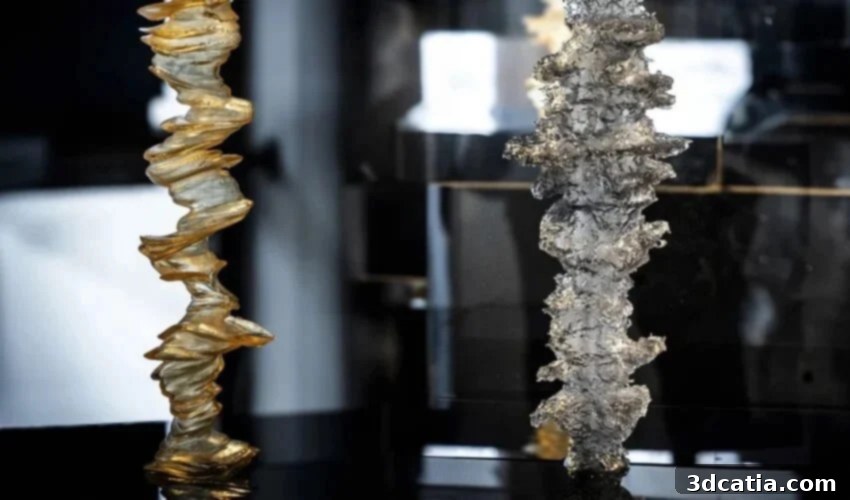
Frozen Music: Pioneering 3D Printing to Transform Sound into Tangible Art
The “Frozen Music” project represents a groundbreaking fusion of art and technology, pushing the boundaries of traditional artistic expression by transforming the ephemeral beauty of music into concrete, 3D-printed sculptures. This ambitious initiative is the fruit of an extraordinary collaboration between the renowned Gävle Symphony Orchestra, the visionary Austrian designer Julia Körner, and the esteemed curator Andreas Vierziger. Together, they have forged a unique sensory experience that captivates audiences, allowing them to not only hear but also visibly and tangibly perceive the intricate structures and emotions embedded within musical compositions. This innovative approach offers a profound new dimension to how we interact with and understand music, bridging the auditory and visual senses in an unprecedented way.
At the heart of the “Frozen Music” project lies a sophisticated and meticulously crafted process for translating sound into form. This intricate journey begins with the careful analysis of musical pieces using advanced, specialized software. This cutting-edge technology delves deep into the layers of each composition, meticulously dissecting its fundamental elements: the fluid progression of melody, the compelling pulse of rhythm, the rich interplay of harmony, and the dynamic variations in tempo and timbre. Every nuance, every shift in emotional intensity, and every structural detail of the music is meticulously captured and converted into complex digital data points.
Once the musical data has been thoroughly analyzed and digitized, it serves as the blueprint for creating intricate 3D models. These digital models are not mere arbitrary shapes; rather, they are carefully designed to embody the very essence and character of the original musical piece. Through a process of algorithmic and artistic interpretation, the software and designers work in tandem to visualize the music’s trajectory, its emotional arc, and its structural integrity. For instance, a soaring melodic line might translate into an ascending curve, while a sudden percussive accent could manifest as a sharp, angular protrusion. This transformation breathes new life into the music, providing a tangible representation that can be explored from multiple perspectives.
The final, exhilarating step in this creative process is the application of additive manufacturing, commonly known as 3D printing. This state-of-the-art technology is employed to bring the digital 3D models into physical existence, allowing the abstract concepts of melody, rhythm, and harmony to take on a sculptural form. By leveraging the precision and versatility of 3D printing, the project adds a revolutionary new dimension to music. It transforms something heard and felt into something seen and touched, offering an immersive, multi-sensory engagement that redefines the boundaries of artistic perception. This innovative use of technology not only celebrates the beauty of music but also showcases the immense potential of 3D printing in the realm of fine art and cultural interpretation.

3D image of the Suite Boulogne Opus 32 by Bo Linde
As a testament to the project’s ambition and artistic achievement, “Frozen Music” culminated in the creation of three highly distinctive 3D-printed sculptures. Each of these unique pieces draws its inspiration from a specific musical composition, showcasing the diverse ways in which sound can be translated into sculptural form and offering a fascinating glimpse into the visual language of music:
- Serenade No. 1 in D major, Op. 11, Fifth movement, Scherzo. Allegro by Johannes Brahms: This sculpture is a magnificent visual representation of Brahms’ dynamic and spirited composition. It features thick, intensely radial forms that powerfully capture the rapid tempo changes and energetic shifts characteristic of the Scherzo movement. The design conveys the exhilarating momentum and vibrant character of the piece, with its sweeping curves and bold extensions. Furthermore, intricate microstructures adorning the surface symbolize the richness and complexity of Brahms’ melodic lines, mirroring the detailed orchestration and the natural, organic flow of his musical ideas. This piece offers a tangible interpretation of the serenade’s grand scale and passionate energy.
- Third movement of the Suite Boulogne Op. 32 by Bo Linde: Inspired by the serene and gentle sounds of the flute, this sculpture embodies tranquility and calm. Its design is characterized by soft, flowing geometries that eloquently reflect the peaceful and meditative essence of the musical piece. The forms evoke a sense of continuous motion, much like a gentle breeze or flowing water, perfectly aligning with the delicate nuances and melodic purity of the flute. The smooth transitions and subtle undulations in the sculpture mirror the sustained notes and lyrical phrases, creating a visual harmony that resonates deeply with the auditory experience.
- Djefvulsdansen (The Devil’s Dance) by Symphonic Stomp of Sweden: This sculpture is a vibrant and compelling visualization of the high-energy and traditional folk-inspired “Devil’s Dance.” Its form is remarkably flowing and dynamic, designed to evoke the raw, untamed musical energy brought forth by the distinct rhythm and unique timbre of bagpipes. The sculpture twists and turns, with elements that suggest movement and a spirited, almost wild dance. It captures the infectious vitality and cultural essence of the piece, allowing viewers to perceive the rhythmic pulse and the emotive force of the music as a tangible, swirling form.

The music Djefvulsdansen (Dance of the Devil) by Symphonic Stomp of Sweden is visualized through additive manufacturing.
Using 3D Printing to Bring “Frozen Music” to Life: A Collaborative Masterpiece
The realization of the “Frozen Music” project is a testament to the power of interdisciplinary collaboration, a unique synergy between diverse talents that were absolutely crucial in bringing this complex vision to life. The project’s success is a direct result of the combined expertise of Julia Körner, the Gävle Symphony Orchestra, and Andreas Vierziger, each contributing distinct skills that seamlessly complemented one another.
Julia Körner, a highly acclaimed Austrian designer, stands at the forefront of the collaboration, bringing her unparalleled expertise in computational design and additive manufacturing to the “Frozen Music” project. Körner is globally recognized for her pioneering innovations at the intersection of architecture, fashion, and technology. Her work has graced high-profile projects ranging from collaborations with major film studios like Marvel, where her designs pushed visual boundaries, to partnerships with luxury fashion houses such as Chanel and leading haute couture designer Iris Van Herpen, showcasing her mastery in creating intricate, futuristic forms. Her deep understanding of parametric design and digital fabrication techniques was instrumental in translating abstract musical data into visually stunning and structurally sound 3D sculptures. She is the artistic architect who bridges the digital and physical realms.
With her extensive experience and command over the latest design technologies, Julia Körner provides the essential creative vision and technical acumen necessary to transform raw music data into expressive, tangible 3D sculptures. Her remarkable ability to merge cutting-edge technology with artistic sensibility proved absolutely crucial in the intricate process of creating sculptures that authentically capture the ephemeral essence and emotional depth of each musical piece. Körner’s contribution ensures that each sculpture is not merely a data visualization but a true work of art, resonating with the original composition’s spirit.

Austrian designer Julia Körner has managed to give music “shape” with the help of 3D printing
On the other hand, the Gävle Symphony Orchestra, established in 1912, represents a venerable and vital institution within the vibrant Swedish music scene. Driven by an undeniable passion for musical performance and guided by an unwavering commitment to artistic excellence, the orchestra comprises 52 dedicated musicians. These talented individuals explore a vast and diverse repertoire, spanning from the intricate works of the Baroque era to the innovative compositions of contemporary music, all approached with tireless curiosity and precision. Their rich history and profound understanding of musical interpretation made them an ideal partner for a project aimed at dissecting and representing music in new forms.
The orchestra played a profoundly important and multifaceted role in the “Frozen Music” project. Their contribution extended far beyond merely providing the musical pieces that served as the initial source of inspiration. Crucially, the orchestra’s deep expertise in musical structure, dynamics, and emotional nuance was indispensable in helping to analyze and accurately translate these complex compositions into the digital data required for sculptural transformation. By lending their artistic insight and performing the chosen pieces with expressive depth, they effectively guided the computational process, ensuring that the essence of the live performance was captured. Through this fruitful and forward-thinking collaboration, the Gävle Symphony Orchestra is charting an innovative new course, actively exploring uncharted artistic terrain and significantly expanding the traditional horizons of musical expression, proving that classical institutions can also be pioneers of modern art.
Andreas Vierziger, an acclaimed curator and expert in the dynamic field of digital art, also played a pivotal and decisive role in this ambitious undertaking. His expertise was instrumental in orchestrating the seamless collaboration between the various multidisciplinary players involved in the project. Vierziger was not only responsible for bringing together the diverse talents of the designer and the orchestra but also for ensuring the overarching artistic coherence and conceptual integrity of the entire project. His curatorial vision provided the necessary framework to navigate the complex challenges of translating abstract sound into physical art, ensuring that the final sculptures were both technologically innovative and artistically profound. His ability to bridge different creative disciplines was key to the project’s holistic success.
The Transformative Impact of “Frozen Music” on Art and Perception
The “Frozen Music” project stands as a monumental demonstration of innovative thinking, offering a revolutionary method for rediscovering and exploring the profound art of music by uniquely combining it with the tangible realm of sculpture and the endless possibilities of new technologies. This project is far more than a mere artistic experiment; it is a powerful showcase of the transformative capabilities of additive manufacturing, specifically 3D printing, in an artistic context. It allows viewers to engage with music on an entirely new plane, offering an unprecedented opportunity to literally “see” the music, to perceive its inherent vibrations, and to comprehend its intricate structure in a deeply innovative and multi-sensory fashion.
“Frozen Music” challenges traditional perceptions of both music and sculpture. It liberates music from its purely auditory confines, transforming its temporal flow into a spatial, permanent form that can be observed, analyzed, and appreciated from all angles. Simultaneously, it redefines sculpture, imbuing static objects with the dynamic energy and narrative of musical compositions. This project opens up new avenues for artistic expression and interaction, fostering a deeper, more holistic understanding of creative works. It underscores the incredible potential when artistic vision meets technological advancement, proving that boundaries between disciplines are increasingly fluid and ripe for groundbreaking innovation. As such, “Frozen Music” is not just a project; it is a vision of the future of art, where sensory experiences merge, and imagination is given tangible form through cutting-edge technology.
What do you think of “Frozen Music”? Let us know in a comment below or on our LinkedIn, Facebook, and Twitter pages! Don’t forget to sign up for our free weekly newsletter here, for the latest 3D printing news straight to your inbox! You can also find all our videos on our YouTube channel.
*Cover Photo Credits: JK3D