
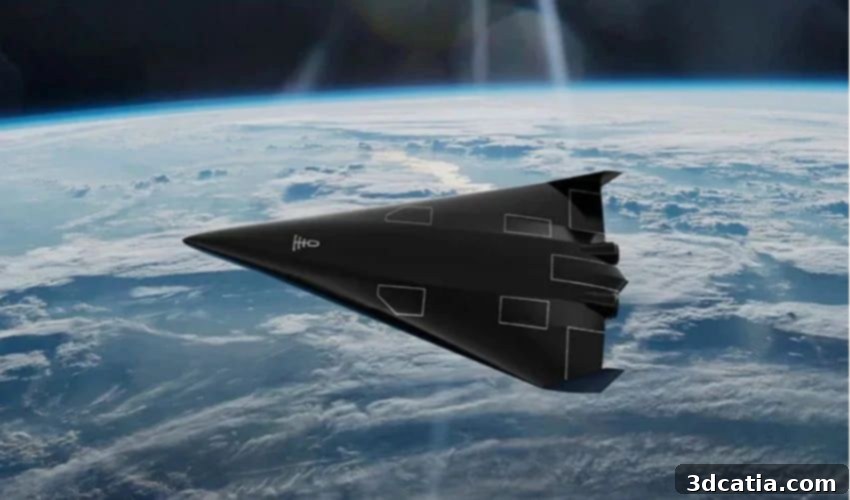
POLARIS Spaceplanes Propels Aerospace Innovation with Successful 3D Printed Aerospike Engine Tests
In a monumental leap for advanced propulsion systems and the burgeoning private space sector, POLARIS Spaceplanes, a pioneering German aerospace start-up headquartered in Bremen, has achieved a critical and inspiring milestone. The company has successfully completed rigorous testing of its groundbreaking, 3D printed Aerospike rocket engine. This remarkable accomplishment not only underscores POLARIS’s innovative spirit but also profoundly highlights the accelerating and indispensable role of advanced additive manufacturing technologies in shaping the future of the aerospace industry. The MIRA II prototype, an impressively engineered five-meter-long vehicle, underwent a series of comprehensive taxi and flight tests that demonstrated its robust capabilities and the unparalleled potential of its core propulsion system. At the heart of this success is the innovative LOX/Kerosin-AS-1 engine, which has been meticulously produced using cutting-edge additive manufacturing processes. Looking ahead with ambitious projections, POLARIS Spaceplanes anticipates that this prototype will transition from its current testing phase to become fully operational in scheduled flights as early as 2028, marking a significant step towards more agile and cost-effective access to space.
The Evolution of MIRA: From Setback to Success with MIRA II
The journey to the MIRA II’s successful tests is one marked by resilience, continuous improvement, and a commitment to innovation. The MIRA II prototype represents a significant evolution from its predecessor, the original MIRA demonstrator. This initial demonstrator, while instrumental in gathering vital data and insights, unfortunately experienced a setback during a test flight in May 2024. Learning invaluable lessons from this incident, POLARIS Spaceplanes swiftly channeled its expertise into refining and enhancing its design and engineering processes, leading to the creation of the more advanced and robust MIRA II. Since that pivotal incident, the team at POLARIS has made extraordinary progress, demonstrating an impressive capacity for rapid iteration and problem-solving inherent in agile start-up environments. The new MIRA II prototype commenced its rigorous testing regimen with an extensive three-hour engine test conducted on an airstrip, meticulously evaluating its performance and reliability under controlled conditions. Following this successful ground-based assessment, the prototype progressed to successfully complete unmanned flight tests conducted over the expansive and challenging environment of the Baltic Sea, pushing the boundaries of its aerodynamic and control systems. The culmination of this intensive testing program was the final, decisive flight test. The demonstrator majestically took off from Peenemünde airport, initially powered by four conventional turbojets to gain altitude and speed. Once the critical parameters were met, the advanced AS-1 Aerospike engine ignited, delivering a powerful and sustained three-second burn. During this crucial firing, the engine generated a substantial 900 newtons of thrust, propelling the vehicle with an impressive acceleration of 4 m/s². This series of successful tests unequivocally validates the MIRA II’s advanced design and the groundbreaking capabilities of its additively manufactured propulsion system, positioning POLARIS at the forefront of the next generation of spaceflight technology.
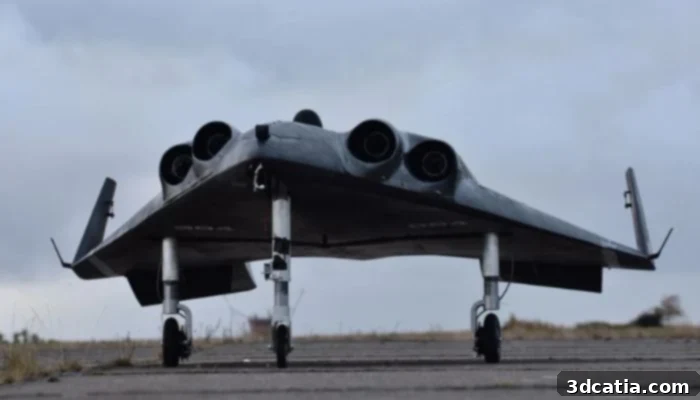
The demo unit MIRA II successfully tested by POLARIS Spaceplanes. (Photo: POLARIS Spaceplanes)
The Aerospike Advantage: Redefining Rocket Propulsion with 3D Printing
The choice of an Aerospike engine for the MIRA II is a strategic decision that positions POLARIS Spaceplanes at the leading edge of propulsion technology. The Aerospike engine represents a fundamentally more efficient and adaptable alternative to conventional rocket engines, which typically utilize large, bell-shaped nozzles that are optimized for a specific altitude. In stark contrast, the MIRA II’s Aerospike engine incorporates a distinctive dart-shaped nozzle, a design innovation that offers a multitude of compelling advantages for next-generation space vehicles. One of the foremost benefits is a significant reduction in overall vehicle weight. The compact, mass-saving design inherent to Aerospike engines, particularly when enhanced by additive manufacturing, contributes to lighter spacecraft, which translates directly into lower launch costs and increased payload capacity. More importantly, the Aerospike’s inherent design allows it to dynamically adapt to varying atmospheric pressures and altitudes. This crucial capability ensures optimum performance throughout the entire flight profile, from sea-level liftoff where atmospheric pressure is high, to the vacuum of space. By effectively adjusting its thrust to suit the prevailing conditions, the Aerospike maximizes fuel efficiency and propulsion effectiveness at every stage, a critical factor for reusable spaceplanes aiming for orbital or suborbital missions. This adaptive thrust capability is a game-changer, offering a level of flexibility and efficiency that traditional nozzles simply cannot match, thereby paving the way for more versatile and economically viable space missions.
Addressing Engineering Challenges: The Role of Additive Manufacturing in High-Performance Engines
While the Aerospike design offers substantial performance advantages, it also presents unique engineering challenges, most notably the intense heat generated during operation. Unlike traditional nozzles where exhaust gases expand outwards, an Aerospike directs hot gases along a central spike, necessitating exceptionally sophisticated cooling systems to prevent structural failure and maintain performance integrity. To ingeniously meet this formidable challenge, POLARIS Spaceplanes leveraged the transformative capabilities of additive manufacturing technologies, specifically partnering with AM Global. Additive manufacturing, often referred to as 3D printing, is ideally suited for creating the complex, intricate internal geometries required for advanced regenerative cooling channels within rocket engines. These channels, impossible or prohibitively expensive to produce with conventional manufacturing methods, allow for a coolant (often the fuel itself) to circulate through the engine walls, absorbing heat and preventing thermal damage. This application of 3D printing is a testament to its pivotal role in enabling designs that push the boundaries of propulsion efficiency and reliability. The ability to precisely print components with internal cooling passages and complex forms allows for optimal heat dissipation and structural integrity, ensuring that the Aerospike engine can withstand the extreme temperatures of combustion and operation. POLARIS plans to continue its relentless optimization of the Aerospike engine, embarking on an extensive flight test program specifically designed to thoroughly assess the long-term operational capability and durability of this state-of-the-art 3D printed technology. This ongoing development will further refine the engine’s performance, enhance its reliability, and pave the way for its integration into future spaceplane designs. This commitment to iterative improvement and rigorous testing is crucial for ensuring that POLARIS’s innovations not only perform exceptionally well but also meet the stringent safety and reliability standards demanded by spaceflight.
POLARIS’s Vision for the Future of Aerospace and Sustainable Space Access
POLARIS Spaceplanes’ successful development and testing of the 3D printed Aerospike engine is more than just an engineering achievement; it represents a significant step towards a new era of space travel. The company’s ambitious target of having the MIRA II prototype operational in scheduled flights by 2028 speaks volumes about its confidence in its technology and its vision for the future. This timeline suggests a rapid progression from testing to potential commercial or research applications, which could include rapid cargo delivery to orbit, microgravity research missions, or even future suborbital passenger flights. The very concept of a spaceplane, distinct from traditional rockets, is to offer aircraft-like operations, including horizontal take-off and landing, which promises greater reusability, reduced operational costs, and increased flight frequency. The integration of 3D printing into critical engine components significantly contributes to these goals by enabling faster prototyping, more efficient designs, and potentially more cost-effective production. By leveraging additive manufacturing, POLARIS is not only creating cutting-edge hardware but also establishing a more agile and responsive development cycle, which is crucial in the fast-paced “New Space” economy. This approach facilitates quicker design iterations and optimizations, allowing the company to adapt to new challenges and opportunities with remarkable speed. The success of POLARIS also reinforces Bremen’s standing as a prominent hub for aerospace innovation in Germany and Europe, attracting talent and investment to the region. As the demand for more affordable and flexible access to space continues to grow, technologies like the 3D printed Aerospike engine from POLARIS Spaceplanes will be instrumental in shaping a future where space is not just reachable, but routinely accessible for a wider range of purposes. The ongoing extensive flight test program will further solidify the operational capability of this groundbreaking technology, bringing us closer to a future where spaceplanes like MIRA II are a common sight in the skies, bridging the gap between Earth and orbit with efficiency and sustainability.
What are your thoughts on POLARIS Spaceplanes’ pioneering work with the 3D printed Aerospike rocket engine and its potential impact on the future of aerospace? We invite you to share your insights and opinions in a comment below or join the conversation on our LinkedIn, Facebook, and Twitter pages! Don’t miss out on the latest advancements and news in additive manufacturing by signing up for our free weekly Newsletter here, delivering the freshest 3D printing updates straight to your inbox! Additionally, you can explore all our engaging videos and in-depth content on our dedicated YouTube channel.
*Cover Photo: MIRA II prototype during testing, courtesy of POLARIS Spaceplanes