
Revolutionizing Industries: Top 5 Breakthroughs in 3D Printing and Additive Manufacturing
This week, we delve into the most exciting developments shaping the landscape of 3D printing and additive manufacturing. These groundbreaking technologies are not just theoretical concepts; they are actively infiltrating and transforming numerous industrial sectors, from advanced medical applications and personalized healthcare solutions to high-performance automotive components and rapid prototyping. Our curated selection of videos for the week brings you face-to-face with the cutting-edge innovations pushing the boundaries of what’s possible. Prepare to explore fascinating topics such as the intricate world of submicron metal 3D printing, the vibrancy of full-colour additive manufacturing, and much more. These insights highlight how additive manufacturing is not merely a tool but a catalyst for societal and industrial evolution. If you find these features intriguing, remember you can always discover even more captivating 3D printing videos and in-depth content on our YouTube channel. We hope you enjoy this journey through the latest advancements!
Top 1: Advancing Local Additive Manufacturing Capabilities
The future of additive manufacturing is being forged through powerful collaborations between academia and industry. A prime example of this synergy comes from North Carolina, where researchers from the University of North Carolina, North Carolina State University, and North Carolina A&T State University have teamed up with industry giants like Siemens Energy Inc. and other key partners. This initiative focuses on developing and advancing local applications of additive manufacturing, creating a robust ecosystem for innovation and technological deployment within the region.
This collaborative effort is significantly bolstered by the UNC Research Opportunities Initiative (ROI). The ROI is a strategic funding program designed to provide targeted financial support for innovative and potentially game-changing research projects across the UNC system. Established with a recurring $3-million annual appropriation from the 2014 General Assembly, the ROI stands as North Carolina’s inaugural significant financial investment in the UNC system’s ambitious five-year strategic plan. This commitment underscores a recognition of additive manufacturing’s potential to drive economic growth, foster skilled workforce development, and position North Carolina as a leader in advanced manufacturing. By investing in foundational research and practical applications, these institutions and their partners are not only pushing the scientific envelope but also building a localized hub of expertise that benefits various industries. Discover more about how these partnerships are accelerating the adoption and advancement of 3D printing technology:
Top 2: Unleashing Full-Colour Potential in 3D Printing
Colour is a critical element in design, prototyping, and end-product aesthetics, influencing everything from brand recognition to user experience. Until recently, achieving accurate and consistent colour in 3D printed parts was often a complex and time-consuming process. However, the landscape of additive manufacturing has recently taken a vibrant leap forward with Stratasys’ announcement that the industry-standard Pantone colour system is now fully compatible with its advanced PolyJet 3D printers.
This pivotal integration means that designers and engineers can now produce parts with incredibly accurate and highly realistic colours, matching specific Pantone codes directly from their digital designs. The implications for design processes are profound. Colour accuracy is no longer a bottleneck but a seamless part of the workflow, offering unprecedented agility and efficiency. Designers can rapidly create prototypes that perfectly reflect their final product’s visual specifications, allowing for faster validation of concepts and significantly reducing iteration cycles. This capability is invaluable in sectors like consumer goods, medical device design, and architectural modeling, where visual fidelity is paramount. The partnership between Stratasys and Pantone democratizes precise colour reproduction in 3D printing, enabling creators to bring their visions to life with unparalleled realism and speed. This innovation not only streamlines product development but also opens new avenues for aesthetic complexity and personalization in 3D printed objects.
Top 3: Revolutionizing the Automotive Industry with 3D Printing
The automotive sector has an enduring legacy of innovation, perpetually seeking out new technologies to enhance manufacturing agility, improve performance, and reduce costs. In this relentless pursuit of advancement, additive manufacturing has emerged as a disruptive force, rapidly transforming various facets of the industry, from the precision engineering found in high-performance motorcycles to the demanding world of Formula 1 racing.
3D printing offers unparalleled advantages, enabling manufacturers to create components that are not only stronger and more durable but also significantly lighter. This lightweighting capability is crucial for improving fuel efficiency in traditional vehicles and extending range in electric vehicles, while simultaneously boosting overall vehicle performance. Furthermore, the ability to produce complex geometries and customized parts with additive manufacturing leads to more efficient designs that are often impossible with conventional methods. These advancements translate into tangible benefits: reduced material waste, consolidated assemblies, and ultimately, lower production costs for both prototyping and small-batch end-use parts.
Beyond performance enhancements and cost efficiencies, 3D printing dramatically accelerates the market launch of new vehicles. By offering the ability to rapidly produce functional prototypes, designers and engineers can quickly iterate and validate designs, dramatically shortening development cycles. This agility extends to tooling, jigs, and fixtures, optimizing assembly lines and reducing downtime. From custom interiors to complex engine components, 3D printing is proving indispensable in shaping the next generation of automotive design and manufacturing, providing a competitive edge in an ever-evolving market.
Top 4: The Precision Frontier: Submicron Metal 3D Printing
As additive manufacturing continues its exponential growth, it’s also delving into increasingly smaller scales, unlocking possibilities in microfabrication previously unimaginable. Leading this charge is Cytosurge, a specialist renowned for its expertise in metal 3D printing at the microscopic level. The company has taken a significant step forward by announcing the creation of a dedicated 3D printing subsidiary, Exaddon, which will now spearhead all of Cytosurge’s additive manufacturing activities.
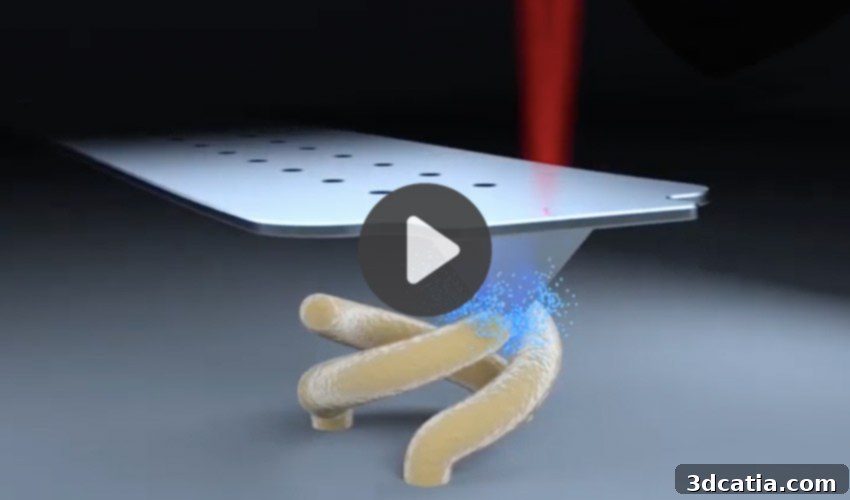
Exaddon’s core innovation lies in its unique technology that enables the creation of incredibly precise metallic structures measured in micrometers, or even submicrons. This level of precision is paramount for applications demanding minute details and perfect geometric fidelity. Imagine creating tiny components for micro-robotics, highly specialized sensors, or advanced medical implants with features that are barely visible to the naked eye. The technology offers unparalleled control over material deposition, allowing for the fabrication of intricate designs and complex geometries at scales previously dominated by lithography or other subtractive microfabrication techniques.
The video below provides a compelling demonstration of this capability, showcasing the 3D printing of a triple helix structure. This example perfectly illustrates the technology’s ability to produce complex, three-dimensional forms with extraordinary resolution and accuracy. Such advancements pave the way for breakthroughs in fields like micro-electronics, telecommunications, and high-precision scientific instrumentation, where the ability to manufacture custom metal parts at the micron and submicron scale is a game-changer. Exaddon is truly pushing the boundaries of what is achievable in metal additive manufacturing, opening up new frontiers for high-performance micro-devices.
Top 5: Markforged Metal X: Accessible Industrial Metal 3D Printing
The promise of metal 3D printing has long been tantalizing, but its high cost, complexity, and specialized infrastructure have often limited its accessibility to a select few. Markforged, a prominent player in the additive manufacturing space, set out to democratize metal 3D printing, making it a viable solution for a wider range of industrial users. Their answer to this challenge is the Metal X system, an innovative industrial solution that combines affordability with robust performance.
The Metal X system is inspired by the well-established Metal Injection Molding (MIM) process, adapting its principles for additive manufacturing. This unique approach allows for the production of dense, high-quality metal parts without the need for complex and expensive laser systems typically associated with traditional metal 3D printing. The process involves printing a “green” part using a metal powder bound in plastic, which then undergoes debinding and sintering in a furnace to achieve its final metallic form. This method significantly reduces both equipment costs and operational complexity, making metal additive manufacturing more approachable for small to medium-sized businesses and various manufacturing facilities.
The versatility of the Metal X is further highlighted by its material capabilities. It is capable of producing durable tools, functional prototypes, and even end-use parts from a range of industrial-grade metals, including stainless steel, titanium, and Inconel. These materials are chosen for their excellent mechanical properties, making the Metal X suitable for demanding applications across aerospace, automotive, general manufacturing, and consumer product sectors. From custom jigs and fixtures on a factory floor to high-strength functional components in complex machinery, the Metal X offers an efficient and cost-effective pathway to leverage the power of metal 3D printing, bridging the gap between plastic prototyping and traditional metal manufacturing processes.
What are your thoughts on this week’s selection of top 3D printing innovations? The diversity of applications, from micro-scale precision to industrial accessibility and vibrant full-colour design, truly underscores the dynamic and transformative power of additive manufacturing. We’d love to hear your insights and predictions for the future of 3D printing. Drop a comment below to share your perspectives or engage with us on our Facebook and Twitter pages! For those eager to stay at the forefront of this rapidly evolving industry, don’t miss out – sign up for our free weekly Newsletter to receive all the latest news and essential updates in the 3D printing world, delivered directly to your inbox!