
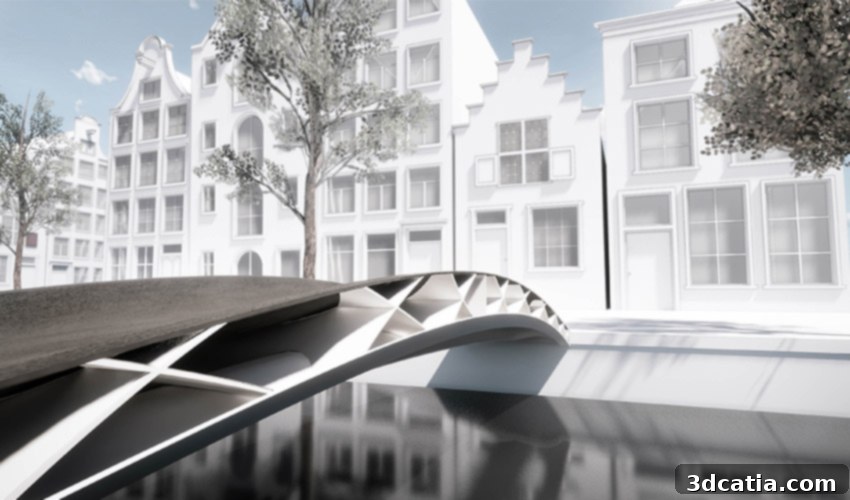
Pioneering Sustainable Infrastructure: The First Lightweight 3D Printed Bridge Revolutionizing Construction with Advanced Composites
The future of urban and rural infrastructure is rapidly evolving, driven by unprecedented innovations in materials science and digital manufacturing. At the forefront of this transformation is a groundbreaking collaboration that has unveiled the first lightweight 3D printed bridge prototype, meticulously designed for pedestrian use. This pioneering project is the result of a powerful partnership between Royal HaskoningDHV, CEAD, and DSM – three leading companies from the Netherlands committed to spearheading a revolution in bridge construction and design. Their collective effort not only showcases advanced engineering capabilities but also serves as a beacon for the transition towards a more sustainable and circular economy, demonstrating how cutting-edge technology can address contemporary challenges in infrastructure development.
This ambitious undertaking brings together distinct yet complementary expertise. Royal HaskoningDHV, a globally recognized international engineering and project management consultancy, lends its extensive experience in complex infrastructure projects and structural design. DSM, a global science-based company, contributes its profound knowledge in nutrition, health, and sustainable living, particularly its pioneering role in advanced 3D printing materials. Completing this formidable trio is CEAD, a specialist supplier of state-of-the-art 3D printing equipment, pushing the boundaries of large-scale composite additive manufacturing. Each partner’s unique strengths are indispensable to the success and innovative nature of this project, ensuring that every aspect, from material composition to structural integrity and manufacturing process, meets the highest standards of innovation and sustainability.
Innovation at its Core: Advanced Composite Materials
The bridge’s remarkable properties stem from its innovative construction material: a high-performance composite material. This advanced composite primarily consists of a glass-filled thermoplastic PET, which is then uniquely combined with continuous glass fibers. These continuous fibers are meticulously integrated into the structure during the 3D printing process, providing directional strength and enhanced structural integrity. This revolutionary combination yields exceptional strength-to-weight ratio, extreme versatility in design, and a profound commitment to sustainability. Unlike traditional construction materials such as steel or concrete, this composite offers superior performance and a significantly reduced environmental footprint.
Fiber Reinforced Polymer (FRP) bridges, generally, are already well-regarded for their inherent advantages over conventional steel alternatives. They boast a significantly longer lifetime expectancy, often attributed to their resistance to corrosion, fatigue, and various environmental stressors. This extended lifespan translates directly into lower life cycle costs, requiring less maintenance and fewer replacements over decades. The introduction of 3D printed FRP composites, especially with continuous fiber reinforcement, amplifies these benefits, presenting a paradigm shift in how we conceive, design, and build durable infrastructure. The recyclability of the thermoplastic PET further reinforces the project’s dedication to a circular economy, minimizing waste and promoting resource efficiency throughout the bridge’s entire life cycle.
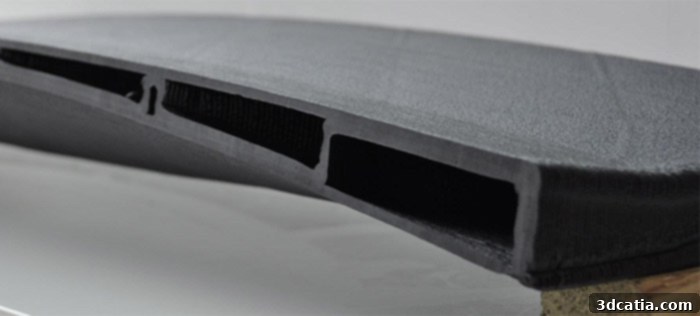
First Lightweight 3D Printed Bridge Prototype: A Collaborative Vision
The choice of materials and manufacturing techniques plays a crucial role in realizing the project’s ambitious goals. Patrick Duis, Segment Leader for Additive Manufacturing at DSM, elaborated on the advantages of their chosen material: “Using a material such as Arnite (PET) has huge benefits for the construction of bridges. Rather than using traditional materials such as steel or concrete, these bridges can be much more sustainable and offer greater flexibility in design using recyclable materials. We know that designs previously deemed challenging or impossible to produce with other manufacturing methods are now possible with 3D printing, and we’re excited to be playing our part in this partnership.” This statement underscores the transformative power of advanced polymer science in addressing the limitations of conventional construction and paving the way for environmentally conscious solutions.
Maurice Kardas, Business Development Manager at Royal HaskoningDHV, further highlighted the technological leap: “What’s new here is the use of a new 3D printing technology, enabling us to print large scale continuous fiber reinforced thermoplastic parts. Using this new composite thermoplastic material, we will be ushering in a new era for sustainability and push the boundaries of bridge functionality even further.” This emphasizes the dual innovation – both in material science and in the additive manufacturing process itself. The ability to produce large-scale, continuously reinforced components opens up a myriad of possibilities for infrastructure projects that require both strength and lightweight properties, without compromising on environmental stewardship.
Unlocking Unprecedented Design Freedom and Efficiency
Beyond the novel technology and materials, the project champions an unprecedented level of design freedom. By combining the partners’ expertise in generative design and predictive modeling, the creative boundaries for infrastructure have been significantly expanded. Generative design, an algorithmic approach, allows engineers to define performance requirements and constraints, letting computer software explore thousands of design variations that might be impossible for human designers to conceive. This process often results in highly optimized, organic structures that use material far more efficiently, reducing weight and enhancing structural integrity. Coupled with predictive modeling, which simulates the performance of these complex designs under various real-world conditions, engineers can ensure durability and safety before a single component is printed.
It is unequivocally clear that 3D printing has evolved dramatically over the past years. What was once considered speculative or technically impossible is now becoming a tangible reality. The construction sector, traditionally slow to adopt new technologies, is now beginning to take full advantage of additive manufacturing’s potential. We have witnessed a growing number of industry players embracing this technology for various applications, from housing to intricate architectural elements. This 3D printed bridge project serves as a powerful testament to the maturity and scalability of additive manufacturing for large-scale infrastructure, demonstrating its capacity to deliver both aesthetic appeal and robust functionality.
A Sustainable Future for Global Infrastructure
The implications of this breakthrough extend far beyond a single bridge prototype. Maarten Logtenberg, representing CEAD, passionately concluded: “This 3D printed bridge prototype demonstrates the huge strides that we are making which will transform the future of this industry, not only speeding up construction, but also making the process more cost and time efficient. We developed this technology for exactly these industry applications, making them more sustainable and easier to manufacture.” This vision of accelerated, cost-effective, and sustainable construction is incredibly compelling for a world facing increasing infrastructure demands amidst growing environmental concerns.
The potential impact on global infrastructure development is immense. Lightweight 3D printed bridges can be manufactured and deployed more rapidly than their traditional counterparts, significantly reducing project timelines and associated labor costs. The ability to print components on demand, potentially even on-site, minimizes transportation needs, further cutting down on emissions and logistical complexities. Moreover, the inherent durability and resistance to harsh environmental conditions offered by FRP composites mean less frequent maintenance and replacement, leading to a substantial reduction in resource consumption over the bridge’s lifespan. This aligns perfectly with the principles of a circular economy, emphasizing resource efficiency, waste reduction, and the recycling of materials wherever possible.
This collaborative project exemplifies how cutting-edge research and industrial application can converge to create innovative solutions for pressing global challenges. By pushing the boundaries of material science, 3D printing technology, and digital design, Royal HaskoningDHV, CEAD, and DSM are not just building bridges; they are constructing a blueprint for a more sustainable, efficient, and resilient future for infrastructure worldwide. This prototype is a significant milestone, proving that additive manufacturing is no longer a niche technology but a powerful tool capable of revolutionizing the very foundations of our built environment.
You can find more information about this project and the companies involved HERE.
What are your thoughts on this revolutionary 3D printed bridge prototype and its potential to reshape the construction industry? We invite you to share your insights and engage with us! Let us know in a comment below or connect with us on our Facebook and Twitter pages. For all the latest news and updates in the world of 3D printing, don’t forget to sign up for our free weekly Newsletter, delivered straight to your inbox!