
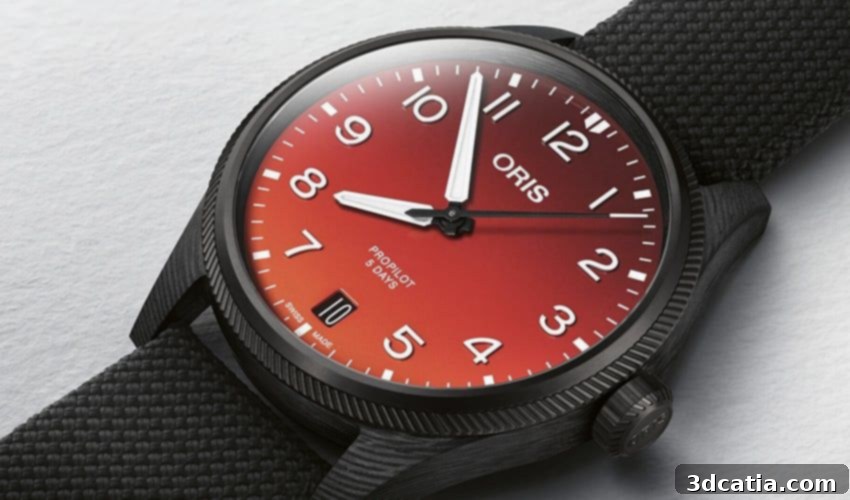
Oris Coulson Limited Edition: Pioneering 3D Printed Carbon Fiber in Watchmaking for Aerial Firefighting Heroes
In a remarkable fusion of horological innovation and heroic endeavor, Oris, the distinguished independent Swiss watchmaker, has unveiled its latest limited edition timepiece: the ‘Coulson Limited Edition’. This groundbreaking watch is the culmination of a significant partnership with Coulson Aviation, a Canadian powerhouse renowned globally for its specialized aerial forest fire suppression services. This collaboration is not merely about crafting a new watch; it’s a profound tribute to the courage and dedication of an organization that deploys vital pilots, state-of-the-art planes, and essential equipment to the most challenging regions affected by devastating forest fires worldwide. Coulson Aviation’s unwavering mission is to provide critical support to ground firefighters, tirelessly working to protect communities, save lives, and safeguard our precious natural environment from the destructive force of wildfires. The Oris Coulson Limited Edition embodies this spirit of resilience and essential service, making it more than just a time-telling instrument; it is a symbol of global heroism and environmental commitment.
The Oris Coulson Limited Edition stands out not only for its inspiring backstory but also for its pioneering manufacturing process. At its core, the watch features a revolutionary carbon fiber case meticulously produced through advanced 3D printing, also known as additive manufacturing. This innovative approach represents a significant leap forward in watchmaking materials and production techniques, pushing the boundaries of what is traditionally achievable. To achieve this unprecedented feat, Oris partnered with 9T Labs, a visionary Swiss company that has developed a proprietary 3D printing method specifically designed for creating robust and intricate structures using carbon composites. 9T Labs leveraged its acclaimed Red Series solution, an industrial-grade 3D printer engineered for high-volume manufacturing of composite parts. The process involves the simultaneous printing and fusion of continuous carbon fiber strands with a high-performance thermoplastic polymer known as PEKK (Polyetherketoneketone). PEKK is celebrated for its exceptional strength-to-weight ratio, high temperature resistance, and chemical inertness, making it an ideal matrix material for advanced composites. When these two advanced materials are blended together at a molecular level, they create an extraordinarily lightweight yet exceptionally rigid and durable material, perfectly suited for the demanding environment a pilot might encounter in the field. According to Ulrich W. Herzog, President of Oris, this technique represents a milestone: “Our new watch features a 3D printing technique never before used in watchmaking,” underscoring the innovative spirit driving this limited edition and setting a new precedent for the industry.
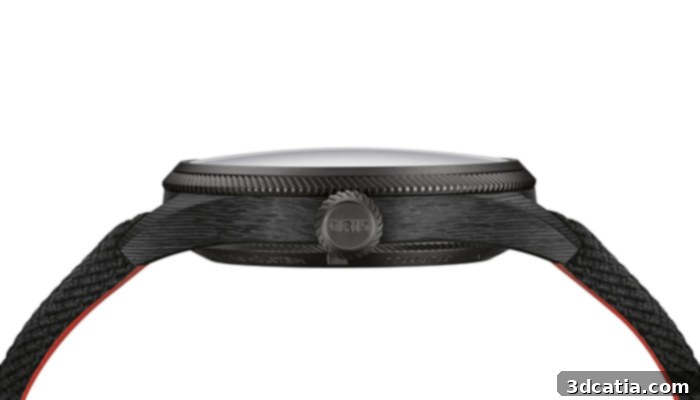
The case of the Oris Coulson Limited Edition is innovatively 3D printed using a high-performance mixture of continuous carbon fiber and PEKK, achieving unparalleled strength and lightness. (Photo credits: Oris)
Revolutionizing Watch Production: The Strategic Advantages of 3D Printing for Sustainability and Design
Advanced 3D Printing Enables Precision Production for 1,000 Limited Edition Watches
The adoption of advanced 3D printing technology for the manufacturing of the Oris Coulson Limited Edition watch has yielded a multitude of significant benefits, particularly when compared to conventional watchmaking methods. Oris embarked on this project with a clear dual objective: to create a timepiece that is not only exceptionally resistant and reliable, capable of withstanding extreme conditions, but also demonstrably environmentally responsible. Additive manufacturing stands as a powerful enabler of both these goals. By precisely depositing material layer by layer, 3D printing technology facilitates vastly superior resource management, dramatically limiting material waste – a common byproduct of traditional subtractive manufacturing processes where material is cut away from a larger block, often resulting in significant scrap. This inherent efficiency aligns perfectly with Oris’s commitment to sustainability and responsible production, reducing ecological impact and optimizing material usage throughout the manufacturing cycle.
Working in close collaboration with 9T Labs, the pioneering Swiss brand was able to meticulously produce all 1,000 units of this exclusive limited edition series. The precision offered by 9T Labs’ Red Series solution ensured that each watch case was crafted with the exact, optimized quantity of raw material needed, minimizing excess and maximizing efficiency. This level of control not only contributes to a greener manufacturing footprint but also ensures unparalleled consistency and quality across the entire limited run, a crucial factor for luxury timepieces. Beyond the environmental and production efficiencies, 3D printing also unlocked new possibilities in design, allowing for intricate geometries and unique material compositions. The watch’s aesthetic is striking and purposefully functional: the dial features a vibrant, bright orange hue, a color expertly chosen to evoke the intensity of fire – symbolizing both the destructive element that Coulson Aviation battles and the life-saving courage of its personnel. This bold choice ensures high legibility, a critical aspect for aviators, and makes a powerful statement. The case, meanwhile, presents a sleek, sophisticated black finish and a timeless round shape, providing a robust yet elegant housing for the innovative internals. This combination of cutting-edge materials and thoughtful design results in a watch that is both a functional tool for aviation professionals and a compelling piece of horological art. For enthusiasts keen to delve deeper into the technical specifications and design philosophy of this remarkable timepiece, further details can be found by clicking HERE.
The Expanding Horizon of Additive Manufacturing in Horology: Beyond Traditional Craftsmanship
While Oris has undeniably set a new benchmark with its 3D printed carbon fiber composite case, demonstrating a forward-thinking approach to watchmaking, it is not the sole innovator harnessing the power of additive manufacturing for watch design. The watchmaking industry, traditionally steeped in centuries of heritage and meticulously refined manual craftsmanship, is slowly but surely embracing the transformative potential of 3D printing. Brands like Sychronos, for instance, have previously launched their own collections of 3D printed watches, often utilizing technologies such as DMLS (Direct Metal Laser Sintering). DMLS is a robust metal 3D printing technique that fuses fine metallic powders with a laser, creating incredibly strong and intricate metal components, suitable for various watch parts including cases, bezels, or even complex movement components. However, despite these pioneering efforts, the broader application of 3D printing within the watch sector remains relatively less widespread compared to its pervasive adoption in related luxury goods segments like jewelry, bespoke accessories, and even high-precision industries such as aerospace and medical device manufacturing.
This slower adoption rate in watchmaking can be attributed to several factors, including the industry’s deep-rooted respect for traditional manufacturing techniques, the extremely high precision required for micro-components within a watch movement, and historical limitations in available 3D printing materials that could meet horological standards for aesthetics, durability, and tactile feel. Often, the investment in traditional machinery and skilled artisans also presents a barrier to rapid technological shifts. Nevertheless, with the continuous evolution and rapid advancement of 3D printing technologies – offering ever-improving resolution, a wider array of high-performance materials (like the continuous carbon fiber and PEKK composite used by Oris), and enhanced surface finishes capable of meeting luxury standards – the landscape is rapidly shifting. Watch designers are increasingly recognizing the immense benefits of integrating this process into their product development and manufacturing workflows. Additive manufacturing empowers designers to iterate rapidly, explore complex and organic geometries previously impossible or prohibitively expensive with traditional machining, and create highly customized components with unparalleled efficiency. Furthermore, it allows for the development of lightweight yet robust structures, improved material properties, and contributes significantly to more sustainable production cycles by reducing material waste, optimizing designs for minimal material use, and enabling on-demand manufacturing. This transformative potential suggests that, in the coming years, we will witness a significant paradigm shift, with watchmakers increasingly turning to 3D printing to design and produce exceptional products faster, more sustainably, and with uncompromised quality, thereby pushing the boundaries of what is possible in contemporary horology and opening doors to innovative watch designs.
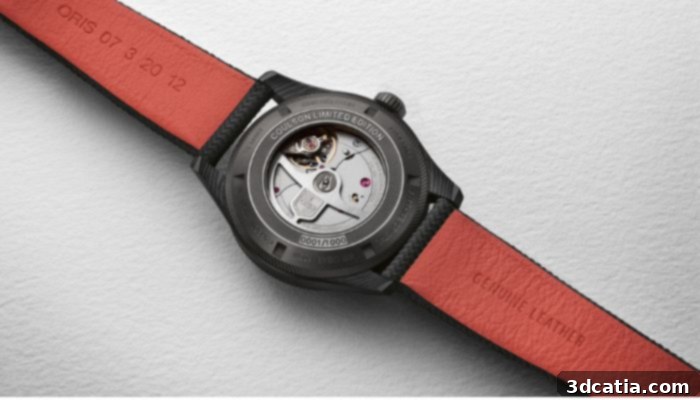
The Oris Coulson Limited Edition: A symbol of innovation and heroism, demonstrating the practical application of advanced 3D printing in luxury watchmaking. Photo credit: Oris
Share Your Thoughts: The Future of 3D Printed Watches
The Oris Coulson Limited Edition represents a pivotal moment for the watch industry, showcasing how cutting-edge technology, specifically advanced 3D printing with carbon fiber composites, can be harmoniously blended with a noble cause such as aerial firefighting. What are your initial impressions of this innovative 3D printed watch and its unique construction? Do you believe additive manufacturing will become a standard practice in luxury watch production for cases, or even intricate movement components, or will it remain a niche for specialized editions and experimental designs? We invite you to share your valuable insights and opinions in a comment below. You can also join the conversation and connect with us on ourLinkedIn,Facebook, and Twitter pages to discuss this and other advancements in the fascinating world of 3D printing. Don’t miss out on the latest developments in additive manufacturing – be sure to sign up for our free weeklyNewsletter here, delivering the most relevant 3D printing news straight to your inbox! Additionally, explore all our informative and engaging videos on our dedicatedYouTube channel for visual insights into additive manufacturing’s diverse applications.