

Unlocking Victory: How 3D Printing Propelled Lamborghini’s SC63 at the 24 Hours of Le Mans
The dynamic world of motor racing is constantly pushing the boundaries of innovation, and 3D printing has emerged as a transformative force within this high-stakes environment. Its unparalleled ability to rapidly produce highly customized components, experiment with cutting-edge designs, and utilize specialized materials has made it an indispensable tool for leading automakers and racing teams alike. From the intricate aerodynamics of Formula 1 cars to the robust demands of endurance racing, additive manufacturing offers a unique competitive edge. This widespread adoption is exemplified by collaborations such as Visa Cash App RB’s partnership with ROBOZE in F1, and pioneering initiatives by iconic brands like Ferrari and McLaren Racing, all leveraging the speed and versatility of 3D printing to gain precious tenths of a second on the track.
A compelling recent demonstration of 3D printing’s critical role on the racetrack unfolded during the legendary 24 Hours of Le Mans. Lamborghini, a marque synonymous with performance and luxury, found itself in a challenging situation concerning its revolutionary SC63 hypercar. Facing an urgent need for crucial parts that were otherwise unavailable through traditional supply chains, Lamborghini turned to local additive manufacturing expert EProjets Lab. This swift intervention not only showcased the agility of 3D printing but also highlighted its essential contribution to keeping high-performance vehicles competitive in the most demanding races globally.

Lamborghini SC63 hypercars competing at the 24 Hours of Le Mans 2024 (photo credits: Lamborghini)
Lamborghini SC63: A New Era in Endurance Racing
The Lamborghini SC63 hypercar represents a monumental leap forward for the Italian automaker in the realm of endurance racing. First unveiled to an eager audience at the prestigious Goodwood Festival of Speed in 2023, an annual motorsport celebration held at the iconic Goodwood circuit in England, the SC63 immediately signaled Lamborghini’s serious intent to dominate. This formidable machine was engineered to compete in the highly competitive 2024 World Endurance Championship (FIA WEC) and the IMSA WeatherTech SportsCar Championship, marking a significant and ambitious milestone for the brand.
At its heart, the SC63 is a sophisticated hybrid prototype, powered by a potent 3.8-liter twin-turbo V8 engine. This powertrain, combined with advanced aerodynamic principles and lightweight construction, makes it the most technologically advanced racing car ever conceived and built by Lamborghini’s Squadra Corse division. Its design prioritizes performance, efficiency, and driver experience, all crucial factors in the grueling nature of endurance motorsport. For the intense 2024 racing season, Lamborghini forged a strategic partnership with Iron Lynx, a renowned racing team, to further optimize the car’s performance envelope and attract an elite roster of world-class drivers. This star-studded lineup included talents from Formula 1 and top-tier endurance racing, such as Mirko Bortolotti, Andrea Caldarelli, Daniil Kvyat, and Romain Grosjean, all contributing their expertise to push the SC63 to its limits.
Additive Manufacturing to the Rescue: Essential Parts for Le Mans
The 24 Hours of Le Mans, the fourth round of the FIA WEC championship, is renowned for its unrelenting demands on both car and driver. During this arduous race, Lamborghini and its partner Iron Lynx encountered an unexpected and critical need for replacement parts for the SC63. With time of the essence and no traditional manufacturing solutions available to meet the immediate demand, they commissioned EProjets Lab, a local 3D printing service, for urgent production. This decision underscored the unparalleled agility and problem-solving capability of additive manufacturing in high-pressure motorsport scenarios.
The parts required were fundamental to both driver comfort and pit stop efficiency. EProjets Lab was tasked with 3D printing two critical sets of components. The first consisted of two air ducts for the cockpit ventilation system. In an endurance race stretching for 24 hours, maintaining optimal thermal management within the cockpit is paramount for driver concentration, endurance, and overall safety. These ducts were designed to ensure a constant supply of fresh, cool air, directly impacting the drivers’ ability to perform at their peak under extreme conditions. The second urgent requirement was for two guides for the vehicle’s pneumatic lifting system. These guides are small yet vital components that facilitate rapid and precise pit stops. Their proper functioning ensures the smooth insertion and removal of the car from its elevated position, shaving off crucial seconds during tire changes and refuels – moments that can often dictate the outcome of a race.
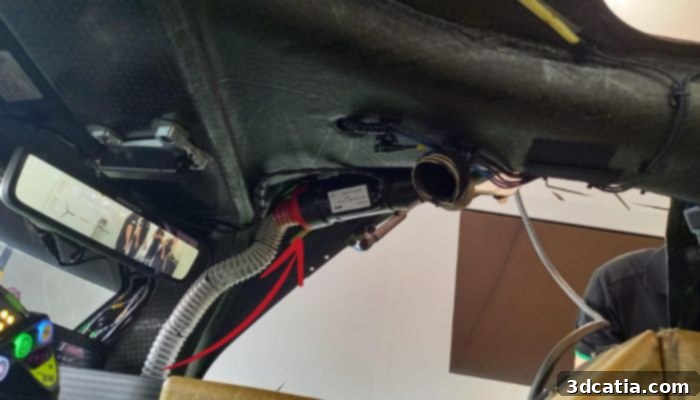
The 3D-printed ABS air ducts for the cockpit ventilation system, designed to enhance driver comfort by bringing fresh air into the car (photo credits: EProjets Lab)
Material Selection and Process: Tailored for Performance and Durability
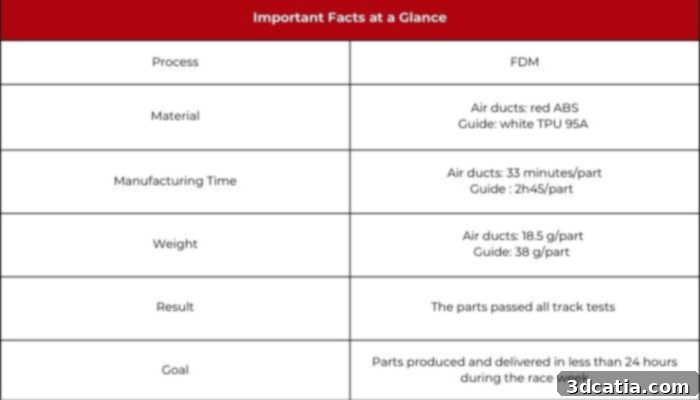
The selection of materials and manufacturing processes was crucial to meet the specific demands of each component. For the air ducts, the Fused Deposition Modeling (FDM) process was chosen, utilizing red ABS (Acrylonitrile Butadiene Styrene) material. FDM is a widely used additive manufacturing technique known for its ability to produce strong, functional parts relatively quickly. ABS, a common thermoplastic, offers excellent strength, rigidity, and is relatively lightweight, making it an ideal choice for the non-structural but essential air ducts that needed to withstand the vibrations and moderate temperatures within the cockpit without adding unnecessary mass to the vehicle. The vibrant red color also offered a visual distinction while being purely functional in application.
The guides for the pneumatic lifting system presented a different, and perhaps even more significant, material challenge. These components are subjected to immense stress during pit stops and, once ejected, often fall onto the abrasive asphalt, leading to frequent breakages with traditional materials. Past experiences had revealed resistance problems, highlighting the need for a material that was not only strong and durable but also flexible enough to absorb impact without fracturing. The FDM process was again selected for its speed and versatility in handling various thermoplastics.
After careful consideration, TPU 95A (Thermoplastic Polyurethane) proved to be the optimal material choice for these critical guides. TPU 95A is an elastomeric thermoplastic known for its exceptional flexibility, high tear and abrasion resistance, and superior impact absorption capabilities. These properties were precisely what was needed to address the historical durability issues. By using TPU 95A, EProjets Lab could manufacture guides that would withstand repeated falls onto hard surfaces, ensuring reliable, long-lasting performance even under the extreme, fast-paced conditions of pit stops. This innovative material choice directly contributed to increased operational reliability and reduced risk of costly delays during a race where every second counts.
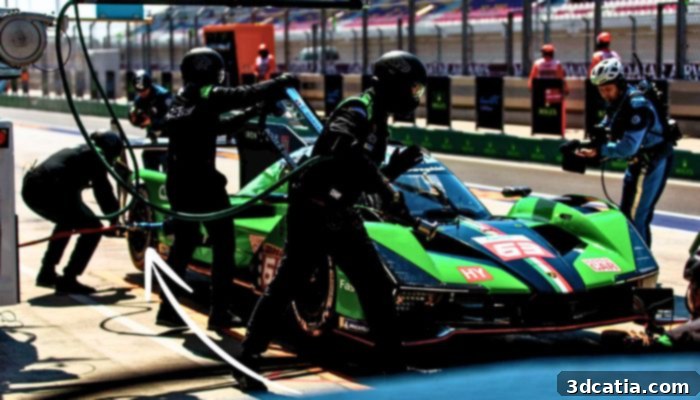
A robust 3D-printed part in white TPU95A, engineered to optimize performance and precision during crucial pit stops (photo credits: Lamborghini, Iron Lynx)
Rapid Delivery and Proven Performance on the Track
The success of this operation hinged not just on material and process selection, but crucially, on speed. EProjets Lab delivered the high-quality 3D printed parts in an astonishing timeframe of less than 24 hours. This rapid turnaround, a hallmark benefit of additive manufacturing, was instrumental in allowing Lamborghini and Iron Lynx to address their urgent needs without compromising their race weekend. The flexibility and swiftness inherent in 3D printing proved to be a game-changer, demonstrating how on-demand production can overcome traditional logistical bottlenecks in critical situations.
The satisfaction with EProjets Lab’s service was unequivocally expressed by the client. John McGill, Engineering Coordinator at Iron Lynx Lamborghini, remarked, “We received the parts very quickly, at a competitive cost and with exceptional quality. We’re very impressed.” This statement underlines the comprehensive value proposition of additive manufacturing – not just speed, but also cost-effectiveness and adherence to rigorous quality standards required for elite motorsports.
The immediate impact of these 3D printed components was evident during the demanding 24 Hours of Le Mans. The parts seamlessly integrated into the Lamborghini SC63, performing flawlessly under race conditions. Following the intense competition, the parts underwent further stringent testing, which unequivocally confirmed their durability and robust performance. This long-term validation led to their continued use in subsequent high-profile races. The Lamborghini SC63s, equipped with these same 3D printed components from EProjets Lab, went on to compete successfully at the IMSA 6 Hours of Watkins Glen, navigating the challenges of the Watkins Glen International Circuit and performing reliably throughout the entire race. This continuous deployment in multiple endurance events serves as definitive proof of the reliability, precision, and customization capabilities that 3D printing brings to the pinnacle of motor racing. For additional insights into this innovative partnership, you can explore the details on EProjets Lab’s website HERE.
What are your thoughts on Lamborghini’s strategic adoption of 3D printing for its SC63 hypercar at the 24 Hours of Le Mans and beyond? Share your insights in a comment below or join the discussion on our LinkedIn, Facebook, and Twitter pages! Don’t miss out on the latest advancements in additive manufacturing – be sure to sign up for our free weekly newsletter here, delivering crucial 3D printing news directly to your inbox. You can also explore all our engaging videos and content on our dedicated YouTube channel.
*Cover Photo Credits: Lamborghini