
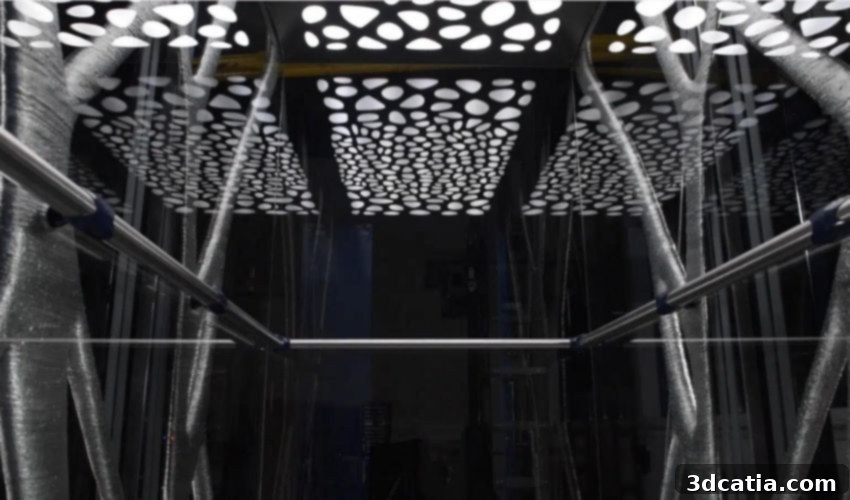
Schindler and MX3D Elevate Design: Pioneering 3D Printed Interiors for Sustainable and Aesthetically Pleasing Elevators
What began in 1857 in the Haughwout department store in New York has evolved into an indispensable fixture of modern life: the passenger elevator. Despite their daily presence, these essential vertical transport systems often fade into the background, rarely leaving a memorable impression. While some architectural marvels, such as high-rise buildings and luxury hotel lobbies, boast sophisticated elevators with transparent floors or intricate gold embellishments, these examples remain exceptional. Recognizing this untapped potential for innovation, Swiss industry leader Schindler, renowned for its cutting-edge elevator and escalator manufacturing, has forged a groundbreaking partnership with MX3D. This Dutch company gained international acclaim for installing a 3D-printed metal bridge in Amsterdam, showcasing their mastery of additive manufacturing on an impressive scale. Together, Schindler and MX3D are committed to reimagining the elevator experience, aiming to transform ordinary rides into visually captivating journeys. This ambitious goal will be achieved through the integration of artistic elements within the elevator car, meticulously produced using advanced metal 3D printing techniques. This collaboration signifies a bold step towards blending art, engineering, and sustainability within an everyday utility, promising a future where elevators are not just functional but also inspiring.
Schindler’s Vision: Redefining the Elevator Experience Through Innovation
Schindler, a name synonymous with reliability and innovation in vertical mobility, has been at the forefront of the industry since its inception in 1874. With a staggering global presence, the company transports an estimated one and a half billion people every single day, making it a pivotal part of global urban infrastructure. However, in a world that constantly evolves, remaining static is simply not an option for a company committed to progress. Schindler’s philosophy demands continuous innovation, which is why they are now strategically embracing the transformative power of additive manufacturing. This forward-thinking approach is driven by a desire to push beyond conventional design and manufacturing limitations.
By harnessing advanced 3D printing technology, Schindler not only anticipates realizing highly creative and intricate designs for elevator car interiors – designs that were previously impossible to achieve with traditional methods – but also identifies significant potential for material optimization. This translates directly into a reduction in the overall weight of the elevator cab, a critical factor that inherently leads to another profoundly positive outcome: substantially lower energy consumption throughout the elevator’s operational lifespan. This commitment underscores Schindler’s dedication to both aesthetic excellence and environmental responsibility, positioning them as pioneers in sustainable vertical transport solutions.
The pursuit of lighter, more efficient components is a major driver behind this technological shift. Conventional manufacturing processes often involve material waste and are limited in their ability to create complex, hollow, or lattice structures that offer high strength-to-weight ratios. Additive manufacturing, by contrast, builds objects layer by layer, allowing for the creation of intricate geometries precisely where material is needed, and omitting it where it is not. This inherent efficiency not only reduces raw material usage but also decreases the energy required for both manufacturing and, crucially, for the daily operation of the elevator. For a company transporting billions daily, even small gains in energy efficiency per ride accumulate into massive environmental and economic benefits globally, aligning perfectly with modern sustainability goals and the demand for greener building solutions.
MX3D: Leading the Charge in Large-Scale Metal Additive Manufacturing
MX3D, an innovative additive manufacturing solutions provider based in the Netherlands, stands at the cutting edge of large-scale metal 3D printing. Their core mission is to evangelize and establish the profound benefits of this technology across diverse and challenging industries. MX3D achieves this by developing and deploying smart, robust, and exceptionally user-friendly robotic technologies specifically tailored for additive manufacturing. These advanced systems empower their industry partners to successfully 3D print substantial metal objects using WAAM (Wire Arc Additive Manufacturing), a sophisticated form of Directed Energy Deposition (DED). This technology is particularly suited for creating large-format structures with high material deposition rates, making it ideal for architectural and industrial applications that demand both scale and precision.
The WAAM process, at its essence, utilizes an arc welding technique to melt wire feedstock, depositing layers of metal to build up a three-dimensional object. This method offers several distinct advantages, including the ability to print very large components, work with a wide range of metals, and achieve high material utilization, reducing waste compared to subtractive manufacturing. MX3D’s expertise was famously showcased with their pioneering project in Amsterdam: the world’s first 3D-printed metal bridge. This monumental achievement not only demonstrated the structural integrity and aesthetic capabilities of their technology but also proved its viability for real-world, high-impact applications. It cemented MX3D’s reputation as a company that pushes the boundaries of what is possible with digital fabrication, making them an ideal partner for Schindler’s ambitious vision to revolutionize elevator design.
The Synergy of Collaboration: Aesthetics Meets Performance in Elevator Design
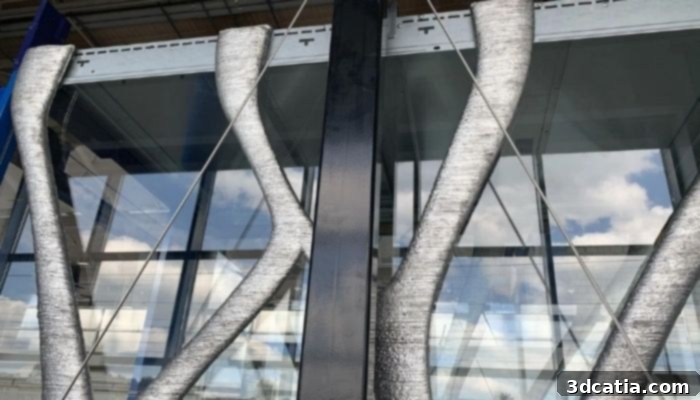
The joint project between Schindler and MX3D represents a remarkable fusion of artistic vision and advanced engineering. At the heart of this collaboration is the re-imagination of the elevator car interior, transforming it from a mere functional space into an engaging artistic environment. The design chosen for this pioneering initiative evokes the delicate and intricate beauty of filigree leafless branches – a complex, organic pattern that would be virtually impossible to produce with traditional manufacturing techniques. It is precisely this level of geometric freedom and complexity that metal 3D printing excels at, allowing designers to create forms that are both visually stunning and structurally optimized. The use of additive manufacturing here is not just about making things look good; it’s about making them inherently better, from their structural properties to their environmental footprint.
Beyond the immediate aesthetic appeal, this project is equally dedicated to exploring the profound benefits of topology optimization. This sophisticated computational design method is crucial for achieving the best possible design by minimizing material while maximizing performance. Gijs van der Velden, CEO of MX3D, eloquently explains the core principle: “Essentially, you look at an object and lots of it is superfluous material. The idea is to whittle that object down to its bare essentials.” This philosophy is perfectly embodied in the branch-like structures within the elevator, where material is intelligently placed only where it contributes to structural integrity or aesthetic intent, resulting in significant weight reduction without compromising strength. This symbiotic approach ensures that the resulting components are not only visually striking but also engineered for peak efficiency and sustainability, demonstrating a holistic approach to innovative design.
Topology Optimization Explained: Maximizing Efficiency, Minimizing Material
Topology optimization is a powerful algorithmic tool within generative design that allows engineers to find the optimal material distribution within a defined design space for a given set of loads and constraints. Instead of designing a part and then checking its performance, topology optimization essentially designs the part itself, driven by performance requirements. The software iteratively removes material from areas that are not critical for structural integrity or thermal performance, leaving behind only the essential load-bearing elements. This often results in organic, bionic-like forms that mimic natural structures, such as bones or tree branches, which are inherently optimized for strength and minimal weight. For the elevator project, this means the intricate branch patterns are not just decorative; they are rigorously engineered structures that provide the necessary support using the least amount of metal possible. This intelligent design process significantly contributes to the overall weight reduction of the elevator car, which in turn diminishes the energy required to move it, offering tangible environmental and economic advantages. It’s a testament to how digital design tools, combined with advanced manufacturing techniques like 3D printing, can unlock unprecedented levels of efficiency and innovation in product development.
Recognizing Excellence: A Finalist in the Purmundus Contest
The innovative collaboration between Schindler and MX3D has garnered significant attention within the additive manufacturing community, solidifying its status as a pioneering project. As a testament to its forward-thinking design and engineering, the project has been selected as one of the 35 distinguished finalists in Cirp GmbH’s prestigious Purmundus Contest. This globally recognized competition celebrates innovation in 3D printing and additive manufacturing, highlighting projects that push the boundaries of design, functionality, and sustainability. The winner of this highly anticipated contest is traditionally announced at Formnext, one of the world’s leading trade fairs for additive manufacturing and industrial 3D printing, scheduled for 2021. Being a finalist in such a competitive arena underscores the project’s technical sophistication and its potential impact on the industry.
Under the inspiring motto “Innovation in Progress,” the Purmundus Contest finalists showcase how innovation can transcend mere ideation and become a systematic art, enabling a seamless and efficient transition from initial prototyping to successful series production using 3D printing technologies. The Schindler-MX3D project perfectly embodies this ethos, demonstrating not just a novel application but a viable pathway for incorporating complex, optimized, and aesthetically rich components into mainstream industrial products. This recognition not only validates the technical achievements of the teams involved but also amplifies the message that additive manufacturing is no longer just for prototypes but is ready for high-value, high-impact industrial applications. You can delve deeper into the specifics of this remarkable project and its development by visiting the official MX3D project page HERE.
The Future of Vertical Mobility: Customization, Sustainability, and Beyond
The collaboration between Schindler and MX3D heralds a new era for elevator design and manufacturing, extending far beyond the immediate aesthetic and efficiency gains. This pioneering use of metal 3D printing and topology optimization opens up a vast array of possibilities for future vertical mobility solutions. Imagine elevator cabs that are not only lighter and more energy-efficient but also uniquely customized to reflect the brand identity or architectural theme of a specific building. The design freedom offered by additive manufacturing means that bespoke interiors, intricate patterns, and personalized textures can become standard offerings, moving away from the mass-produced, generic look often associated with elevators. This level of customization can significantly enhance the user experience, transforming a mundane daily commute into an engaging and memorable part of a building’s unique character.
Furthermore, the implications for sustainability are profound. As the world increasingly prioritizes green building initiatives, the ability to produce elevator components with minimal material waste and reduced energy consumption will be a significant advantage. This approach not only impacts the manufacturing phase but also the entire lifecycle of the elevator, leading to lower operational costs and a smaller carbon footprint. Beyond the aesthetic and environmental benefits, this technology also presents opportunities for improved functionality. Future iterations could integrate smart materials, embedded sensors within the 3D printed structures for real-time performance monitoring, or even self-healing capabilities. The ability to rapidly produce on-demand replacement parts with complex geometries could also streamline maintenance and reduce downtime, further enhancing the efficiency and reliability of elevator systems. This partnership sets a powerful precedent for how advanced manufacturing technologies can drive innovation across industries, encouraging others to explore similar integrations of digital fabrication for more sustainable, efficient, and user-centric products.
Conclusion: Elevating Expectations for Everyday Journeys
The ambitious project by Schindler and MX3D marks a pivotal moment in the evolution of elevator design. By skillfully integrating the artistic potential of metal 3D printing with the engineering precision of topology optimization, they are challenging the long-held perception of elevators as purely utilitarian conveyances. The intricate, lightweight, and energy-efficient interiors they are developing demonstrate a clear pathway towards a future where everyday journeys are enhanced by thoughtful design and sustainable innovation. This collaboration is a powerful testament to how industries can leverage cutting-edge technologies like additive manufacturing to not only achieve aesthetic excellence but also deliver tangible benefits in terms of material reduction, energy efficiency, and overall environmental impact. As this project continues to evolve and inspires further advancements, it is clear that the future of vertical mobility will be significantly more engaging, sustainable, and memorable. What do you think of this innovative application of 3D printing for elevators? We invite you to share your thoughts in a comment below or join the conversation on our Linkedin, Facebook, and Twitter pages! Don’t forget to sign up for our free weekly Newsletter here to receive the latest 3D printing news straight to your inbox! You can also find all our videos on our YouTube channel.