
Revolutionizing Breast Cancer Treatment: Ricoh 3D for Healthcare and SimBioSys Forge a Path with AI and 3D Printing
In a significant stride towards the future of oncology, Ricoh USA, renowned for its pioneering work in custom medical device design through its specialized division, Ricoh 3D for Healthcare, has officially announced a groundbreaking collaboration with SimBioSys. SimBioSys is an innovative technology company at the forefront of integrating artificial intelligence (AI) with sophisticated computational modeling. This powerful alliance is set to meticulously explore and develop cutting-edge technologies aimed at transforming the treatment landscape for breast cancer patients.
This pivotal initiative is specifically designed to harness the immense potential of artificial intelligence when combined with advanced 3D printing techniques. The overarching goal is to achieve unprecedented improvements in surgical precision, enhance the efficacy of treatment strategies, and profoundly personalize the care pathways for individuals battling breast cancer. By synergizing their distinct areas of expertise, Ricoh and SimBioSys are committed to engineering medical solutions that promise to fundamentally revolutionize how breast cancer is diagnosed, treated, and managed, ultimately leading to better patient outcomes and quality of life.
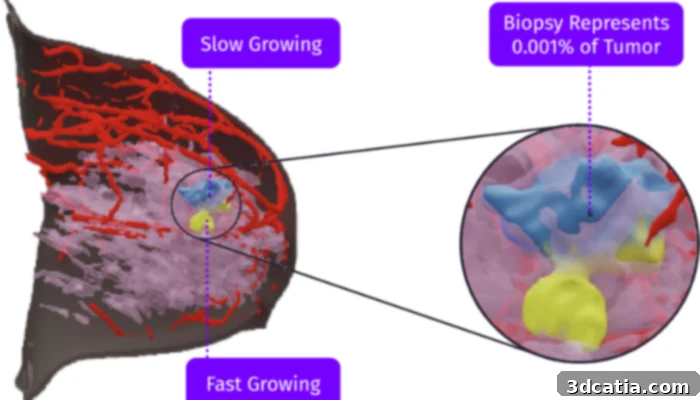
The combined strength of these two industry leaders represents a formidable force in medical innovation. SimBioSys brings to the table its state-of-the-art artificial intelligence capabilities, which are crucial for analyzing vast amounts of patient data, identifying complex patterns, and creating predictive models. Complementing this is Ricoh’s unparalleled expertise in 3D printing, enabling the physical manifestation of these digital insights into highly accurate, patient-specific anatomical models. This collaborative effort will primarily focus on creating detailed breast cancer models that mirror the unique pathology and anatomy of each individual patient, offering an invaluable tool for surgical planning and personalized treatment approaches.
(Photo Credits: SimBioSys)
The Power of AI and 3D Printing in Breast Cancer Care
The convergence of artificial intelligence and 3D printing is poised to unlock new frontiers in medical treatment, especially in complex fields like oncology. AI excels at processing and interpreting intricate medical imaging data, genetic information, and clinical histories to provide actionable insights. It can identify subtle tumor characteristics, predict tumor growth patterns, and even suggest optimal therapeutic regimens. When these AI-driven insights are fed into a 3D printing workflow, the result is the creation of physical models that offer an unparalleled level of detail and personalization.
For breast cancer, this means moving beyond generalized treatment protocols to highly individualized plans. Surgeons can utilize these patient-specific 3D printed models, informed by AI analysis, to pre-visualize the tumor’s exact location, size, and relationship to surrounding tissues. This capability is instrumental in refining surgical approaches, minimizing damage to healthy tissue, and ultimately improving the chances of complete tumor removal, which is a critical factor in patient prognosis. The partnership between Ricoh 3D for Healthcare and SimBioSys is specifically designed to leverage these synergistic capabilities to their fullest extent.
Showcasing Innovation at ASBrS 2024
The impact and potential of this collaboration were prominently highlighted at the American Society of Breast Surgeons (ASBrS) conference, a key event in the breast cancer community, held from April 11th to 14th, 2024. During this prestigious gathering, Ricoh 3D for Healthcare and SimBioSys unveiled their latest advancements, including the pioneering breast cancer models developed through their combined expertise. The showcase underscored the immense capabilities and transformative potential inherent in their joint technologies.
Speaking passionately about the partnership and its implications, Gary Turner, Managing Director at Ricoh USA, emphasized the profound vision driving this endeavor. He stated, “Through a collaboration with SimBioSys, we hope to not just envision a new future for medical treatment but help actively create it. Our dedication to precision and personalization in breast cancer care is about to be showcased at ASBrS, reflecting the potential of our combined efforts.” This statement resonates with Ricoh’s long-standing commitment to innovation and its strategic expansion into high-impact healthcare solutions.
While the specific proprietary methodologies and advanced technologies underpinning their innovative workflow were not publicly disclosed in granular detail at the conference, attendees gained invaluable insights into the myriad advantages stemming from this collaboration. The partnership’s presence at ASBrS was particularly significant, as underscored by Jyoti Palaniappan, Commercial Director of SimBioSys. He highlighted the transformative potential of this synergistic effort to empower surgeons and patients with a far deeper and more comprehensive understanding of complex cancer surgeries, even before the initial incision is made. This pre-operative clarity can significantly reduce surgical risks, optimize operative time, and enhance patient peace of mind.
Transforming Surgical Planning and Patient Education
The core benefit of these AI-driven, 3D-printed breast cancer models lies in their ability to revolutionize both surgical planning and patient education. For surgeons, these models serve as highly accurate physical representations of the patient’s anatomy and pathology. This allows for meticulous pre-surgical planning, enabling them to simulate procedures, identify potential challenges, and rehearse complex maneuvers. Such detailed preparation can lead to shorter operating times, reduced complications, and more precise resections, ultimately contributing to better oncological and cosmetic outcomes.
From the patient’s perspective, these personalized models offer an unprecedented opportunity for engagement and understanding. Explaining a complex breast cancer diagnosis and the proposed surgical intervention can be challenging for both medical professionals and patients. However, presenting a tangible, 3D-printed model that replicates their specific tumor and surrounding tissues allows patients to visualize their condition and understand the planned procedure in a far more intuitive and reassuring way. This enhanced understanding empowers patients to make more informed decisions about their care, fostering trust and alleviating anxiety during an already stressful period.
The Path Forward: From Educational Tools to Clinical Validation
It is crucial to note that, at this preliminary stage, the innovative workflow developed jointly by SimBioSys® and Ricoh 3D for Healthcare is intended solely for educational purposes. This means the models and associated data are currently utilized for training, research, and pre-surgical planning simulations, rather than for direct diagnostic interpretation or guiding live surgical procedures where regulatory approval is required. While this is an important distinction, it represents a crucial and foundational first step in the arduous yet necessary journey towards the future development and comprehensive validation of these advanced technologies for widespread clinical use.
The transition from an educational tool to a clinically approved diagnostic or therapeutic aid is a rigorous process, typically involving extensive clinical trials, regulatory submissions, and stringent validation protocols established by bodies such as the FDA in the United States. This careful and methodical approach ensures that any new medical technology is both safe and effective for patient care. The collaboration’s current focus on educational applications allows for continuous refinement, data collection, and robust testing of the workflow and models, laying a solid groundwork for future regulatory approval and broader adoption in medical practice.

Ricoh showcases breast cancer anatomical models at the 2024 Annual Meeting of the American Society of Breast Surgeons. (Photo Credits: Ricoh 3D for Healthcare)
Driving Precision Medicine in Oncology
The partnership between Ricoh 3D for Healthcare and SimBioSys exemplifies a broader trend towards precision medicine in oncology. Precision medicine aims to tailor treatments to the individual characteristics of each patient, moving away from a one-size-fits-all approach. By combining AI’s analytical power with 3D printing’s ability to create physical replicas, this collaboration is pushing the boundaries of what is possible in personalized cancer care. It’s about empowering healthcare professionals with tools that offer unparalleled insights and precision, ultimately leading to more effective treatments and improved prognoses for breast cancer patients globally.
This alliance not only signifies a leap forward in breast cancer treatment but also sets a precedent for how interdisciplinary collaboration, leveraging cutting-edge digital and additive manufacturing technologies, can address complex medical challenges. The commitment of both Ricoh and SimBioSys to innovation, patient-centric care, and scientific rigor promises a future where breast cancer treatment is more precise, less invasive, and deeply personalized, offering renewed hope to millions.
What are your thoughts on this groundbreaking collaboration between Ricoh 3D for Healthcare and SimBioSys to enhance patient care for breast cancer? We encourage you to share your insights in a comment below or join the discussion on our LinkedIn, Facebook, and Twitter pages! For the very latest news and developments in the world of 3D printing, don’t forget to sign up for our free weekly newsletter here, delivered straight to your inbox. You can also explore all our compelling video content on our dedicated YouTube channel.