
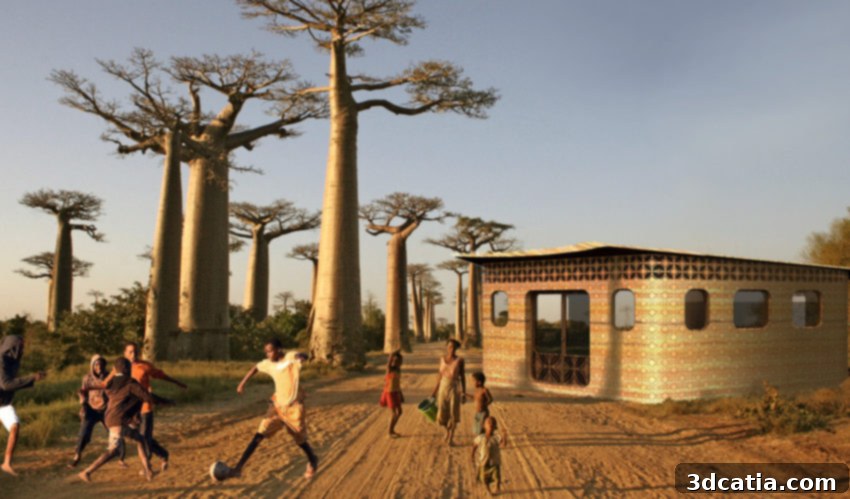
Building Brighter Futures: The Global Impact of the First 3D Printed School in Madagascar
Innovation in education and construction is reaching new heights with the upcoming opening of the world’s first 3D printed school. While the concept of additive manufacturing in construction has seen numerous groundbreaking projects, this particular endeavor stands out for its profound social mission and innovative approach to tackling a critical global challenge. The visionary behind this initiative is Maggie Grout, who, at the remarkable age of fifteen, founded Thinking Huts. Her goal was clear: to leverage technology to enhance access to quality education for millions of underserved children worldwide. Six years after its inception, Thinking Huts, in collaboration with their esteemed partners Hyperion Robotics and Studio Mortazavi, is on the verge of turning this ambitious dream into a tangible reality. The team initially aimed to open the doors to this pioneering institution as early as December 2021, a timeline adjusted by global circumstances but driven by an unwavering commitment to impact, pandemic allowing.
The urgency of Thinking Huts’ mission has only been amplified by recent global events. The ongoing education crisis is a stark reality, with more than 260 million children currently lacking access to education globally. This already alarming figure was tragically exacerbated by the COVID-19 pandemic, which disrupted learning for an unprecedented 1.2 billion children across the planet. In the face of such overwhelming statistics, Thinking Huts proposes a revolutionary solution: utilizing 3D printed schools to democratize access to quality education. This innovative approach offers a promising pathway to bypass traditional construction hurdles that often delay or completely prevent the establishment of necessary educational infrastructure. The choice of Madagascar for the inaugural 3D printed school was meticulously strategic. The country presents a pressing need for robust educational facilities, combined with a relatively stable political environment and an emerging economy ripe for growth. Furthermore, Madagascar boasts significant renewable energy potential, a factor that aligns perfectly with the school’s sustainable design, which thoughtfully incorporates solar panels to ensure energy independence and environmental responsibility.
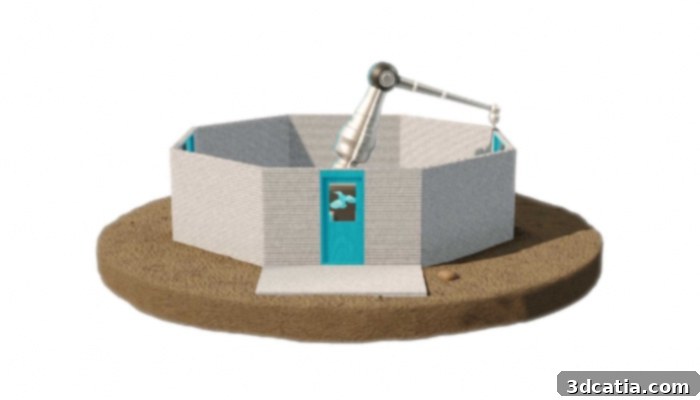
An illustration of a 3D printed school in Madagascar for The Thinking Huts project. (Credit: Hyperion Robotics)
The construction of this pioneering educational facility leverages the cutting-edge technology developed by Hyperion Robotics. The school’s structural walls will be meticulously built using an advanced extrusion-based construction 3D printer. This method involves extruding layers of concrete material, akin to how a conventional desktop 3D printer builds objects layer by layer, but on a much larger scale. This process allows for rapid construction, reduced labor, and precise material usage. While additive manufacturing construction methods have made remarkable strides, they are not yet exhaustive for every component of a building. Consequently, certain elements of the school, such as the roof, doors, and windows, will not be 3D printed. Instead, these essential components will be crafted from locally-sourced materials, a deliberate decision that not only supports the local economy but also reduces the project’s environmental footprint by minimizing transportation needs. This hybrid approach beautifully combines technological innovation with practical, sustainable considerations. Beyond the physical structure, Thinking Huts is committed to ensuring a lasting positive impact on the community. They have forged strong partnerships with local residents, embarking on a comprehensive training program to teach community members how to operate and maintain the 3D printer. This empowerment initiative aims to foster self-sufficiency, enabling the community to independently construct additional schools and other vital infrastructure in the future. Furthermore, the school’s innovative design incorporates a distinctive beehive-like structure, a thoughtful architectural choice that not only adds aesthetic appeal but also pragmatically facilitates easy and efficient expansion of the building as educational needs grow.
Thinking Huts articulates compelling reasons for choosing additive manufacturing as their preferred construction method. They emphasize that “3D printed buildings use less concrete than the average building and shorten construction time, while supporting infrastructure integrity.” This efficiency translates into significant environmental benefits; their specially formulated cement mixture is engineered to withstand diverse environmental pressures typical of Madagascar, all while emitting substantially less CO2 compared to conventional concrete. This commitment to sustainability extends to the entire lifecycle of the building, making it a truly green initiative. Mortazavi, representing Studio Mortazavi, further highlighted the remarkable aesthetic and architectural advantages inherent in additive manufacturing. He noted, “the beauty of 3-D printed walls is that it’s actually easier to make curves rather than right angles. We can have walls that undulate in thickness as well as create relief patterns that with more traditional forms of construction is more challenging and expensive.” This design flexibility not only allows for more visually appealing and inspiring learning environments but also opens up possibilities for culturally resonant architectural features that would be prohibitive with conventional building techniques. The ability to create complex geometries with ease means that these schools can be tailored to local contexts, providing unique and engaging spaces for children to learn and grow. While 3D printing may not be a standalone panacea for all the complexities of the education crisis, its potential to make a monumental and transformative contribution is undeniable. It offers a scalable, efficient, and environmentally conscious method to rapidly deploy essential educational infrastructure where it is needed most, laying the foundation for a brighter future for countless children.
The implementation of this innovative construction technology is poised to address several critical challenges faced by communities in developing regions. Beyond the sheer speed of construction, which can reduce project timelines from months to mere weeks, 3D printing significantly lowers material waste, a common issue in traditional building. This reduction in waste not only aligns with sustainable practices but also helps in managing overall project costs, making the construction of schools more economically viable in resource-constrained areas. The durability and resilience of 3D printed structures are also key factors. Designed to withstand local climatic conditions, including extreme weather patterns, these schools are built to last, providing a safe and stable learning environment for generations to come. This longevity is crucial for communities seeking long-term solutions to their infrastructure needs, moving beyond temporary fixes to establish permanent educational hubs.
The broader vision of Thinking Huts extends far beyond a single school in Madagascar. This project serves as a powerful proof of concept, demonstrating the viability and effectiveness of 3D printed educational facilities on a global scale. The model developed in partnership with Hyperion Robotics and Studio Mortazavi is designed for replication, offering a blueprint for other regions struggling with similar educational infrastructure deficits. By training local communities, the project fosters a sense of ownership and equips residents with valuable skills that can be applied to future development projects. This empowerment strategy ensures that the impact of Thinking Huts is not just about building schools, but about building capabilities within communities, catalyzing sustainable development from the ground up. The integration of renewable energy sources, such as solar panels, further underscores the project’s commitment to creating self-sufficient and environmentally friendly learning spaces, reducing reliance on costly and often inaccessible power grids. This holistic approach, combining technological advancement, community engagement, and environmental stewardship, positions the world’s first 3D printed school as a beacon of hope and a model for future humanitarian and development initiatives worldwide.
To delve deeper into the inspiring work of the Thinking Huts project and its mission to revolutionize global education, we encourage you to visit their official website, accessible HERE. This groundbreaking initiative showcases the immense potential of 3D printing technology as a powerful tool for social good. Do you believe that 3D printing holds the key to helping resolve the persistent education crisis that affects millions of children worldwide? We welcome your thoughts and insights! Share your opinions by leaving a comment below, or engage with us on our vibrant Facebook and Twitter pages. For the very latest updates, news, and developments in the exciting world of 3D printing delivered straight to your inbox, don’t forget to sign up for our free weekly Newsletter here. Join the conversation and be part of the future of innovation!