
Helixx Drives Sustainable Urban Mobility with 3D Printed Electric Vans: A Revolution in Logistics
The landscape of modern manufacturing is being rapidly reshaped by innovation, with the transportation sector emerging as a particularly fertile ground for groundbreaking advancements. Within this dynamic environment, the 3D printing industry, also known as additive manufacturing, is not just evolving but accelerating, finding new impetus and practical applications that were once considered futuristic. A significant stride in this direction comes from Helixx, an innovative UK-based franchise dedicated to pioneering sustainable mobility solutions. In an era profoundly defined by escalating environmental concerns and a global imperative to reduce carbon footprints, the market for electric vehicles (EVs) is experiencing unprecedented growth. This surge is not merely a trend but a fundamental shift towards more eco-conscious living and sustainable infrastructure. Additive manufacturing stands at the forefront of this revolution, offering unparalleled capabilities to design and produce components that are lighter, stronger, and more efficient. By leveraging the precision and flexibility of 3D printing, companies like Helixx are actively developing next-generation electric vehicles, crafting solutions that are inherently more sustainable, cost-effective, and ultimately better for consumers and the planet.
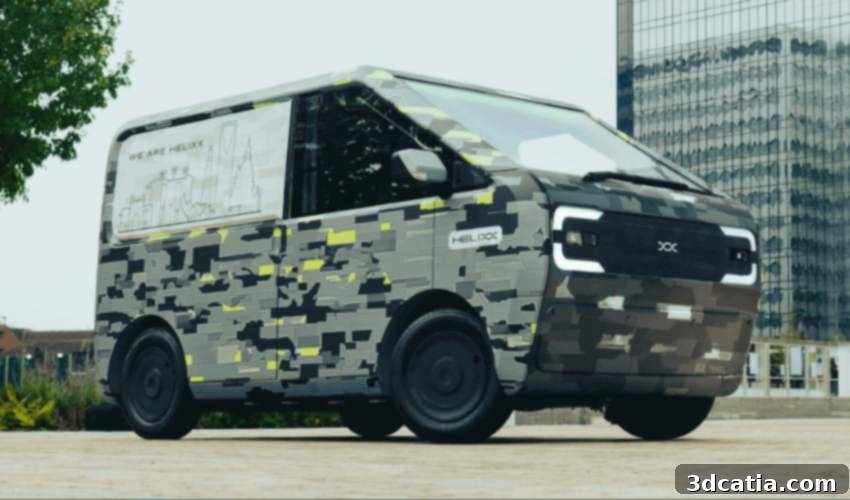
Helixx exemplifies this pioneering spirit with its latest breakthrough: an ingenious all-electric, 3D-printed, single-seat van that features a distinctive central driving position. This innovative vehicle is not merely a product; it represents a strategic solution engineered to address critical challenges in modern urban environments. Its core mission is to actively support and foster sustainable economic development, particularly within the rapidly expanding and often congested emerging megacities across the globe. By offering an efficient, compact, and environmentally friendly transportation option, Helixx aims to empower businesses and communities, enhancing logistical efficiency while simultaneously mitigating the ecological impact of urban transit. This remarkable van, however, marks just the initial chapter in Helixx’s ambitious narrative. The company harbors grander visions for the future of urban mobility, positioning itself as a key driver in transforming how goods and potentially people move within dense metropolitan areas, making cities greener, more functional, and ultimately more livable.
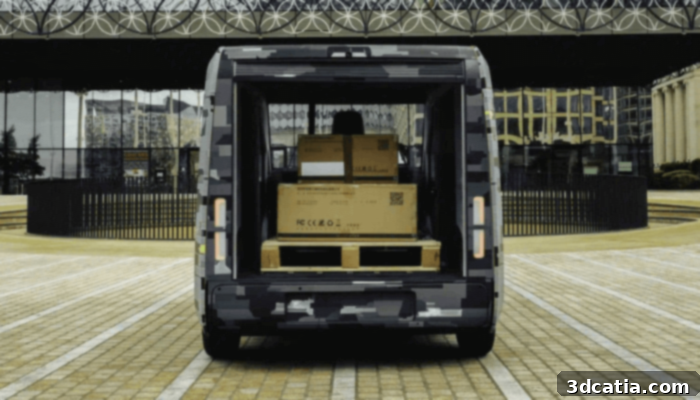
Seamless manufacturing means faster, more efficient vehicle assembly
Unveiling the Helixx Delivery Van: Specifications and Unrivaled Practicality
The engineering philosophy behind the Helixx delivery van perfectly marries compact design with exceptional utility, making it an ideal solution for navigating the intricate, often congested streets of urban centers. Measuring a mere 3.2 meters in length and 1.5 meters in width, this diminutive electric vehicle belies its external dimensions with an astonishing interior volume. Despite its small footprint, it boasts an impressive 2,100-liter cargo capacity, offering significant space for various goods, packages, and supplies. Furthermore, its robust design allows for a substantial 500kg payload at the rear, ensuring it can handle demanding delivery tasks with ease. This combination of compact size and high capacity makes it a game-changer for last-mile delivery services, small businesses, and urban logistics providers seeking to optimize their operations and reduce delivery times in densely populated areas.
Accessibility is another key design triumph for the Helixx van. Facilitated by a spacious rear door, loading and unloading operations are streamlined and efficient. The thoughtfully designed load compartment extends to an impressive 140 cm in length, a critical feature that allows for the perfect insertion of a standard shipping pallet. This capability dramatically enhances logistical flexibility, enabling businesses to transport pre-packed, palletized goods without needing to transfer them to smaller containers, thereby saving time and labor costs. Moreover, the decision to implement a single-seater configuration with a central driving position provides a unique advantage: it inherently frees up additional cargo space at the front of the vehicle. This clever design choice not only maximizes internal volume but also eliminates the need for complex and costly adjustments for left-hand drive markets versus right-hand drive markets, making the Helixx van inherently globally adaptable and simplifying its deployment across diverse international regions. The focus on practicality and universal design ensures the Helixx van is ready to serve a global clientele with minimal modification.
Revolutionizing Production: The Power of 3D Printing in Vehicle Assembly
While the specific technical details concerning the Helixx van’s powertrain are currently being kept confidential, the truly transformative aspect of this innovative vehicle lies in its groundbreaking manufacturing methodology. The van’s entire design philosophy is deeply rooted in the capabilities of advanced 3D printing for both its structural integrity and its aesthetic appeal. This strategic reliance on additive manufacturing significantly streamlines and simplifies the entire assembly process, marking a paradigm shift from traditional automotive production lines. Instead of complex, multi-stage assembly requiring numerous small parts, the Helixx van’s body is intelligently designed from just five major components. These large, precisely fabricated parts fit together seamlessly, akin to advanced interlocking modules. This ingenious approach entirely eliminates the need for conventional welding, a labor-intensive and costly process, which not only accelerates manufacturing but also enhances the structural consistency of the vehicle. The direct result of this additive manufacturing-centric approach is a staggering reduction in production costs, estimated at an impressive 50%. This substantial cost saving is crucial for making sustainable electric vehicles more accessible and affordable on a global scale, particularly in the emerging markets Helixx aims to serve.
The vision extends far beyond current production. Helixx is not just building vehicles; it’s establishing a revolutionary manufacturing ecosystem. The company plans to scale this highly efficient, localized production strategy on a global scale. This will involve the establishment of strategically located ‘Mobility Hubs’ around the world. Within these hubs, 3D printing will serve as the absolute cornerstone of the production process for virtually every vehicle component. This decentralized manufacturing model offers myriad benefits: it drastically reduces logistics costs associated with shipping parts across continents, minimizes lead times, and enables rapid iteration and customization. Localized production also empowers regional economies by creating skilled jobs and fostering technological expertise in the areas where the vehicles will be deployed. By placing manufacturing directly within the communities it serves, Helixx aims to create a truly sustainable, responsive, and resilient supply chain that can adapt quickly to local demands and specific market needs, fundamentally changing the traditional global automotive production model.
Helixx’s Vision for Global Mobility: Local Production and Expanding Markets
Helixx’s bold entry into the emerging market of 3D-printed commercial vehicles is poised to be more than just a new product launch; it represents a potential paradigm shift that could fundamentally revolutionize local vehicle production methods worldwide. This innovative approach promises to unlock unprecedented opportunities and open up entirely new prospects in rapidly developing economies and emerging markets where traditional automotive manufacturing infrastructure might be nascent or cost-prohibitive. By enabling localized, on-demand production, Helixx can bypass many of the challenges associated with global supply chains, fostering economic growth and self-sufficiency in regions previously underserved by conventional vehicle manufacturers. The company’s ambition extends beyond a single van model; it hopes to pave the way for an entire series of innovative commercial vehicles, establishing a comprehensive ecosystem for urban logistics. This vision encompasses rolling out a full range of adaptable commercial vehicles, each designed with specific urban needs in mind.
The planned future lineup is diverse and highly practical, addressing various aspects of urban transportation. It will include a traditional pickup truck, offering versatility for hauling diverse loads; a closed-body cab model featuring comfortable rear seating, suitable for ride-sharing, last-mile passenger transport, or specialized delivery services requiring secure cargo; and an open-body vehicle. This open-body variant is designed to offer unique flexibility, particularly for passengers who prioritize ease of ingress and egress, making it ideal for shuttle services, tourist applications, or communal transport in congested urban areas. Each vehicle will benefit from the same modular, 3D-printed manufacturing approach, ensuring cost-efficiency, rapid production, and adaptability. These future models underscore Helixx’s commitment to providing comprehensive, sustainable mobility solutions that cater to the evolving demands of modern cities and their inhabitants. While these broader ambitions are on the horizon, Helixx is taking a strategic initial step, commencing production in 2024. The company will initially launch a series of 100 vehicles specifically for the UK market, serving as a crucial pilot phase to refine production processes, gather real-world data, and demonstrate the robust capabilities of their 3D-printed electric vans before scaling up internationally. For those eager to delve deeper into Helixx’s pioneering work and explore their full vision, additional information is readily available by clicking HERE.
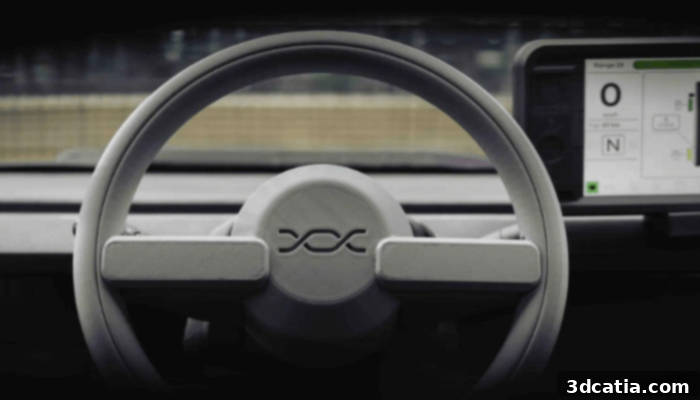
The van’s steering wheel is also made using 3D printing
The Broader Impact of 3D Printing on the Automotive Sector
Helixx’s advancements with its 3D printed electric vans serve as a powerful testament to the transformative potential of additive manufacturing within the entire automotive industry, extending far beyond specific vehicle types. The integration of 3D printing technologies is revolutionizing various facets of car production, from initial design and prototyping to complex parts manufacturing and even bespoke customization. Historically, the automotive sector relied on expensive tooling and lengthy production cycles. Additive manufacturing fundamentally challenges this model by enabling rapid prototyping, allowing designers and engineers to quickly iterate on concepts, test functionalities, and refine aesthetics in a fraction of the time and cost. This agility accelerates innovation and brings advanced designs to market much faster.
Beyond prototyping, 3D printing facilitates the creation of complex geometries and internal lattice structures that are impossible or cost-prohibitive to produce with traditional methods. This capability is instrumental in lightweighting vehicles, a critical factor for enhancing the efficiency and range of electric vehicles. Lighter components translate to less energy consumption, directly contributing to sustainability goals and improving overall vehicle performance. Furthermore, additive manufacturing allows for on-demand production of specialized parts, reducing the need for extensive inventories and potentially extending the lifespan of older vehicles through easily reproducible spare parts. This is particularly relevant for niche models or classic cars, where conventional parts may no longer be manufactured. The ability to customize vehicles and components to individual customer specifications, from interior elements to exterior details, also marks a significant shift, offering unparalleled personalization options. As materials science continues to advance, incorporating high-performance polymers and metals, 3D printing’s role in the automotive sector is only set to expand, promising a future of more efficient, sustainable, and personalized transportation solutions for everyone.
What are your thoughts on Helixx’s pioneering 3D-printed electric delivery vans and their potential to redefine urban logistics? We’d love to hear your perspective and insights! Let us know in a comment below or join the conversation on ourLinkedIn,Facebook, andTwitter pages! Don’t miss out on the latest advancements and news from the additive manufacturing world – remember to sign up for our free weeklyNewsletter here, delivering the most up-to-date 3D printing insights straight to your inbox! You can also find all our comprehensive videos and exclusive content on ourYouTube channel.
*All Photo Credits: Helixx