
The Construction Revolution: SmarTech Forecasts a $40 Billion 3D Printing Market by 2027
The future of construction is rapidly evolving, driven by groundbreaking advancements in additive manufacturing. While the previous week highlighted the immense potential of 3D printing in the dental sector, this week, the spotlight shifts to an even more monumental transformation: the construction industry. According to a comprehensive report from SmarTech Publishing, a leading authority in additive manufacturing market research, the 3D printed construction market is on the cusp of explosive growth, projected to skyrocket from a modest $0.07 billion in 2017 to a staggering $40 billion by 2027. This dramatic increase underscores a fundamental shift in how we conceive, design, and erect structures, promising efficiency, sustainability, and unprecedented design freedom.
The Rise of 3D Printing in Construction: A Market Overview
SmarTech Publishing stands as a beacon for those navigating the complex landscape of additive manufacturing. Renowned for its in-depth analysis, market trends, and meticulous forecasts, the company provides critical insights into key technologies, machinery, materials, and applications across various industries. Their latest report on 3D printing in construction and architecture isn’t just a prediction; it’s a bold declaration of a paradigm shift. The figures presented by SmarTech suggest that additive manufacturing is not merely an alternative but a dominant force poised to redefine the global construction landscape within a decade.
SmarTech Publishing’s Groundbreaking Forecast: From Millions to Billions
The numbers speak volumes about the anticipated impact of 3D printing on the construction industry. From a nascent market generating $70 million in revenue in 2017, the sector is forecast to achieve an astounding $40 billion in annual revenue by 2027. This exponential growth trajectory, representing a nearly 57,000% increase over ten years, reflects a powerful convergence of technological maturity, increasing adoption rates, and a growing demand for more efficient and sustainable building solutions. This isn’t just about faster builds; it’s about a complete reimagining of the construction value chain.
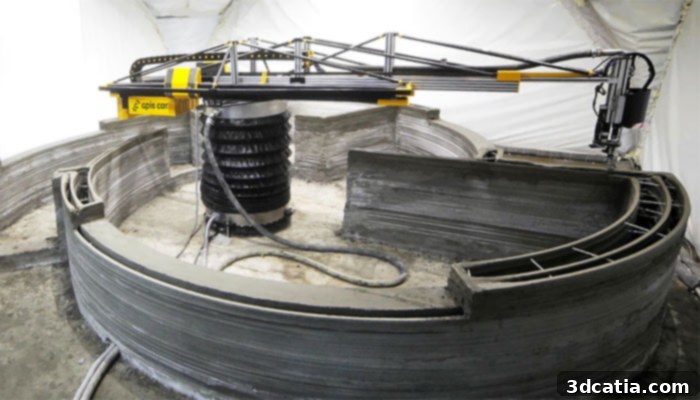
Apis Cor’s huge industrial 3D printers can build houses in just 24 hours, showcasing the rapid potential of construction 3D printing.
Unpacking the Benefits: Why 3D Printing is Revolutionizing Construction
The rapid surge in the 3D printed construction market is not without substantial merit. Compared to conventional building practices, additive manufacturing offers a suite of compelling advantages that address many of the industry’s long-standing challenges. These benefits are attracting a wave of innovative companies, such as Apis Cor, which are pioneering new methods and pushing the boundaries of what’s possible in architectural realization. Understanding these advantages is key to grasping the industry’s monumental growth.
Cost Reduction and Waste Minimization
One of the most immediate and impactful benefits of 3D printing in construction is the significant reduction in both costs and waste. Traditional construction often involves extensive manual labor, complex logistics, and considerable material off-cuts and debris. 3D printing, by contrast, operates on an “add-on” principle, depositing material layer by layer only where it’s needed. This precision minimizes waste, leading to substantial savings on raw materials. Furthermore, automation reduces the need for large on-site labor forces, curbing associated wage and overhead costs. Projects can be completed with a smaller, highly skilled team managing advanced machinery, optimizing resource allocation and project budgets.
Accelerated Construction Timelines
Speed is another transformative aspect of 3D printing in construction. Projects that traditionally take weeks or months can be condensed into days or even hours. The ability of industrial-scale 3D printers, like those developed by Apis Cor, to extrude entire building envelopes in less than 24 hours is a testament to this efficiency. This rapid deployment capability is invaluable for urgent housing needs, disaster relief efforts, or simply accelerating project delivery, allowing for quicker returns on investment and faster development cycles. The automation inherent in the process eliminates many time-consuming traditional steps, from formwork construction to intricate bricklaying.
Enhanced Durability and Structural Integrity
Beyond speed and cost, 3D printed structures can offer superior durability and structural integrity. The layered construction process allows for the creation of intricate internal geometries and optimized wall structures that can enhance thermal performance and load-bearing capabilities. Researchers are constantly developing new concrete and polymer mixtures specifically designed for 3D printing, often resulting in materials with improved strength-to-weight ratios and resistance to environmental stressors. This can lead to buildings that are not only stronger but also more resilient to seismic activity, extreme weather, and general wear and tear over time.
Unprecedented Design Freedom and Architectural Innovation
Perhaps one of the most exciting aspects of construction 3D printing is the unparalleled design freedom it affords architects and engineers. Traditional construction methods are often limited by the constraints of straight lines, right angles, and labor-intensive complex forms. Additive manufacturing, however, excels at creating curvilinear shapes, organic forms, and intricate latticework designs with relative ease. This liberation from conventional limitations allows for breathtaking architectural innovation, enabling the construction of visually stunning, highly customized, and functionally optimized buildings that push the boundaries of creativity and aesthetics.
Sustainability and Environmental Impact
In an era of increasing environmental consciousness, the sustainable aspects of 3D printing in construction are particularly compelling. As mentioned, the process generates significantly less material waste compared to conventional methods. Moreover, the technology facilitates the use of locally sourced or recycled materials, reducing the carbon footprint associated with material transportation and production. The ability to print on-site also minimizes logistics and fuel consumption. Future developments are exploring the integration of bioplastics and other eco-friendly compounds, positioning 3D printed construction at the forefront of green building initiatives.
Diverse Applications of Additive Manufacturing in Building
The versatility of 3D printing technology means its applications in construction are incredibly broad, extending far beyond simply erecting walls. This expansive utility is a primary driver of the market’s anticipated growth, accounting for a staggering 90% of the forecasted revenue from applications and services. From residential dwellings to crucial infrastructure and even artistic endeavors, 3D printing is proving its mettle across a wide spectrum of building needs.
Residential and Commercial Structures
The most prominent application often highlighted is the construction of houses. 3D printing offers a solution for affordable housing crises globally, enabling the rapid deployment of complete homes in underserved areas. Beyond single-family homes, the technology is also being adopted for multi-story residential buildings and commercial properties, where its efficiency and design flexibility can significantly reduce project timelines and costs. Companies are exploring both pre-fabricated 3D printed modules and on-site printing for larger structures, tailoring the approach to specific project requirements.
Infrastructure Development: Bridges, Walls, and Beyond
The scope of 3D printing extends to crucial infrastructure projects. We’ve seen examples of 3D printed bridges that demonstrate the technology’s capability to create robust, complex structures efficiently. It’s also being employed for retaining walls, noise barriers, and various other civil engineering applications. The ability to print custom components on demand, often using recycled or readily available local materials, makes it an attractive option for infrastructure development, especially in remote or challenging environments where traditional logistics are difficult.
Specialized Applications: Art, Heritage, and Disaster Relief
The innovative nature of 3D printing also opens doors to highly specialized applications. In the realm of art, it enables the creation of unique, intricate installations and sculptures that would be impossible or prohibitively expensive to produce with conventional methods. For archeological and heritage conservation, additive manufacturing is a game-changer, facilitating the precise restoration or recreation of damaged and destroyed historical sites, monuments, and artifacts. Furthermore, its speed and efficiency make it an invaluable tool for disaster relief, allowing for the rapid construction of emergency shelters and temporary housing in areas devastated by natural calamities, providing essential support when time is of the essence.
Deconstructing the $40 Billion Forecast: Revenue Streams
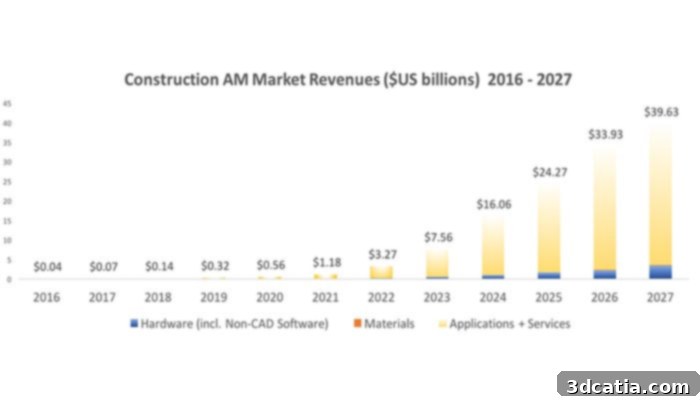
SmarTech Publishing’s report offers a detailed breakdown of the projected $40 billion in total revenues by 2027, illustrating how different segments of the 3D printed construction market will contribute to this colossal sum. The forecast highlights key areas of investment and growth, painting a clear picture of where value will be generated in this burgeoning industry.
By 2027, the revenue distribution is expected to be: $150 million from materials, $3.5 billion from machinery, and a dominant $36 billion from applications and services. This stark contrast in segment contributions reveals much about the maturity and operational dynamics of the market.
Materials: The Foundation of Growth
While $150 million might seem modest compared to other segments, the materials sector is foundational. It encompasses specialized concrete mixes, polymers, geopolymers, and other innovative compounds optimized for 3D printing. The development of these materials is crucial for the performance, durability, and sustainability of printed structures. Investment in R&D for new, cost-effective, and environmentally friendly construction materials will continue to drive this segment, ensuring that the additive manufacturing process can adapt to diverse structural requirements and environmental conditions.
Machinery: Powering the Revolution
The $3.5 billion projected for machinery reflects the significant investment in the large-scale industrial 3D printers that make this construction revolution possible. This segment includes the sale, maintenance, and upgrading of gantry systems, robotic arms, mobile printing units, and other automated construction equipment. As the technology matures and adoption increases, the demand for more advanced, reliable, and cost-efficient printing hardware will continue to grow, making machinery a critical enabler of the wider market’s expansion.
Applications and Services: The Largest Segment
The overwhelming majority of the forecasted revenue – $36 billion – is attributed to applications and services. This segment represents the actual execution of 3D printed construction projects, encompassing everything from initial design and engineering (digital blueprints for printing) to the printing process itself, post-processing, assembly, and ongoing maintenance. This figure underscores that the true value in the market lies in the direct delivery of constructed outputs and the comprehensive ecosystem of support services that facilitate these projects. It highlights the transition from a technology-centric focus to a solutions-oriented market, where the ability to deliver complete, functional, and innovative structures is paramount.
Technological Advancements Driving the Market
The projected growth is fueled not only by the inherent benefits of 3D printing but also by continuous advancements in the technology itself. Innovation in materials science, robotics, and software is constantly expanding the capabilities and efficiency of construction additive manufacturing.
Materials Innovation
The evolution of printable materials is critical. Researchers are developing concrete mixtures with improved flowability, faster setting times, and enhanced structural properties. Beyond traditional cement-based materials, there’s significant interest in geopolymers, which offer a more sustainable alternative with lower carbon footprints. The use of recycled aggregates and plastic waste in printable formulations is also gaining traction, pushing the boundaries of circular economy principles within construction. These material breakthroughs are essential for meeting diverse building codes, aesthetic preferences, and performance requirements.
Printer Systems and Automation
The hardware itself is becoming more sophisticated. Early systems were often large, cumbersome gantry printers, but now, mobile robotic arms and hybrid systems offer greater flexibility and reach. Automation extends beyond just the printing head; integrated systems for material mixing, pumping, and even post-processing are becoming standard, further enhancing efficiency and reducing the need for manual intervention. The development of AI and machine learning in controlling these systems promises even greater precision, speed, and adaptive printing capabilities, allowing for on-the-fly adjustments to environmental conditions or design changes.
Challenges and the Road Ahead
Despite the optimistic projections, the 3D printed construction market still faces several challenges. Regulatory hurdles, including building codes and certifications, need to catch up with the rapid technological advancements. Scalability remains an issue for truly massive projects, and the initial investment in advanced printing equipment can be substantial for new entrants. Furthermore, a skilled workforce capable of operating and maintaining these sophisticated machines, as well as designing for additive construction, is still developing. Public perception and acceptance of 3D printed buildings also play a role in widespread adoption. Addressing these challenges through continued research, policy adjustments, and education will be crucial for realizing the full $40 billion potential.
Conclusion: Building the Future, One Layer at a Time
SmarTech Publishing’s report unequivocally highlights that the future of the construction industry is undergoing a profound transformation, with 3D printing at its core. The anticipated leap from $0.07 billion to $40 billion within a decade is not merely a financial forecast; it’s a testament to the technology’s capacity to deliver sustainable, cost-effective, and aesthetically innovative building solutions. As the benefits become more widely recognized and technological barriers continue to fall, 3D printed construction is set to revolutionize not just how we build, but what we can build, ushering in an era of unprecedented architectural possibilities and urban development. The journey ahead will undoubtedly be dynamic, marked by continuous innovation, strategic investments, and a growing global acceptance of this groundbreaking construction methodology.
For those interested in delving deeper into the specifics of this transformative market, the full report from SmarTech Publishing is available here.
What are your thoughts on the future of 3D printing in construction? Do you believe these ambitious forecasts will come to fruition? Share your opinions in a comment below or join the conversation on our Facebook and Twitter pages! Don’t forget to sign up for our free weekly Newsletter, to receive all the latest news in 3D printing delivered straight to your inbox and stay ahead of the curve!