
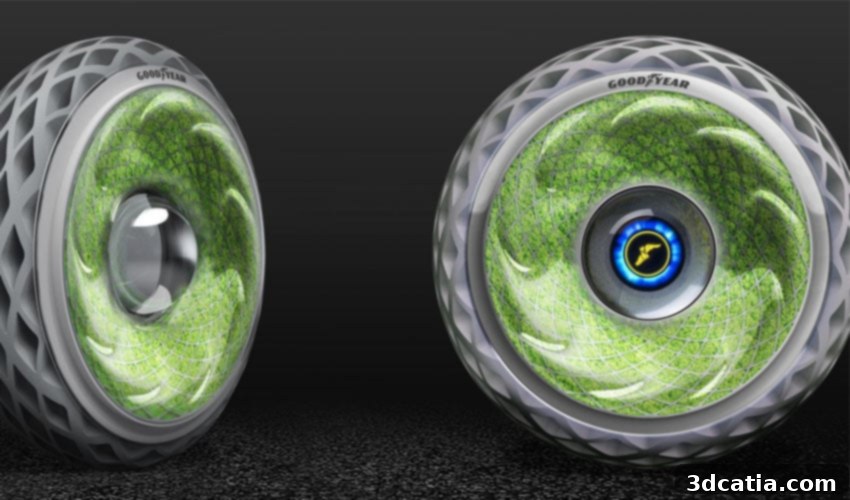
Goodyear Oxygene: The Revolutionary 3D Printed, Air-Purifying Tire of the Future
In an era where urban sustainability and environmental health are paramount concerns, the automotive industry is continually seeking innovative solutions. American tire manufacturing giant Goodyear has stepped forward with a visionary response: the Oxygene concept tire. Unveiled as a profound leap in tire technology, Oxygene masterfully integrates cutting-edge advancements in 3D printing, artificial intelligence, and organic life to redefine what a tire can be. This project isn’t merely about enhancing vehicle performance; it’s a bold statement on sustainable mobility, aiming to actively improve air quality and contribute to greener, smarter cities.
Goodyear, with over a century of pioneering experience in tire development, envisioned a product that transcends its traditional function. The Oxygene tire is designed to be an active participant in improving the environment. At its heart lies a revolutionary bio-integration strategy: living moss is embedded within the tire’s sidewall structure. This ingenious feature allows the tire to absorb harmful carbon dioxide (CO2) from the atmosphere through photosynthesis, while simultaneously releasing clean oxygen. This transformation of a passive component into an active environmental agent marks a significant paradigm shift in the pursuit of eco-friendly transportation solutions.
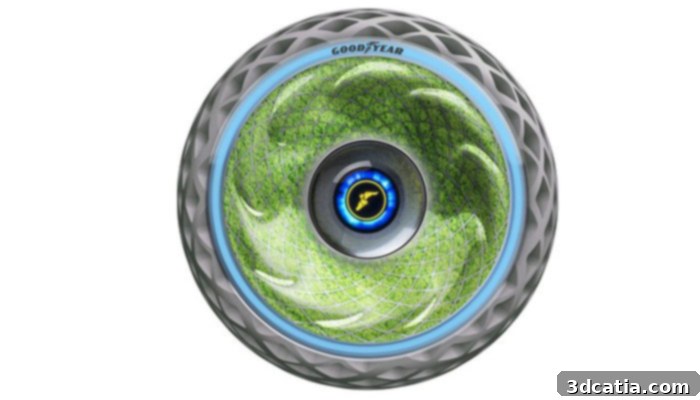
Goodyear Oxygene: Fusing Nature and Advanced Manufacturing for Cleaner Air
The Oxygene concept is a testament to biomimicry, drawing inspiration from nature’s most efficient processes. By harnessing the power of living moss, the tire becomes a mobile air purifier. As vehicles traverse urban landscapes, these tires would actively engage in photosynthesis, converting atmospheric CO2 – a major greenhouse gas and urban pollutant – into vital oxygen. Goodyear’s estimates highlight the potential impact: if approximately 2.5 million vehicles in a densely populated city like Paris were equipped with Oxygene tires, they could collectively absorb more than 4,000 tons of carbon dioxide and emit an impressive 3,000 tons of oxygen annually. Such a contribution would be monumental in mitigating air pollution and enhancing urban dwellers’ respiratory health.
Beyond its biological innovation, the Oxygene tire incorporates advanced manufacturing techniques, most notably 3D printing. The tire’s intricate, open structure, made possible by additive manufacturing, is not just for aesthetics; it plays a crucial functional role. The unique tread design is engineered to absorb moisture from the road, enhancing grip on wet surfaces. This absorbed water is then intelligently channeled to nourish the living moss within the tire, ensuring its optimal growth and photosynthetic activity. This closed-loop system ensures that the moss thrives, maximizing its environmental benefits while simultaneously improving the tire’s performance and safety.
“Oxygene aims to stimulate our thinking and fuel the debate around smart, safe and sustainable mobility. By contributing to cleaner air production, the tire could help improve the quality of life and health of city dwellers. With more than two-thirds of the world’s population expected in cities by 2050, the demand for urban transportation networks will increase dramatically. Smarter and greener infrastructure and transport will be essential to meet the most pressing challenges of urban mobility and development.” – Chris Delaney, president of Goodyear Europe, Middle East and Africa.
Chris Delaney’s statement perfectly encapsulates the broader vision behind Oxygene. It’s a conceptual answer to the imminent challenges of urban expansion and climate change. As global populations continue to urbanize, the strain on city infrastructures and air quality will intensify. Goodyear’s Oxygene tire proposes a symbiotic relationship between technology, nature, and urban living, offering a proactive solution to improve public health and create more livable, breathable cities. This forward-thinking approach aligns with the growing global demand for smart, safe, and inherently sustainable transportation networks.
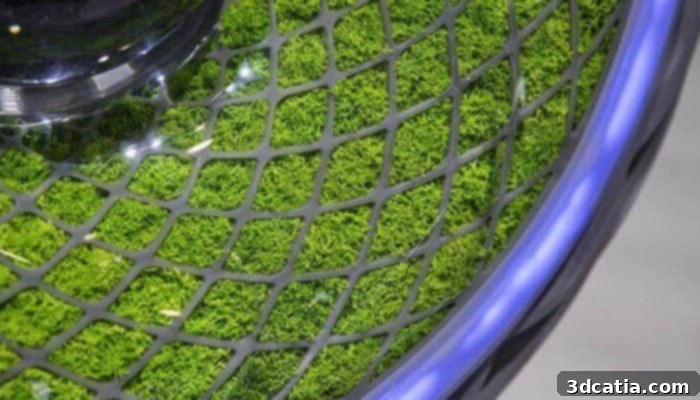
The Integral Role of 3D Printing in Oxygene’s Design and Sustainability
The integration of 3D printing technology is fundamental to Goodyear’s ambition of creating the most environmentally friendly tire possible. Traditionally, tire manufacturing has been a resource-intensive process. With Oxygene, Goodyear takes a significant step towards a circular economy by utilizing recycled tires as its primary raw material. These end-of-life tires are processed and converted into a specialized powder, which then becomes the feedstock for advanced 3D printing processes, such as Selective Laser Sintering (SLS).
Selective Laser Sintering is an additive manufacturing technique that uses a high-powered laser to selectively fuse small particles of polymer powder into a solid structure based on a 3D model. This method is particularly well-suited for creating the complex, porous, and highly customized structures required for the Oxygene tire. Goodyear emphasizes that 3D printing offers numerous advantages in this context. Firstly, it allows for a significant reduction in the tire’s overall weight. Lighter tires contribute directly to improved fuel efficiency and reduced emissions from vehicles. Secondly, the precise control offered by 3D printing enables the creation of tire structures with superior shock-absorbing properties, leading to a more comfortable ride and enhanced durability. Furthermore, this technology facilitates the creation of the intricate internal channels necessary to nourish the living moss and manage moisture effectively, features that would be impossible or impractical with conventional manufacturing methods. This approach not only innovates the product but also the production process itself, moving towards a more sustainable and waste-efficient manufacturing paradigm.
Comparing Visions: Goodyear Oxygene vs. Michelin’s Future Tire Concepts
The pursuit of the next-generation tire is a shared goal among industry leaders. Goodyear’s Oxygene project finds interesting parallels and distinctions with concepts like Michelin’s recent prototype for 3D printed tires of the future. Michelin’s vision also explored a puncture-proof, 3D printed tire that notably wasn’t filled with air. This concept aimed for greater ecological adaptability to varying driving styles and road conditions, emphasizing durability and reduced waste. Both companies are clearly investing heavily in additive manufacturing as a key enabler for future tire development.
While both Goodyear and Michelin leverage 3D printing for structural innovation, their core differentiating elements are distinct. Michelin focused on airless, robust, and adaptive structures, largely through advanced material design and mechanical geometries. Goodyear, on the other hand, pushes the boundary further by introducing a living biological component – the moss – and integrating artificial intelligence for active functionalities. This makes Oxygene a unique proposition, not just as a durable and adaptable tire, but as an active participant in environmental remediation. Both concepts, however, underscore the transformative potential of 3D printing in moving beyond traditional tire designs, offering unprecedented possibilities for customization, sustainability, and enhanced performance.
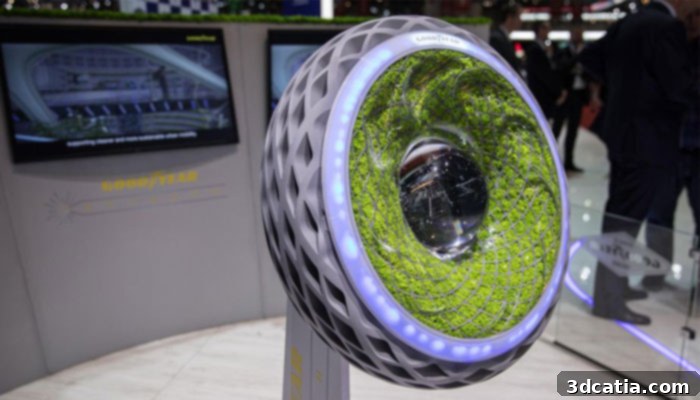
The Intelligence Behind the Green: Artificial Intelligence Integration
The Oxygene tire is not only biologically active and structurally innovative; it’s also remarkably intelligent, powered by advanced artificial intelligence. The energy required to operate its sophisticated sensors and integrated lighting system is generated internally, harnessed directly from the photosynthesis process carried out by the living moss. This self-sustaining energy model eliminates the need for external power sources, further enhancing the tire’s environmental credentials and operational efficiency. The AI system likely optimizes the photosynthesis process, monitors the health of the moss, and manages energy distribution to various components of the tire.
A key safety feature enabled by this AI-powered energy system is the presence of dynamic lights embedded within the tire’s sidewall. These lights are designed to change color, providing crucial real-time information to both the driver and pedestrians. For instance, they can act as turn signals, indicating the vehicle’s intended direction. They could also potentially signal braking, communicate hazard warnings, or even display information about the tire’s health and wear levels. This level of active communication transforms the tire into an integral part of the vehicle’s safety and communication systems, enhancing road safety in increasingly dense urban environments. The AI capabilities extend beyond mere signaling; they open doors for advanced vehicle-to-infrastructure (V2I) communication, where tires could potentially share data about road conditions or air quality, contributing to a more interconnected and responsive smart city ecosystem.
The Goodyear Oxygene concept represents a holistic approach to future mobility, addressing environmental challenges, safety concerns, and urban planning needs simultaneously. It’s a compelling vision of how biomimicry, additive manufacturing, and artificial intelligence can converge to create products that are not only performant but also contribute positively to the planet and its inhabitants.
For more detailed information on this groundbreaking concept, you can visit the official Goodyear website or watch the insightful video below:
What are your thoughts on the future of automation and sustainable innovation in 3D printing, especially as applied to mobility? We encourage you to share your perspectives in a comment below or join the discussion on our Facebook and Twitter pages! Don’t forget to sign up for our free weekly Newsletter to receive all the latest news and updates in the world of 3D printing directly in your inbox!