
Unlocking Opportunities: A Deep Dive into the Evolving Additive Manufacturing Job Market in 2021 and Beyond
The additive manufacturing (AM) sector is experiencing unprecedented growth, leading to a dynamic and expanding job market. As companies worldwide increasingly adopt 3D printing technologies to drive innovation, optimize production, and enhance product capabilities, the demand for skilled professionals is soaring. This surge in adoption is naturally accompanied by more frequent and intensified recruitment policies, as organizations strive to bolster their teams with the expertise needed to push the boundaries of this transformative technology. However, finding the right talent remains a significant challenge. The specialized knowledge and unique skill sets required in additive manufacturing are often not yet widely prevalent among job-seekers, creating a noticeable talent gap. Many companies consistently identify this lack of specific 3D printing knowledge as a substantial barrier to the wider and more effective integration of AM.
Despite these recruitment hurdles, the additive manufacturing sector is continuously on the lookout for diverse new profiles, a trend powerfully evidenced by our Job Board. In 2021 alone, more than 430 job offers were published across our various international platforms (excluding Italian-specific sites), marking an impressive 30% increase compared to 2020. This substantial growth underscores the industry’s vibrant expansion and its persistent need for fresh talent. To gain a clearer understanding of the prevailing dynamics within the additive manufacturing job market, and to identify its principal trends, we meticulously analyzed these job offerings. Our findings clearly indicate that companies dedicated to 3D printing – including equipment manufacturers, material suppliers, software developers, service bureaus, and distributors – are making significant investments, particularly in highly technical roles. Concurrently, major industrial groups are also actively integrating additive manufacturing into their core operations, demonstrating that this technology is no longer a niche application but a fundamental component of modern manufacturing processes. Let’s delve deeper into the key recruitment opportunities that defined the additive manufacturing landscape in 2021!
Long-Term Contracts Drive Industry Stability and Growth
It comes as no surprise that the predominant hiring trend in additive manufacturing leans heavily towards long-term contracts. Companies are strategically focusing on the future, seeking to build stable, experienced teams capable of sustaining innovation and growth in the long run. Our 3Dnatives Job Board alone reflected this sentiment, with nearly 350 job openings specifically designated as long-term positions. This strong preference for permanent roles is a clear indicator of confidence among 3D printing stakeholders in the technology’s enduring potential and its continuous market expansion. When examining the broader market, these observations are consistently reinforced. The year 2021 saw numerous companies, such as Desktop Metal with its series of strategic acquisitions, embarking on or continuing significant expansion initiatives, further solidifying the need for a committed and stable workforce.
Beyond permanent positions, internships and work-study programs collectively accounted for 19% of all job searches. This significant percentage serves as compelling evidence of a burgeoning educational landscape, with an increasing number of specialized training courses dedicated to 3D printing emerging across the globe. These programs are crucial for nurturing the next generation of AM professionals and bridging the existing skill gap. Marine Coré Baillais, the visionary founder of Pâtisserie Numérique, shed light on this crucial phenomenon during a recent discussion. She observed, “There are exceptionally strong training programs in 3D printing available in France, which represents a significant advantage for French companies. Many students have gained invaluable experience in metal additive manufacturing, fostering a culture of rigor and precision. Perhaps it is also incumbent upon us, as employers within the sector, to actively create and promote even more opportunities for these talented individuals.” This sentiment highlights the shared responsibility of educational institutions and industry leaders in cultivating a robust talent pipeline for additive manufacturing. Investing in these early-career opportunities not only provides practical experience for students but also allows companies to scout and develop future experts from the ground up, ensuring a sustainable influx of qualified professionals.
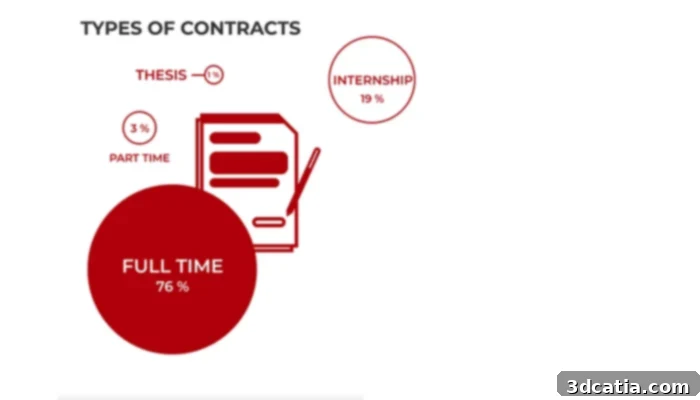
Photo Credits: 3Dnatives
The Indispensable Role of Technical Expertise in Additive Manufacturing
Consistently, it is the technical profiles that remain most sought after by companies operating within the additive manufacturing sector. Specialists such as engineers, 3D technicians, and design professionals are at the forefront of demand, as industry players actively seek individuals with deep technological expertise. These roles are critical for every stage of the AM process, from initial design and material selection to process optimization, quality control, and post-processing. Markus Seibold, Vice President of Additive Manufacturing at Siemens Energy and Materials Solutions, emphasized this need, stating, “To effectively support the scale-up of our volume production, we are actively looking for industry experts who not only possess a profound understanding of the specific intricacies of additive manufacturing but also bring valuable experience in complementary areas such as Lean principles and process automation.” This statement highlights the interdisciplinary nature of modern AM roles, where technical mastery must be combined with broader operational efficiency skills.
This trend extends beyond large corporations to smaller, agile companies. Marine Coré Baillais further elaborated on this, explaining, “At Pâtisserie Numérique, we are actively seeking diverse talent to work on the design and industrialization of our innovative new food 3D printer. This project requires a wide array of skills, including expertise in mechanics, electronics, biochemistry, automation, human-machine interface (HMI), and user experience (UX). The subjects are incredibly varied and call for a truly multidisciplinary approach.” This illustrates how even highly specialized niches within AM require a broad spectrum of technical competencies to bring cutting-edge products to market. These technical roles are crucial for innovation, problem-solving, and ensuring the practical application of 3D printing technology across various industries.
As the additive manufacturing market continues to mature and generate increasing value, the demand for sales-oriented positions has also seen a significant surge in popularity. Roles such as Business Developer, Sales Manager, and Salesperson are now highly prized by industry players. These professionals are essential for translating complex technical capabilities into tangible business solutions, identifying new market opportunities, and fostering client relationships. In 2021, sales-related job openings represented a substantial 18.31% of all offers published on the 3Dnatives Job Board, underscoring their critical contribution to the industry’s commercial success and expansion. The need for individuals who can effectively communicate the benefits and value proposition of AM technologies to a diverse customer base is more important than ever, making sales expertise a vital component of a well-rounded AM team.
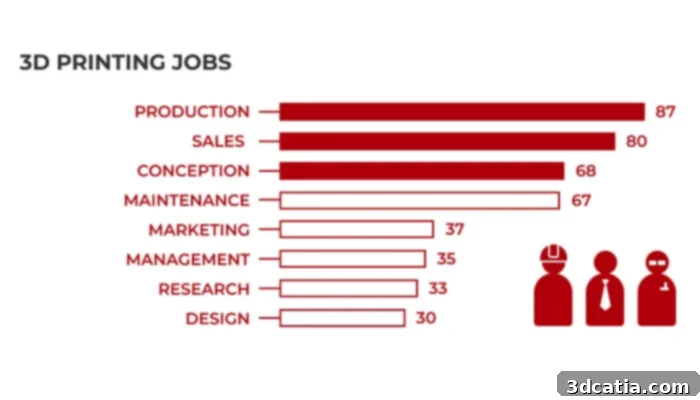
Photo Credits: 3Dnatives
Widespread Adoption and the Industry Sectors Driving Demand
As previously highlighted, the additive manufacturing industry is experiencing a period of robust and rapid expansion. This accelerated growth is fueled by a relentless pace of innovation, with new materials, processes, and applications continuously emerging. Crucially, the tangible benefits offered by 3D printing technology are becoming increasingly evident and accessible to a wider range of businesses. These advantages include significantly lower production costs for complex parts, substantial reductions in part weight (critical for aerospace and automotive applications), unparalleled design flexibility, rapid prototyping capabilities, and enhanced supply chain resilience. Consequently, a growing number of companies across diverse sectors are actively adopting AM into their operations.
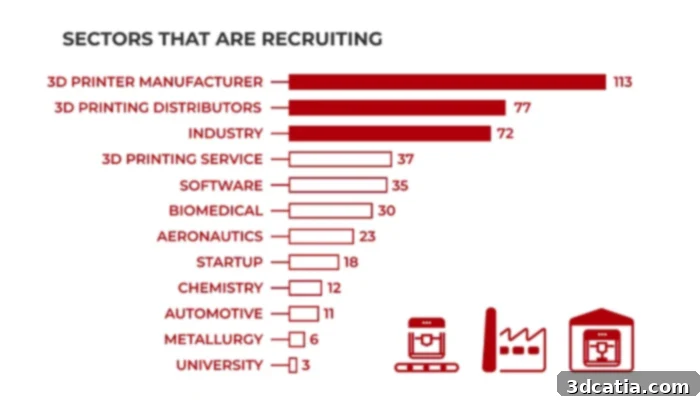
Logically, with 113 job postings in 2021, 3D machine manufacturers are leading the charge in recruitment. These companies are at the very heart of the industry, developing the foundational hardware that enables AM. Their need for talent spans mechanical, electrical, and software engineering, as well as materials science and customer support. Sara Romero, HR Director of the renowned Spanish manufacturer BCN3D, unequivocally confirms this trend: “3D printing is experiencing a global boom; it is undergoing strong growth and the market is consolidating at an incredible pace. There are an increasing number of profiles in demand, and we are witnessing the gap between talent supply and demand in the 3D printing sector begin to narrow. A few years ago, there were fewer professionals specializing in our technology to fill the positions on offer, but that gap is considerably narrowing, and that’s genuinely good news for the industry’s sustainable development.” Behind machine manufacturers, traditional industrial sectors that integrate AM into their production lines and distributors who facilitate the widespread adoption of 3D printing products and services occupy the 2nd and 3rd positions in terms of job offerings, respectively.
Furthermore, when integrating 3D printing into any production process, the critical role of 3D software cannot be overstated. From CAD (Computer-Aided Design) and CAM (Computer-Aided Manufacturing) to simulation, topology optimization, and process management, software solutions are increasingly efficient and optimized, proving to be an indispensable part of the additive manufacturing workflow. This necessity explains why companies specializing in 3D software development are also experiencing significant growth and actively expanding their teams. Moreover, long-time pioneers and users of AM technology, such as the automotive and aerospace industries, continue to be significant recruiters. Together, these two sectors accounted for a respectable 7.78% of all job offerings, leveraging AM for everything from lightweight components and complex geometries to rapid prototyping and customized tooling, further demonstrating the technology’s versatile and transformative impact across high-value manufacturing.
SMEs and Large Corporations: Diverse Contributions to the Market
While one might intuitively assume that large multinational corporations dominate recruitment within the additive manufacturing job market, the reality reveals a more balanced and dynamic landscape where Small and Medium-sized Enterprises (SMEs) are exceptionally active and play a pivotal role. With an impressive 33% of all job offers, companies employing between 11 and 50 individuals emerged as the most prolific recruiters in the industry in 2021. This strong showing by SMEs underscores their agility, specialization, and capacity for innovation, often focusing on niche applications or specific material developments that drive the broader industry forward. They frequently offer environments where employees can take on broader responsibilities and witness the direct impact of their work.
However, it would be a misjudgment to conclude that large companies are inactive. Quite the contrary, organizations with 51 or more employees are a very close second in recruitment volume, accounting for 31% of the total offers. These larger entities often possess substantial R&D budgets, sophisticated infrastructure, and the capacity for high-volume production, contributing significantly to the industrialization and mainstream adoption of AM. Their demand for talent typically focuses on scaling operations, integrating AM into existing complex workflows, and pioneering new applications. Finally, very large groups, those with more than 5,000 employees, also actively seek new talent, representing a significant 20% of the offerings. These global players typically look for highly specialized experts who can navigate complex organizational structures and contribute to large-scale, strategic additive manufacturing initiatives.
BCN3D perfectly encapsulates this demand for diverse expertise, concluding, “We are constantly looking for very diverse profiles for our high-technology endeavors. As a very complete company, we not only design and manufacture 3D printers but also develop our own software solutions. This requires highly qualified professionals across various skill sets, with robust professional and academic experience to drive innovation across all facets of our operations.” This statement highlights that regardless of company size, the additive manufacturing sector thrives on a broad spectrum of skills, from hands-on technical abilities to advanced software development, reflecting the technology’s multifaceted nature and its profound impact across the entire product lifecycle. The sustained growth across all company sizes indicates a healthy and expanding ecosystem, offering varied career paths for professionals at different stages of their careers.
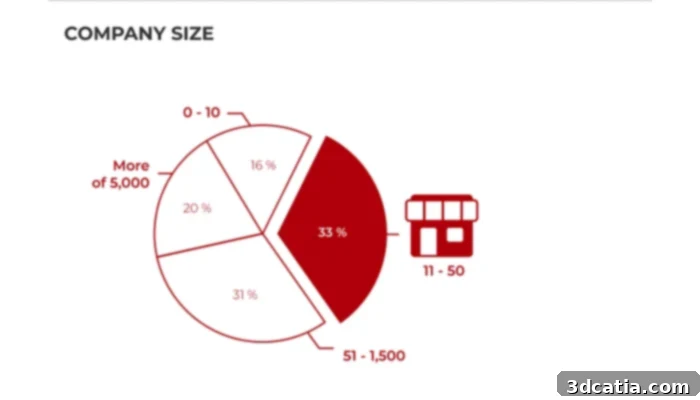
Photo Credits: 3Dnatives
The additive manufacturing job market in 2021 clearly demonstrated robust growth, a strong demand for long-term technical expertise, and an increasing diversification of roles across companies of all sizes. As the industry continues to evolve at a rapid pace, it promises even more exciting opportunities for skilled professionals and new avenues for innovation.
What are your thoughts on the 3D printing job market trends observed in 2021 and its implications for the future? We invite you to share your perspectives in a comment below or engage with us on ourLinkedin, Facebook, and Twitter pages! Don’t miss out on the latest advancements and sign up for our free weekly Newsletter here, delivering the freshest 3D printing news straight to your inbox! You can also find all our insightful videos and interviews on our YouTube channel.
For a visual summary of the 3D Printing Job Market in 2021, find the detailed infographic HERE.