

The Transformative Power of Additive Manufacturing: Navigating Post-COVID-19 Supply Chains and Economic Resilience
The advent of the COVID-19 pandemic sent shockwaves across the globe, fundamentally altering economic landscapes and redefining established work paradigms. It forced a critical re-evaluation of global value chains, international trade practices, production methodologies, and communication strategies. Within this tumultuous environment, the additive manufacturing (AM) sector emerged as a remarkable outlier. Far from faltering, the industry demonstrated extraordinary agility, rapidly adapting its capabilities to provide critical medical solutions during the unprecedented health emergency. This swift response highlighted the intrinsic benefits of additive manufacturing technologies, which inherently facilitate local production, enable faster design iterations, and drastically reduce manufacturing lead times. These attributes proved to be indispensable advantages when confronted with a crisis of such magnitude. Given the sector’s proven effectiveness during the pandemic, a crucial question arises: What role will additive manufacturing play in the “new normal” as the world gradually recovers? Will it sustain its newfound prominence within our manufacturing ecosystems? Has the global crisis permanently shifted mindsets regarding its potential? What significant challenges still lie ahead, and what profound lessons can be drawn from this experience?
To delve deeper into these pivotal questions and explore the evolving landscape of additive manufacturing, we engaged with three leading experts from the industry. These thought leaders offered invaluable insights into what the pandemic revealed about current manufacturing systems and shared their informed visions for the future trajectory of additive manufacturing. Our first expert, Sumeet Jain, serves as the Managing Director of 3D Printing Solutions by Arkema. This dedicated business unit of the renowned French chemical group Arkema specializes in additive manufacturing, having developed a comprehensive portfolio of high-performance polymers tailored for various 3D printing processes, including extrusion, powder bed sintering, and photopolymerization. Our second esteemed expert is Mark Seaton, the EVP of Global Sales at Link3D. Link3D is a cutting-edge software platform designed to empower companies by streamlining and optimizing their complex additive manufacturing workflows, from design to production. Finally, we sought the perspective of Thierry Rayna, a distinguished Professor of Innovation Management at Ecole Polytechnique. Professor Rayna’s research primarily focuses on the profound impact of digital technologies on innovation paradigms and their transformative effects on contemporary business models and strategies.
-

- Sumeet Jain, Managing Director of 3D Printing Solutions by Arkema

-
- Mark Seaton, EVP of Global Sales at Link3D

-
- Thierry Rayna, Professor of Innovation Management at Ecole Polytechnique

Additive Manufacturing vs. COVID-19: A Critical Response to Global Disruption
The initial months of the COVID-19 pandemic presented unprecedented challenges across nearly every sector, causing widespread disruption and uncertainty. Yet, amidst this crisis, a remarkable demonstration of global solidarity emerged, powerfully exemplified by the additive manufacturing market. The rapid and unified mobilization of players across the entire AM ecosystem was truly inspiring. Companies, researchers, and individuals alike pivoted their operations to produce vital personal protective equipment (PPE), crucial ventilator components, and a myriad of other innovative medical solutions. Their collective goal was clear: to protect frontline workers, safeguard communities, and stem the tide of the spreading virus. Sumeet Jain of Arkema vividly recalls this period, stating, “As our global supply chain of critical equipment got strained, it was immensely gratifying to see how everyone along the value chain came to the rescue using 3D printing technologies. Arkema helped the community in a variety of ways – Arkema manufactured materials were used by partners in manufacturing of nasal swabs, face shields and ventilator/respirator parts.” This rapid response underscored additive manufacturing’s unique capability to address the critical gaps left by fractured global supply channels, offering a viable and immediate alternative.
Mark Seaton of Link3D echoes this sentiment, further emphasizing the pivotal role of additive manufacturing. He observed, “As Covid-19 has disrupted supply chains on a global scale, it’s been amazing to see how additive manufacturing has stepped up. It is designed to help organizations optimize supply chains and empower distributed manufacturing.” Indeed, with traditional supplier networks crippled by lockdowns and international trade restrictions, many organizations found themselves without access to essential components and finished goods. In this context, 3D printing emerged as a vital lifeline, offering an agile, decentralized production method that dramatically reduced overall lead times. Sumeet Jain further corroborates this, explaining, “The COVID crisis was an opportunity for 3D printing technology to demonstrate its value proposition around digital manufacturing and its ability to meet on-demand production needs. 3D printing companies across the ecosystem broke traditional boundaries and partnered openly to fast-track qualifications for PPE and testing applications. 3D printing’s ability to iterate hundreds of designs in short term was a key differentiation to develop viable solutions meeting unforeseen demand.” This flexibility allowed for rapid design adaptation and localized production, minimizing dependency on vulnerable global logistics.
Professor Thierry Rayna highlighted another critical aspect of 3D printing’s contribution: its capacity for “repurposing.” He noted that rather than solely creating entirely new designs, the technology excelLed at adapting existing objects for novel medical applications. A prime example was the transformation of readily available snorkeling masks, like those from Decathlon, into urgently needed respiratory devices. “What is most striking is the fact that 3D printing has been able to adapt things that already existed. But for me, the most interesting thing is what will happen next. Will the technology be as useful and present when world trade picks up again, assuming it goes back to the way it was before?” This insight raises a pertinent question about the long-term impact and sustained relevance of AM beyond the immediate crisis, particularly as global trade patterns potentially normalize.
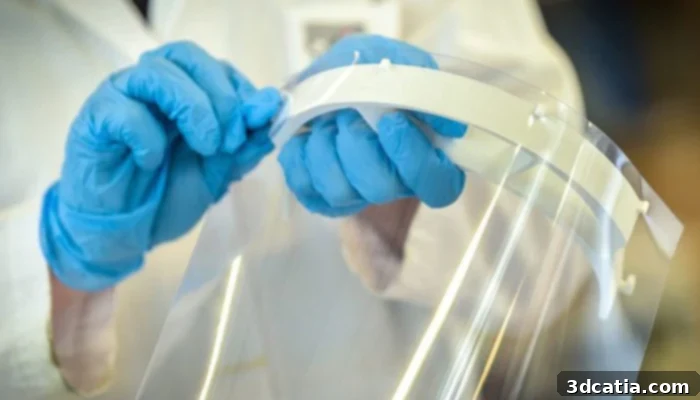
Additive manufacturing played a crucial role in producing essential medical supplies like face shields during the pandemic.
Beyond the Crisis: Additive Manufacturing’s Enduring Role in “Post-COVID-19” Manufacturing
While additive manufacturing undeniably showcased its immense potential during the peak of the pandemic, it also starkly exposed the inherent fragilities and limitations of our traditional, globally dispersed supply chains. The critical question now shifts to its enduring role in the post-crisis era. Despite its proven capabilities, AM largely remains a niche market when viewed against the broader landscape of global manufacturing. How can the industry ensure that it transitions from a crisis-response tool to an indispensable component of mainstream industrial operations? Sumeet Jain points to several fundamental challenges that must be addressed for widespread global adoption. He emphasizes, “The major challenge that still needs to be overcome is standardization and reliability of products manufactured using 3D printing.” For additive manufacturing to achieve true industrial scale, there is an urgent need for more robust certifications, stringent industry standards, and consistent quality control measures. These are essential to meet the exacting requirements of manufacturers and facilitate a seamless transition towards mass production dynamics. Currently, issues such as printing errors, and the often complex and time-consuming preparation and post-processing stages, remain significant hurdles. However, the market is actively responding to these challenges, with a growing trend towards developing advanced automation and sophisticated workflow management solutions. The ultimate goal is to create highly repeatable, reliable, and efficient additive manufacturing systems that can compete effectively with conventional production methods.
Mark Seaton from Link3D further elaborates on the imperative for digital transformation, emphasizing the need for comprehensive integration and intelligent decision-making within AM workflows. He states, “We need to make this digital transformation complete through automated and predictive decisions for continual process optimization. We must capture and make sense of all the data produced from design through part delivery. Use this data to maintain standard and consistent quality produced parts at scale.” This highlights the critical role of data analytics, artificial intelligence, and machine learning in enhancing the reliability, efficiency, and scalability of additive manufacturing. By leveraging data from every stage of the AM process, manufacturers can move towards predictive maintenance, optimize print parameters, and ensure consistent quality, thereby accelerating the industrialization of the technology.
For Professor Thierry Rayna, the lasting impact of the current crisis hinges on whether the shifts observed are merely transitory or represent a more fundamental, enduring change. The friction experienced in global trade during the pandemic significantly enhanced the profitability of 3D printing for numerous applications, primarily by reducing costs associated with lead times and expedited shipping. This scenario, characterized by reduced international trade, inadvertently fostered and accelerated the adoption of 3D printing. Companies investing in AM solutions are driven by the expectation of a high return on investment. As Rayna explains, “We’re going to produce parts simply because we’ve got the equipment, which will lower the cost of the machine’s acquisition. So at least in a transitional period, we’ll tend to use 3D printing for things we didn’t before.” This dynamic leads to a fascinating feedback loop: increased utilization of 3D printing by companies potentially reduces their reliance on international trade, which, in turn, could lead to a surge in global transportation costs. This seemingly “vicious cycle” ultimately becomes “virtuous” for additive manufacturing. If these logistics costs rise consistently, they will naturally incentivize and boost the long-term adoption and utilization of 3D printing, further strengthening its position in diversified supply chains.

3D printing enabled the adaptation of existing products; for instance, Decathlon diving masks were ingeniously repurposed into respirators.
Additive Manufacturing in an Age of Uncertainty: A Resilient Strategy
A fundamental question emerges regarding additive manufacturing’s capacity to thrive and contribute effectively in an era defined by persistent economic uncertainty. The post-COVID-19 world is unlikely to fully revert to pre-pandemic norms, necessitating resilient and adaptable manufacturing solutions. This is precisely where additive manufacturing shines. While its advantages during crises – such as local production capabilities, rapid responsiveness, inherent agility, and swift design iterations – are well-documented, its true strength lies in its ability to mitigate risk in an inherently unpredictable economic climate. A company that invests in an AM machine gains a remarkably versatile production asset. Regardless of shifts in market demand or disruptions in traditional supply chains, the machine retains its utility, capable of producing a vast array of parts for numerous applications. This inherent flexibility reduces the overall operational risk, as the invested production capacity can always be repurposed and utilized. As one expert noted, “It reduces the risk because that production capacity that you have invested in can be used can always be used. Its return is ultimately higher in this uncertain environment.” This makes AM an increasingly attractive investment for businesses seeking to build greater resilience and adaptability into their manufacturing strategies.
Governments also have a crucial role to play in fostering the growth and widespread adoption of additive manufacturing, recognizing its strategic importance for national economic resilience and critical infrastructure. The inherent flexibility and adaptability of 3D printing far exceed those of conventional manufacturing methods, making it a powerful tool for responding to unforeseen challenges and supporting localized economies. Thierry Rayna encapsulates this future outlook, concluding: “This post-COVID-19 period does not necessarily imply that more companies will equip themselves with 3D printers, but that more will use them. It implies an increase in service providers: the more traditional ones will invest in 3D technologies. Finally, I think that post-COVID will increase the use of additive manufacturing, hopefully in the long term.” This suggests a future where additive manufacturing evolves beyond individual company ownership to a more distributed model, with a proliferation of specialized AM service bureaus providing on-demand production capabilities to a broader industrial base. This service-oriented growth will be key to unlocking AM’s full potential and integrating it deeply into the global manufacturing landscape for sustained periods of economic and technological advancement.
One undeniable certainty is that the evolution of additive manufacturing within this new post-crisis context will be closely monitored. Its capacity to provide innovative and resilient solutions to our industries will be a defining factor in its trajectory. We encourage you to share your valuable thoughts and insights on this topic in the comments section below or engage with us on our vibrant Facebook and Twitter pages! To stay abreast of all the latest advancements and breaking news in the dynamic world of 3D printing, be sure to sign up for our free weekly Newsletter, delivered directly to your inbox!