
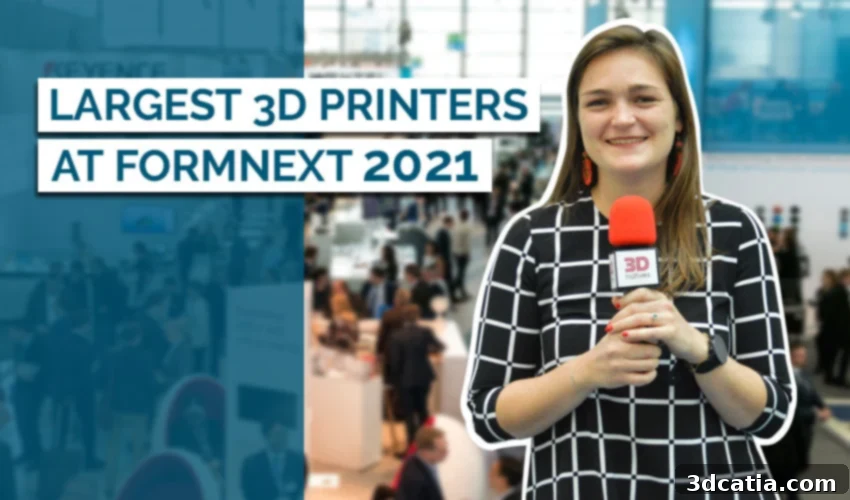
Unveiling the Giants: The Largest 3D Printers That Dominated Formnext 2021
Formnext consistently stands as the premier global exhibition for additive manufacturing and industrial 3D printing, a crucial gathering point where innovation takes center stage. Each year, it offers an unparalleled opportunity for industry professionals, enthusiasts, and innovators to witness groundbreaking advancements, explore new product launches, and experience state-of-the-art machinery in live demonstrations. Formnext 2021 was no exception, showcasing a vibrant landscape of evolving technologies and pushing the boundaries of what’s possible in manufacturing. Among the many exciting displays, a particular area of interest was the emergence of incredibly large-scale 3D printers, signaling a significant shift towards industrial production capabilities and expanded application possibilities.
Our focus at Formnext 2021 was specifically on these colossal machines – the largest 3D printers on display that promise to revolutionize various sectors. These weren’t just bigger versions of existing models; they represented a new frontier in additive manufacturing, designed to tackle the demands of large-format part production, accelerate prototyping cycles, and enable the creation of previously impossible geometries. In the insightful video embedded below, we delve into five distinct printing solutions that caught our eye, each leveraging different foundational technologies. From the precision and surface quality offered by advanced stereolithography to the robust capabilities of metal 3D printing and the versatility of plastic extrusion, these machines redefine what users can achieve, significantly broadening the scope of additive manufacturing applications and empowering industries to push their creative and functional limits. We invite you to watch the video and share your thoughts on our selection!
The Growing Demand for Large-Scale Additive Manufacturing
The additive manufacturing industry has witnessed a dramatic evolution from its origins in rapid prototyping to its current trajectory towards industrial-scale production. A pivotal driver of this evolution is the increasing demand for larger 3D printed parts. Traditional manufacturing methods often struggle with complex, large-format components, frequently requiring extensive assembly of smaller pieces, which can introduce weak points and increase lead times and costs. Large-scale 3D printing directly addresses these challenges by enabling the fabrication of monolithic, highly complex parts in a single build. This not only enhances structural integrity but also reduces assembly steps, optimizes material usage, and allows for greater design freedom, leading to lighter, more efficient, and often higher-performing end products.
Industries such as automotive, aerospace, marine, and architecture are particularly benefiting from these advancements. Imagine aircraft components printed in one piece, eliminating hundreds of fasteners, or custom tooling for large-scale production lines being manufactured on demand. These massive machines are not just about size; they represent a commitment to pushing the boundaries of production efficiency, cost-effectiveness for large batches, and the ability to integrate advanced functionalities directly into the printed part. Formnext 2021 provided a compelling snapshot of how manufacturers are rising to meet these industrial demands, showcasing systems that are robust, reliable, and capable of sustained operation in demanding production environments.
Diverse Technologies Driving Large-Format Innovation
The five printing solutions highlighted in our video demonstrate the incredible technological diversity within large-scale additive manufacturing. Each technology offers unique advantages, catering to specific material requirements and application needs:
Stereolithography (SLA): Precision and Detail on a Grand Scale
Stereolithography, one of the earliest forms of 3D printing, continues to evolve, now offering impressive build volumes without compromising its hallmark precision and surface finish. Large-format SLA printers utilize a UV laser to cure liquid photopolymer resins layer by layer, creating highly accurate and detailed models. These machines are ideal for producing large prototypes, master patterns for casting, complex jigs and fixtures, and even functional end-use parts where intricate details and smooth aesthetics are paramount. The ability to print expansive parts with exceptional resolution makes large-scale SLA invaluable for industries requiring high-fidelity visual and functional prototypes, such as automotive styling, architectural models, and consumer product development. The resins available for SLA have also diversified, now including materials with enhanced properties like toughness, flexibility, and heat resistance, further expanding their applicability.
Metal 3D Printing: Unlocking Strength and Complexity for Large Components
Metal additive manufacturing has long been lauded for its ability to produce strong, lightweight, and complex metal parts. Scaling this technology to larger build envelopes presents significant engineering challenges but offers immense rewards. At Formnext 2021, we saw metal 3D printers employing various processes, such as Selective Laser Melting (SLM), Electron Beam Melting (EBM), and Binder Jetting, capable of producing substantial metal components. These machines are critical for applications in aerospace, defense, energy, and medical sectors where the unique properties of metal alloys (e.g., titanium, aluminum, stainless steel) combined with complex geometries are essential. Large-format metal printers allow for the consolidation of multiple components into a single, optimized part, reducing weight, improving performance, and streamlining supply chains. The ability to create large, high-performance metal parts on demand is transforming how critical components are designed and manufactured across numerous high-stakes industries.
Plastic Extrusion (FDM/FFF and Pellet Extrusion): Versatility and Cost-Effectiveness for Big Builds
Plastic extrusion technologies, primarily Fused Deposition Modeling (FDM) or Fused Filament Fabrication (FFF), have become synonymous with accessible 3D printing. However, industrial-grade, large-format extrusion systems showcased at Formnext have taken this technology to an entirely new level. These machines can print with engineering-grade thermoplastics, including reinforced composites, offering impressive strength-to-weight ratios and material versatility. Furthermore, advanced systems often feature pellet extrusion, which allows for the use of readily available and more cost-effective thermoplastic pellets instead of filaments. This drastically reduces material costs for large prints and enables faster material deposition rates, making these printers highly efficient for producing large tools, molds, jigs, fixtures, and even end-use parts in industries ranging from automotive to general manufacturing. Their robust nature and ability to utilize a wide array of plastics make them incredibly versatile for tackling a broad spectrum of large-scale applications.
Transforming Industries: Applications and Future Impact
These formidable large-scale 3D printers are not just engineering marvels; they are powerful tools that are reshaping entire industrial landscapes. Their capabilities extend far beyond simple prototyping, moving firmly into full-scale production and enabling entirely new design paradigms. For instance, in the automotive sector, these machines are accelerating the development of large-format functional prototypes for testing, producing custom tooling and fixtures that improve assembly line efficiency, and even fabricating lightweight composite parts for high-performance vehicles. The aerospace industry benefits from the ability to create complex, lightweight structural components that can withstand extreme conditions, reducing fuel consumption and enhancing performance. The ability to manufacture large parts as single units reduces the need for complex assembly, minimizes potential failure points, and opens doors for previously unattainable design optimization through topology optimization and lattice structures.
Beyond traditional manufacturing, these printers are finding their way into areas like architecture and construction, where large-scale polymer or concrete structures can be printed, offering unprecedented design freedom and speed of construction. The ability to push additive manufacturing to these new limits means manufacturers can innovate faster, respond to market demands more quickly, and produce custom solutions that were once prohibitively expensive or technically impossible. Formnext 2021 vividly illustrated that the future of manufacturing is increasingly large-scale, automated, and driven by the advanced capabilities of these powerful 3D printing solutions.
Join the Conversation and Stay Connected
We’re eager to hear your thoughts! What did you find most impressive about the largest 3D printers showcased at Formnext 2021? Did you have the chance to experience any of these revolutionary machines in person? Share your insights and opinions in a comment below, or connect with us and join the ongoing discussions on our social media channels. You can find us on Linkedin, Facebook, and Twitter pages. Your feedback is invaluable in shaping our coverage and understanding the evolving landscape of additive manufacturing.
To ensure you never miss out on the latest advancements, breaking news, and exclusive insights from the world of 3D printing, don’t forget to sign up for our free weekly Newsletter here. Get the most relevant 3D printing news delivered straight to your inbox, keeping you at the forefront of this dynamic industry. Additionally, explore our extensive library of videos, tutorials, and machine showcases by visiting our dedicated YouTube channel.