
Revolutionary 3D Printed Titanium Metamaterial: Nature-Inspired Strength for Aerospace and Medical Applications
The ingenuity of nature has long served as an inexhaustible wellspring of inspiration for scientific and technological innovation. From the aerodynamic perfection of bird wings influencing aircraft design to the self-cleaning properties of lotus leaves inspiring novel surface coatings, biomimicry consistently pushes the boundaries of what’s possible. Recently, this trend was exemplified by researchers developing a groundbreaking 3D printing technique inspired by the remarkable color-changing abilities of chameleons, leading to advanced multicolor printing capabilities. Similarly, the Fraunhofer Institute has been at the forefront of exploring insect-inspired wood binders, paving the way for sustainable advancements in 3D printing and material science. In the latest significant breakthrough, scientists at RMIT University have leveraged this profound connection to nature, engineering a novel metamaterial through sophisticated 3D printing techniques. This material features a distinctive lattice structure composed of hollow struts, drawing direct inspiration from the extraordinary resilience observed in natural architectures such as organ pipe corals (Tubipora musica) and the robust, hollow stems of the Victoria water lily. This pioneering development holds immense promise, poised to fundamentally transform the production of critical components for high-stakes sectors like aircraft and rocket manufacturing, alongside a myriad of other advanced applications.
The advanced 3D printed metamaterial was meticulously fabricated at the state-of-the-art RMIT Advanced Manufacturing Precinct. The production utilized the Laser Powder Bed Fusion (LPBF) 3D printing process, a cutting-edge additive manufacturing technique renowned for its ability to create complex geometries with high precision and material integrity. The chosen material for this innovation was a high-performance titanium alloy, a substance already celebrated for its exceptional strength-to-weight ratio, corrosion resistance, and biocompatibility. While the use of titanium alloy in LPBF is not inherently novel, the true breakthrough and the very essence of this material’s nomenclature lie in its artificially composed structure. Unlike conventional materials, this metamaterial possesses a unique, engineered internal architecture that grants it properties not inherently found in natural, bulk titanium. Visually resembling a complex 3D printed titanium lattice cube, this metamaterial boasts an unprecedented strength-to-weight ratio, seamlessly merging lightweight attributes with truly exceptional mechanical strength. This combination of properties is unparalleled in natural materials, making it a game-changer for applications where both lightness and durability are paramount. The developed metamaterial’s lattice structure exhibits remarkable performance: it is an astonishing 50% stronger than the next most durable comparable material, the cast magnesium alloy WE54. WE54 is a high-strength magnesium alloy sharing a similar density and is a common choice within the aerospace industry due to its performance characteristics, highlighting the significant leap forward achieved by RMIT researchers.
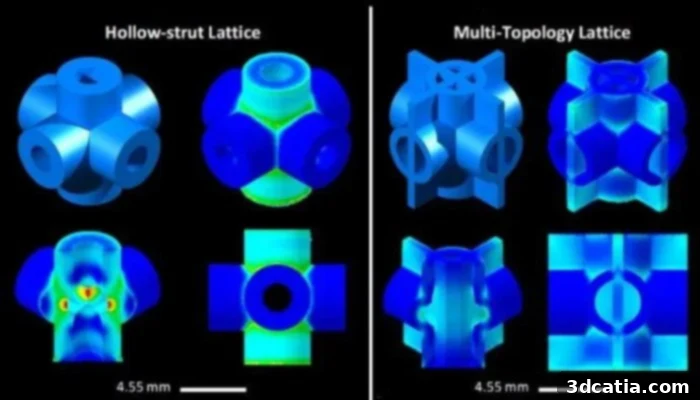
Stress concentrations in red and yellow on the grid (left), while (right) the new grid structure distributes the stress more evenly.
As visually represented in the comparative stress distribution image (Figure 1), this innovative lattice design excels in effectively distributing mechanical stress throughout its structure. By preventing stress from concentrating at specific vulnerable points, the metamaterial significantly reduces potential failure points by half, masterfully deflecting the propagation of potential cracks along its meticulously engineered framework. This optimized stress distribution is crucial, as it leads to a significantly more resilient and durable structure, capable of withstanding extreme loads and environmental conditions. Such enhanced resilience positions this novel material for transformative applications in high-demand fields, particularly in aerospace manufacturing for critical aircraft and rocket components where structural integrity is paramount. Beyond aerospace, its exceptional properties make it an ideal candidate for advanced medical devices, such as long-lasting and reliable bone implants, where strength, durability, and biocompatibility are non-negotiable requirements. Furthermore, the material’s inherent biocompatibility, coupled with its remarkable corrosion and heat resistance, further underscores its immense potential and versatility across an even broader spectrum of challenging industrial and biological environments.
Pioneering the Path to a More Stable Material through Innovative Design
Achieving such a breakthrough in material design has been a long and arduous journey. According to RMIT Professor Ma Qian, decades of previous attempts to replicate the intricate hollow “cellular structures” found abundantly in nature, particularly in metals, have consistently met with failure. These failures were primarily attributable to two persistent challenges: significant problems with manufacturability using traditional methods, and critically, the severe concentration of stress on the inner areas of the hollow struts. This stress concentration invariably led to premature structural failures, rendering these earlier designs impractical for real-world applications. Professor Qian elaborated on this fundamental challenge, explaining, “Ideally, the stress in all complex cellular materials should be evenly spread across the entire structure. However, for most topologies developed historically, it is a common and critical flaw for less than half of the material’s volume to mainly bear the compressive load, rendering the vast majority of the material structurally insignificant or underutilized.” This inherent inefficiency severely limited the performance and reliability of previous designs, making a truly stable and strong lightweight metal cellular structure an elusive goal.
The advent of advanced 3D printing technologies has proven instrumental in overcoming these long-standing conventional limitations. Unlike traditional manufacturing methods that struggle with intricate internal geometries, 3D printing allows for unprecedented design freedom, enabling the creation of highly complex and optimized structures previously deemed impossible. This capability is key to achieving superior load distribution and significantly enhanced material strength. Professor Qian further elucidated the innovative design behind their success: “We specifically engineered a novel hollow tubular lattice structure that incorporates a thin, continuous band running strategically inside it. The synergistic combination of these two fundamental elements—the hollow tubular framework and the internal thin band—results in an unparalleled demonstration of strength and lightness, a combination never before successfully achieved together in nature or engineered materials.” This clever design effectively merges two complementary lattice structures, each playing a crucial role in the overall integrity. By distributing stress exceptionally evenly throughout the entire volume of the material, this approach successfully eliminates the traditional weak points where stress would normally concentrate, thus averting premature failure and unlocking the material’s full potential. Jordan Noronha, the lead author of the groundbreaking study and a dedicated Ph.D. student at RMIT, further emphasized the significance of this novel development with the following powerful words, highlighting its practical superiority:
Compared with the strongest available cast magnesium alloy currently used in commercial applications requiring high strength and light weight, our titanium metamaterial with a comparable density was shown to be much stronger or less susceptible to permanent shape change under compressive loading, not to mention more feasible to manufacture.
This quote succinctly captures the profound impact of their research: not only does the titanium metamaterial outperform existing top-tier alloys in terms of strength and resistance to plastic deformation, but its manufacturing feasibility, enabled by 3D printing, also presents a significant industrial advantage. The newfound lattice structure’s versatility is equally impressive, as it can be precisely produced in a wide array of sizes, ranging from microscopic millimeters, ideal for medical devices or micro-electromechanical systems (MEMS), to macroscopic meters, suitable for large structural components in aerospace or civil engineering applications. This broad scalability is achievable through various types of advanced 3D printers, demonstrating the adaptability of the underlying design principles. Looking ahead, the research team envisions exciting future applications for this metamaterial, particularly in increasingly demanding higher-temperature environments. This opens doors for use in components exposed to extreme heat, such as advanced turbine engines, rocket nozzles, or even re-entry vehicle parts. Nevertheless, despite the clear and compelling advantages, widespread industrial adoption of this revolutionary technology may face initial delays. This is primarily because the specialized additive manufacturing technology required for its mass production, while advancing rapidly, remains relatively inaccessible to the broader industrial public due to factors such as high equipment costs, specialized operational expertise, and the need for further standardization.
What are your thoughts on this innovative 3D printed metamaterial and its potential to reshape various industries? We invite you to share your insights and opinions in a comment below or engage with us on our vibrant social media platforms, including LinkedIn, Facebook, and Twitter! Don’t miss out on the latest advancements and news in the world of additive manufacturing; make sure to sign up for our free weekly newsletter here, delivering the freshest 3D printing news directly to your inbox. You can also explore all our informative videos and engaging content on our YouTube channel for more in-depth perspectives on emerging technologies.
*All Photo Credits: RMIT University