
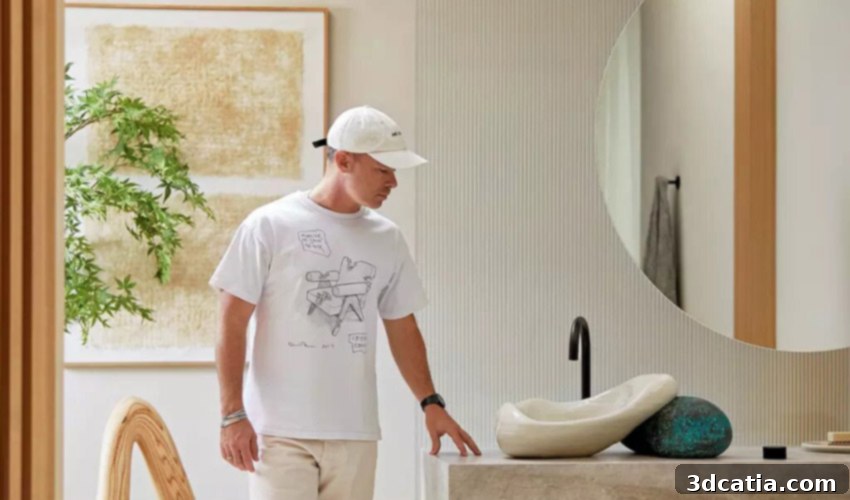
Revolutionizing Interior Design: Kohler and Daniel Arsham Unveil the 3D Printed Rock.01 Sink
The landscape of art, design, and manufacturing is undergoing a profound transformation, largely driven by the advancements in additive manufacturing, more commonly known as 3D printing. This innovative technology is increasingly fostering unique partnerships between visionary artists and leading companies, pushing the boundaries of what’s possible in product creation. A prime example of this flourishing synergy emerged recently with Zellerfeld’s collaboration with acclaimed artist and designer Heron Preston, which resulted in the HERON01, a groundbreaking, fully 3D printed shoe that captivated the fashion world. Such instances highlight a growing trend where bespoke artistry meets cutting-edge production methods, leading to products that defy conventional manufacturing limitations. These collaborations underscore the immense potential of 3D printing to enable unparalleled design freedom and bring highly intricate and personalized concepts to life across various industries.
Following suit in this exciting wave of innovation is Kohler, a globally renowned leader in kitchen and bath products, which has partnered with the distinguished American artist Daniel Arsham. This collaboration has culminated in the creation of an extraordinary 3D printed sink named Rock.01, a testament to the seamless integration of art and technology. With a highly exclusive production run of just 99 units, this limited-edition masterpiece is slated to become available to discerning collectors and design enthusiasts in December. The Rock.01 isn’t merely a functional fixture; it represents a significant milestone in the evolution of luxury home furnishings, demonstrating how advanced manufacturing techniques can be harnessed to achieve aesthetic and structural complexities previously unattainable. This partnership not only showcases Kohler’s commitment to innovation but also Arsham’s ability to translate his unique artistic vision into tangible, functional art pieces, destined to become iconic symbols of contemporary design.
The grand unveiling of the Rock.01 is scheduled to take place for the first time at the prestigious Design/Miami 2021 show, commencing on November 30th. This exclusive event provides the perfect platform to introduce a product that embodies a delicate balance between new technological frontiers and deeply rooted traditional manufacturing methods. The sink itself is a marvel of material composition and craftsmanship, consisting primarily of intricate 3D printed vitreous china. Vitreous china, an enamel coating on ceramics, particularly porcelain, is widely recognized for its durability and smooth finish, commonly utilized in high-quality toilets and sinks due to its hygienic properties and aesthetic appeal. Complementing this technologically advanced ceramic component is a basin crafted from meticulously hand-poured brass, a material chosen for its timeless elegance and artisanal quality. The deliberate juxtaposition of these materials – the futuristic precision of 3D printed ceramic with the ancient craft of brass casting – transforms the Rock.01 into more than just a sink; it becomes a powerful symbol. It represents the harmonious alliance between revolutionary new technologies and venerable, time-honored manufacturing traditions, especially poignant given Kohler’s impressive 148-year legacy in manufacturing excellence.
Artist Daniel Arsham articulated the profound philosophy behind the design, stating, “Rock.01 melds the future of 3D-printing technology with the most basic methods of hand-cast brass. It is literally the new resting on top of the old, and I find that incredibly poetic. Kohler was the ideal partner to bring such a complex and futuristic design to life.” Arsham’s words encapsulate the essence of this project: a dialogue between epochs, where the precision of digital fabrication supports the organic beauty of traditional handcraft. This synthesis allows for an exploration of form and texture that pushes beyond typical manufacturing constraints, offering a piece that is both functional and deeply artistic. The choice of Kohler as a partner was crucial, as their extensive history in manufacturing, combined with their embrace of forward-thinking technology, provided the ideal environment for Arsham’s ambitious vision to materialize. The Rock.01 stands as a testament to the exciting possibilities that arise when artistic innovation converges with industrial mastery, creating pieces that are not only beautiful but also culturally significant, bridging the past and future of design.
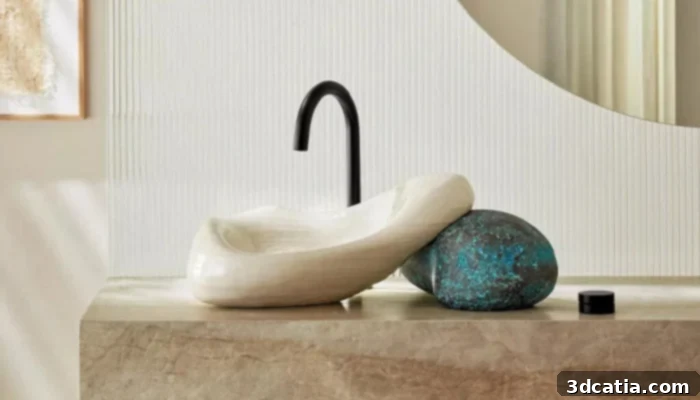
Photo Credits: Kohler
3D Printing Reshaping Interior Decoration and Luxury Fixtures
The application of 3D printing in producing fixtures and decorative elements for bathrooms is not an entirely new phenomenon, though its sophistication and adoption are rapidly accelerating. German company Sandhelden, for instance, has already established itself as an innovator in this niche, leveraging additive manufacturing to craft exceptionally durable and aesthetically pleasing products from sand for bathroom interiors. Their work demonstrates the versatility of 3D printing in handling diverse materials and achieving robust designs suitable for demanding environments. The increasing number of companies turning to this technology for creating such specialized products is far from accidental. There are compelling reasons driving this trend, primarily centered around the unparalleled design freedom and capability to produce complex geometries that traditional manufacturing methods simply cannot match.
Kohler’s journey with the Rock.01 further exemplifies this point. The company explicitly stated that bringing Daniel Arsham’s visionary sink design to fruition would have been an impossibility without the advent of 3D printing. The artist’s intricate concepts, characterized by their unique textures, organic forms, and complex internal structures, demanded a manufacturing process that could translate digital designs into physical objects with absolute precision and fidelity. Additive manufacturing provided the perfect solution, allowing Kohler to reproduce the highly specific and delicate shapes that Arsham envisioned, ensuring every curve and detail was rendered exactly as conceived. This ability to directly translate intricate digital models into physical prototypes and final products is a game-changer for designers and artists. It liberates them from the constraints of molds, tools, and labor-intensive traditional processes, opening up a realm of creative possibilities previously unimaginable. For luxury interior design, where exclusivity and artistic expression are paramount, 3D printing is fast becoming an indispensable tool, enabling truly bespoke and unique installations that elevate spaces into statements of art.
While the aesthetic and conceptual aspects of the Rock.01 have been widely discussed, Kohler has maintained a degree of discretion regarding the specific machine and 3D printing technology utilized in the sink’s manufacturing process. In their press release, the company alluded to a “unique process,” suggesting proprietary innovations or a highly customized approach to achieve the desired results. They emphasized that their revolutionary technology was the sole viable method to produce such a complex and nuanced design, one that traditional manufacturing techniques simply could not replicate. This secrecy, while common in competitive industrial sectors, underscores the advanced nature of the ceramic 3D printing capabilities employed, likely involving a highly specialized form of binder jetting or a modified stereolithography (SLA) process adapted for ceramic materials, enabling the precise layering and sintering of vitreous china powders to form intricate structures with exceptional surface finish and structural integrity.
Nevertheless, Kohler has been unequivocal in stating that the Rock.01 perfectly encapsulates its core values: a deep-seated commitment to combining traditional craftsmanship with pioneering technological innovation. For a company with nearly a century and a half of history in producing high-quality fixtures, embracing 3D printing represents not a departure from its heritage but an evolution, an expansion of its capabilities to continue leading the industry in design and functionality. This project is a powerful demonstration of how legacy brands can remain relevant and push the boundaries of luxury by integrating state-of-the-art manufacturing processes. The Rock.01 is more than just a product; it’s a statement about the future of manufacturing, where artistic vision is no longer limited by physical constraints but amplified by digital fabrication. Further details regarding this landmark project can be explored in Kohler’s official press release, available HERE, offering deeper insights into the collaboration and the technical achievements behind this extraordinary creation.
The broader implications of projects like the Rock.01 extend far beyond individual product launches. They signal a paradigm shift in how luxury goods, bespoke furniture, and architectural elements are conceived, designed, and manufactured. 3D printing allows for unprecedented design freedom, enabling architects and designers to create organic shapes, complex lattices, and highly customized textures that would be impossible or prohibitively expensive to produce with traditional methods. This technology also supports agile product development, facilitating rapid prototyping and iterative design processes that significantly reduce time to market for innovative products. Furthermore, it opens doors for on-demand manufacturing, potentially reducing waste and inventory costs, aligning with more sustainable production practices. The ability to customize each unit, even within a limited series, adds immense value in the luxury market, where uniqueness and personalized touches are highly prized. As materials science continues to advance, we can expect to see even more sophisticated applications of 3D printing in interior design, from structural components to intricate decorative pieces, making every space a unique reflection of artistic and technological prowess. This fusion of art and advanced manufacturing is not just about making things; it’s about redefining the very essence of design and luxury living.
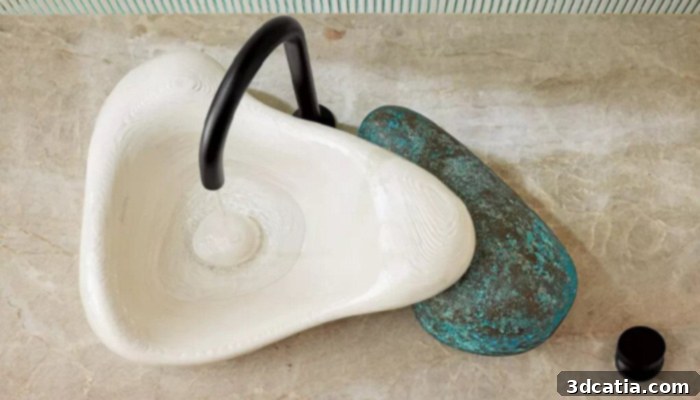
Photo Credits: Kohler
What are your thoughts on Rock.01 and the future of 3D printed luxury interior design? We invite you to share your insights and opinions in a comment below or join the conversation on our social media channels! You can find us on Linkedin, Facebook, and Twitter pages. Don’t miss out on the latest advancements and news in the additive manufacturing world; make sure to sign up for our free weekly Newsletter here, delivering the most current 3D printing news directly to your inbox! Additionally, for visual insights and demonstrations, you can explore all our engaging videos on our YouTube channel.
*Cover Photo Credits: Kohler