
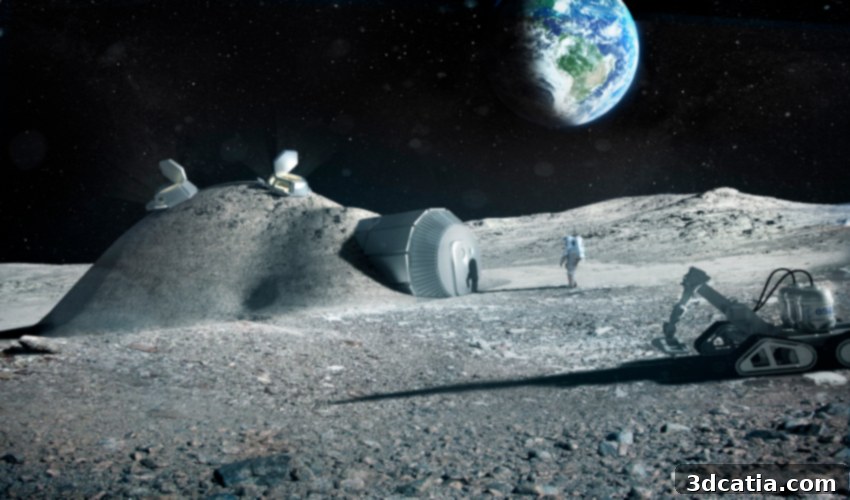
China’s Ambitious Leap: Pioneering Lunar Base Construction with Advanced 3D Printing
Humanity’s enduring dream of establishing a permanent presence beyond Earth is rapidly transitioning from science fiction to tangible reality, largely propelled by innovative technologies like additive manufacturing. In a groundbreaking revelation, China has explicitly laid out its ambitious plans to be the first nation to construct a fully functional 3D printed base on the lunar surface. This bold endeavor not only signifies a monumental step in space exploration but also underscores the pivotal role of advanced manufacturing techniques in shaping our off-world future.
China’s Vision: Harnessing Additive Manufacturing for Lunar Habitats
The announcement, made by the China National Space Administration (CNSA) at a press conference for the State Council Information Office (SCIO), outlined a comprehensive strategy to utilize 3D printing technology for lunar construction. This declaration came on the heels of the highly successful Chang’e 4 mission, which etched its name in history on January 3rd, achieving the world’s first soft landing on the mysterious far side of the Moon. This unprecedented accomplishment was not merely a scientific triumph; it was a powerful statement of intent, showcasing China’s escalating capabilities and unwavering resolve to emerge as a dominant force in the global space arena.
The CNSA detailed an aggressive roadmap involving four subsequent lunar missions, each designed to systematically advance towards the ultimate goal of a permanent lunar habitat. The next significant milestone will be the launch of Chang’e 5, poised to become the first probe since the 1970s to successfully return lunar samples to Earth. This mission is crucial, as the returned samples will provide invaluable data on lunar soil composition, essential for understanding its suitability as a raw material for 3D printing. Following Chang’e 5, three more missions are planned, forming a cohesive series designed to progressively lay the foundation for the eventual construction of a lunar research base using state-of-the-art additive manufacturing techniques.
Central to China’s moon colonization strategy is the Chang’e 8 mission. This mission is specifically dedicated to conducting intensive scientific surveys and pioneering experiments aimed at validating critical technologies required for 3D printing a science and research base on the Moon. Researchers will explore various methods for processing lunar regolith (moon dust) into printable building materials, evaluate the efficacy of different 3D printing technologies in the harsh lunar environment, and test the structural integrity of fabricated elements. The success of Chang’e 8 will be paramount in determining the viability and methodology for large-scale extraterrestrial construction.
The prospect of constructing extraterrestrial “houses” directly from lunar soil using 3D printing technology is a thrilling one that has captured the imagination of scientists worldwide. Wu Yanhua, deputy head of the CNSA, emphasized the collaborative spirit behind this ambitious venture, stating, “We hope that Chang’e 8 will help test some technologies, and do some exploring for the building of a joint lunar base shared by multiple countries.” This statement highlights a vision of international cooperation for lunar exploration, suggesting that China’s efforts could pave the way for a multi-national presence on the Moon. However, Yanhua also tempered expectations with a pragmatic approach, acknowledging the inherent challenges and uncertainties. “Nothing can be confirmed yet,” he added, “We will make the decision according to the performance of Chang’e-5.” This cautious optimism underscores the complexity of space missions and the necessity of step-by-step validation before committing to such a monumental undertaking.
The Global Race: Additive Manufacturing as a Cornerstone for Space Colonization
While China’s explicit declaration of a 3D printed lunar base marks a significant milestone, the CNSA is not alone in recognizing the transformative potential of additive manufacturing for space colonization. Numerous space agencies and private enterprises across the globe are actively investing in and developing similar technologies, fueling a nascent but intense race towards establishing a permanent human presence beyond Earth. The core principle driving these efforts is the concept of In-Situ Resource Utilization (ISRU), which aims to leverage local extraterrestrial materials – like lunar regolith or Martian dust – to construct habitats, tools, and infrastructure, thereby drastically reducing the prohibitive costs and logistical complexities of transporting everything from Earth.
For decades, NASA has been at the forefront of exploring possibilities for off-world construction. Notably, the agency has collaborated with institutions like the University of Central Florida (UCF) to investigate the feasibility of 3D printing structures on Mars. Researchers demonstrated that Martian soil could be processed by heating it to approximately 1648°C (3000°F) within a specialized chamber to produce vital oxygen and molten metal, materials crucial for both life support and construction. Furthermore, NASA has championed initiatives such as the ‘3D-Printed Habitat Challenge,’ encouraging innovators to design and build sustainable shelters using additive manufacturing, paving the way for future lunar or Martian habitats. Project Olympus, a collaboration with ICON, aims to develop and test a large-scale 3D printer for lunar construction, further solidifying the agency’s commitment to leveraging this technology for its Artemis program, which aims to return humans to the Moon.
The European Space Agency (ESA) is also a prominent player in this burgeoning field, with a long-term vision encapsulated in its “Moon Village” concept – an open, international initiative for lunar exploration and settlement. As part of its Technology Research Program, ESA has supported pioneering efforts like those by the research company Fotec, affiliated with the University of Applied Sciences in Austria. Fotec successfully 3D printed a miniature igloo and a section of a wall using a composite material infused with “Mars dust” simulants. These early experiments are vital in understanding how extraterrestrial dust behaves as a building material and how additive manufacturing techniques can be adapted to extreme environments. The ESA’s broader strategy involves exploring advanced robotics and autonomous systems that can operate in challenging lunar conditions to construct infrastructure, laying the groundwork for sustainable human outposts.
The impetus behind these global efforts is clear: 3D printing offers unparalleled advantages for space exploration. It minimizes the mass of materials that need to be launched from Earth, significantly reducing mission costs. It enables the creation of complex geometries and custom parts on demand, providing unprecedented flexibility. Most importantly, it facilitates the use of local resources, moving towards self-sufficiency and away from dependence on Earth-based supply chains – a critical step for long-duration missions and permanent human settlements. Companies like SpaceX, while primarily focused on transportation, also envision a future where 3D printing will be instrumental in building Martian cities, underscoring the universal acceptance of this technology’s potential.
The Future is Being Printed Off-World
The prospect of 3D printing in space represents not just a technological advancement, but a paradigm shift in how humanity approaches space exploration and colonization. China’s detailed plans for a lunar base, coupled with the ongoing research and development by NASA, ESA, and numerous private entities, highlight a collective global endeavor to push the boundaries of what is possible. While challenges remain – from perfecting lunar regolith processing and adapting printing technologies to extreme temperatures and radiation, to establishing robust autonomous construction systems – the progress achieved so far is nothing short of remarkable. The collaborative and competitive spirit driving these initiatives ensures a rapid pace of innovation, promising a future where off-world habitats are not merely theoretical concepts but tangible realities. The moon, and eventually Mars, may soon host human settlements, built brick by 3D-printed brick, marking a new era of permanent extraterrestrial presence.
What are your thoughts on the revolutionary potential of 3D printing for space exploration and colonization? We encourage you to share your insights in a comment below or join the conversation on our Facebook and Twitter pages! Don’t forget to sign up for our free weekly Newsletter to stay informed about all the latest advancements in the world of 3D printing, delivered directly to your inbox!