
Top 5 3D Printing Videos: Pioneering Innovations Across Industries
Welcome to our exclusive weekly roundup, where we delve into the most captivating advancements and applications shaping the landscape of 3D printing and additive manufacturing. This week, we showcase five groundbreaking videos that highlight how this transformative technology is revolutionizing diverse sectors – from modernizing critical infrastructure and streamlining automotive production to fostering new talent and pushing the boundaries of aerial vehicle development. Join us as we explore real-world examples of efficiency, cost-effectiveness, and ingenious problem-solving made possible by the power of 3D printing.
Our journey begins with a fascinating look at how Deutsche Bahn, Germany’s national railway company, is leveraging Formlabs SLS 3D printers to breathe new life into its iconic Intercity Express 1 locomotives. We then transition to the heart of automotive innovation, uncovering the sophisticated operations at Audi’s 3D Printing Center in Ingolstadt, Germany, and their strategic use of additive manufacturing for essential components. Following this, we gain unique insights from Judge Mark Chester on the 2023 WorldSkills UK Additive Manufacturing Finals, emphasizing the importance of nurturing future talent in this rapidly evolving field. Next, we embark on an insightful tour of i-SOLIDS’ impressive 10,000-square-foot 3D printing facility in Houston, Texas, exploring their advanced workflow and cutting-edge technologies. Finally, we conclude with the Tanton Corporation’s ambitious vision for 3D printing the XQ-58 Valkyrie, projecting a future where additive manufacturing converges with Unmanned Aerial Vehicles. Prepare to be inspired by the ingenuity and potential of 3D printing!
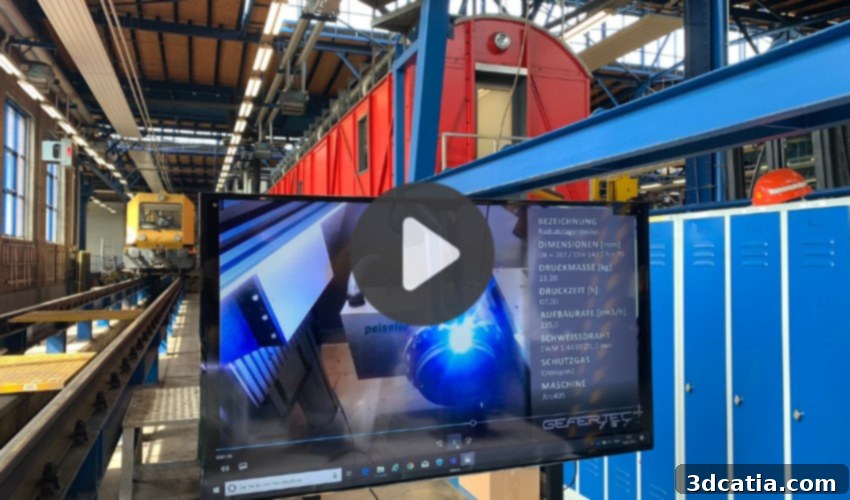
Top 1: Revitalizing Deutsche Bahn Trains with Formlabs SLS 3D Printers
Our first featured video takes us deep into the operations of Deutsche Bahn (DB), demonstrating their remarkable adoption of Formlabs SLS (Selective Laser Sintering) 3D printers. This initiative is not merely about creating parts; it’s about fundamentally transforming workflows, significantly reducing costs, and dramatically accelerating repair times for their legendary Inter City Express 1 trains. Since 2015, DB has harnessed SLS technology to meticulously 3D print over 100,000 parts, a testament to the precision and reliability of this advanced manufacturing method.
The challenge for Deutsche Bahn lies in maintaining a vast fleet, including older models like the Intercity Express 1, for which original spare parts are often no longer available from manufacturers or suppliers. Sourcing replacements for these specialized components can be incredibly time-consuming and prohibitively expensive, potentially leading to prolonged downtime for trains. By integrating Formlabs SLS 3D printers across their 50 plants nationwide, DB has found a powerful solution. SLS technology allows them to produce high-quality, durable, and functional components on-demand, directly addressing the obsolescence issue. This includes not only end-use parts but also essential tools and fixtures required for maintenance and repair, some of which are unique to their legacy trains and long out of production. The ability to rapidly prototype, iterate, and manufacture these critical items in-house has resulted in substantial savings in both time and money, ensuring their trains remain operational and efficient for years to come. This strategic implementation of industrial 3D printing exemplifies how additive manufacturing can extend the lifespan of complex assets and significantly enhance operational resilience in critical infrastructure.
Top 2: Unveiling Efficiency and Cost-Effectiveness at Audi’s Advanced 3D Printing Center
Next, we are treated to an exclusive virtual tour of Audi’s state-of-the-art 3D Printing Center in Ingolstadt, guided by Frank Jablonski from Formnext. This video provides a compelling look at how Audi, a global leader in automotive innovation, masterfully employs 3D printing to manufacture a wide array of essential components. More than just showcasing technology, this segment highlights the profound impact of Additive Manufacturing on the efficiency and cost-effectiveness within the demanding automotive industry.
Audi’s approach to 3D printing extends beyond mere prototyping; it’s deeply integrated into their production processes for both tooling and end-use parts. The video reveals how they use additive manufacturing to craft highly specialized tools and fixtures that were once considered impractical or economically unfeasible using conventional manufacturing methods. A key application demonstrated is the production of hot forming tool segments. These tools are crucial for shaping lightweight yet incredibly stable components used in vehicle body parts, directly contributing to Audi’s reputation for advanced engineering and safety. By utilizing 3D printing for these complex tool segments, Audi gains unprecedented design freedom, allowing for optimized geometries that improve performance and reduce material waste. The speed with which new tools can be designed, printed, and deployed also significantly shortens product development cycles, enabling faster iteration and bringing innovative designs to market more quickly. This strategic investment in additive manufacturing underscores Audi’s commitment to staying at the forefront of automotive technology, driving both efficiency in production and continuous innovation in vehicle design and performance.
Top 3: Expert Judge Insights on the 2023 WorldSkills UK Additive Manufacturing Finals
The third video, presented by CREATE Education, offers a captivating look into the 2023 WorldSkills UK Additive Manufacturing Finals. Held at the esteemed University of Salford in November 2023, this competition was a pivotal event, bringing together the brightest young talents in the field of additive manufacturing from across the UK. It served as a critical platform to assess, develop, and celebrate the skills vital for the future of advanced manufacturing.
In this insightful segment, Judge Mark Chester provides an invaluable perspective on the intricacies of the competition. He elaborates on the rigorous judging process, detailing the specific criteria and technical competencies evaluated, which range from design optimization and material selection to printer operation and post-processing techniques. Mark also underscores the paramount importance of integrating additive manufacturing into national skills competitions like WorldSkills UK. Such events are crucial for elevating the profile of this technology, attracting new talent, and ensuring a skilled workforce capable of driving innovation in various industries. His impressions of the participants’ work are particularly enlightening, highlighting their creativity, technical prowess, and problem-solving abilities under pressure. This video not only offers a behind-the-scenes look at a high-stakes competition but also serves as a powerful reminder of the dedication and expertise required to excel in the rapidly evolving world of additive manufacturing, ultimately shaping the next generation of engineers and specialists.
Top 4: Inside i-SOLIDS’ State-of-the-Art 3D Printing Facility with Managing Director Jason Knight
Our fourth feature provides an exclusive and detailed tour of i-SOLIDS’ impressive 3D printing facility, led by Managing Director Jason Knight. Spanning an expansive 10,000 square feet in Houston, Texas, this facility is not just a workshop but a powerhouse of additive manufacturing, with ambitious aspirations to become one of the largest and most advanced in the nation. The tour meticulously outlines their streamlined workflow, showcasing how projects move from concept to final product, emphasizing efficiency and precision at every stage.
During the tour, viewers are introduced to a diverse array of cutting-edge 3D printers and scanners, demonstrating i-SOLIDS’ capability to handle a wide range of materials and project complexities. This “3D printing farm” is equipped with various additive manufacturing technologies, potentially including industrial-grade FDM, SLA, PolyJet, or even metal AM systems, tailored to specific client needs for rapid prototyping, customized tooling, and batch production. Jason Knight provides insightful updates on their latest investments in advanced machinery and innovative technologies, illustrating how i-SOLIDS continually pushes the boundaries of what’s possible with additive manufacturing. Their strategic location in Houston, a significant industrial hub, positions them perfectly to serve diverse sectors from aerospace and energy to medical and consumer goods. This video offers a compelling overview of i-SOLIDS’ commitment to innovation, quality, and leadership in the additive manufacturing space, making it a must-watch for anyone interested in the scale and sophistication of modern 3D printing facilities.
Top 5: Tanton Corporation’s Ambitious 3D Printing Journey with the XQ-58 Valkyrie
We conclude our weekly roundup with a fascinating video from The Tanton Corporation, which showcases their forward-thinking vision for leveraging readily available, off-the-shelf 3D printers to construct Unmanned Aerial Vehicles (UAVs). This ambitious project centers specifically on creating scaled-down versions of the sophisticated XQ-58 Valkyrie, a stealthy, high-performance combat drone. Tanton Corp’s exploration doesn’t just highlight the immense potential; it also candidly discusses the innovative possibilities and the inevitable technical roadbumps they anticipate encountering in this groundbreaking endeavor.
The video meticulously details the myriad benefits that 3D printing brings to the development and manufacturing of UAVs. Rapid prototyping, for instance, allows Tanton Corp to quickly iterate on design changes, test new aerodynamic configurations, and refine structural elements with unparalleled speed and efficiency. Customization is another significant advantage, enabling them to tailor drone designs for specific missions or incorporate unique payloads with ease. Furthermore, the inherent cost-effectiveness of using consumer-grade or prosumer 3D printers dramatically lowers the barrier to entry for advanced aerospace projects, making sophisticated drone technology more accessible. However, Tanton Corp also realistically addresses challenges such as ensuring the structural integrity of 3D-printed parts under flight stresses, selecting appropriate lightweight yet durable materials, and overcoming potential limitations in terms of size and resolution. This in-depth exploration paints a vivid picture of the future landscape at the exciting crossroads of advanced 3D printing technology and cutting-edge drone development, hinting at a future where customized, rapidly deployable aerial vehicles could transform defense, logistics, and exploration.
We hope you enjoyed this week’s dive into the dynamic world of 3D printing innovations! Which of these groundbreaking applications captivated you the most? Have you encountered other innovative uses of 3D printing in fields like train refurbishing, automotive manufacturing, or drone technology? We’d love to hear your thoughts and experiences. Share your comments below or engage with us on our LinkedIn, Facebook, and Twitter pages! Don’t miss out on the latest 3D printing news, insights, and analyses – sign up for our free weekly Newsletter here, delivered straight to your inbox every week. You can also explore all our featured videos and more on our dedicated YouTube channel. Stay tuned for more innovations!
*Cover photo credits: Deutsche Bahn