
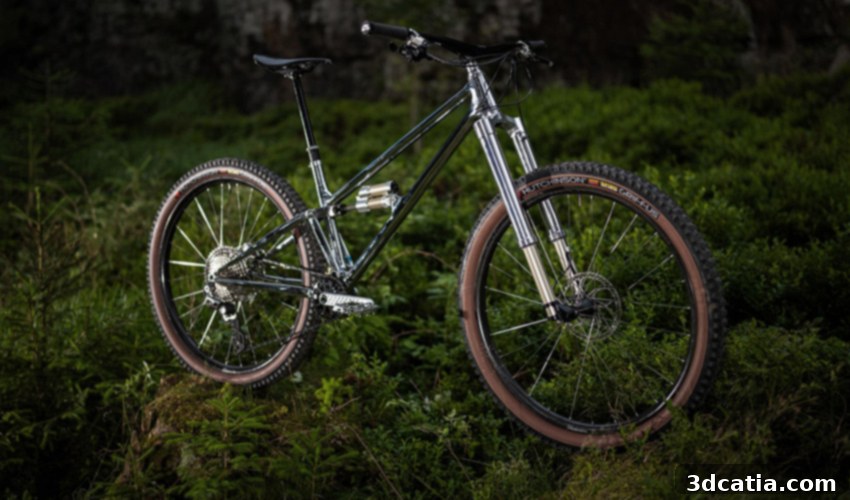
Additive Manufacturing Revolutionizes Cycling: The Award-Winning Moorhun Bike and the Future of Bicycle Design
The esteemed purmundus challenge celebrated its eighth iteration in November 2020, unfolding as a pivotal highlight of the digital Formnext Connect exhibition. This internationally recognized annual competition serves as a prestigious platform, inviting ingenious designers and innovative engineers from every corner of the globe to engage in a thematic 3D printing design contest. Each year, the challenge pushes the boundaries of additive manufacturing applications, fostering creativity and groundbreaking solutions. This particular year’s compelling theme, aptly titled Geometry and Material in Harmony, resonated deeply with the participants, inspiring 35 finalists to interpret its essence through their cutting-edge designs. The top honor, the coveted first prize, was ultimately bestowed upon HUHN cycles for their exceptionally engineered and visually striking 3D printed Moorhun Bike. The jury expressed profound admiration for the project, commending its holistic innovation and exemplary execution. “We thought it was a great example of an innovative use of additive manufacturing for the right reasons,” they emphatically added, underscoring the bike’s strategic leverage of 3D printing’s capabilities. This recognition naturally prompts a crucial question: What transformative potential does additive manufacturing (AM) truly hold for the dynamic and evolving bicycle industry?
An Alternative to Carbon Fibre Frames? Exploring Material Science and Sustainability
In recent years, the bicycle manufacturing landscape has witnessed a surge of fascinating innovations, significantly propelled by advancements in material science. The emergence of high-performance materials such as carbon fibre has played a transformative role in this evolution. As many enthusiasts and engineers are aware, carbon fibre is seldom utilized in its pure, isolated form. Instead, it is predominantly combined with other materials, most commonly polymers, to engineer advanced composite materials. The primary allure of these carbon fibre composites lies in their remarkable strength-to-weight ratio, offering unparalleled performance benefits in applications where minimizing mass while maximizing structural integrity is paramount. Furthermore, they impart an exceptionally high level of stiffness to parts, which translates into enhanced power transfer and responsiveness in bicycle frames, crucial for competitive cycling and high-performance riding. A notable example from this very year showcased AREVO and Superstrata, who unveiled their groundbreaking 3D printed carbon fibre unibody bike frame for their Superstrata bicycle and e-bicycle. While this project garnered widespread acclaim for its impressive technological feat, enabling the production of a bike that was both significantly lighter and considerably stiffer than conventional designs, it also sparked important discussions. Critics and environmental advocates have highlighted the very high carbon footprint associated with the production of carbon fibre, raising concerns about its long-term sustainability and environmental impact.
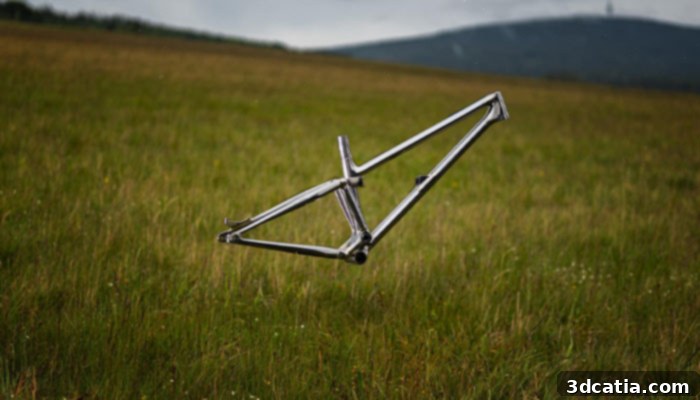
The Moorhuhn bike frame is made from titanium
The debate surrounding carbon fibre’s environmental impact is indeed significant. As articulated on the Purmundus website, a key observation is that “Carbon products have a very short product lifecycle as there is a certain safety risk in using second hand or crashed carbon products. Sadly there are nearly no ways of recycling this composite material, so most of the time carbon frames end up in land fields or get burned.” This stark reality underscores a critical environmental challenge for the cycling industry. It is precisely this concern that elucidates the jury’s decision to commend and reward HUHN cycles, a pioneering company dedicated to developing bike frames crafted from titanium. While titanium possesses inherent properties that allow it to compete admirably with carbon fibre for bicycle frames—offering excellent strength, durability, and corrosion resistance—it also presents unique processing difficulties. Traditionally, titanium is notoriously challenging to machine and weld, which historically has somewhat constrained the design freedom and fabrication possibilities for frame builders. Overcoming these limitations is crucial, as the performance of a bicycle frame can be substantially improved through innovative alterations and optimizations in the design process, making the handling of titanium quite the engineering challenge. Furthermore, while titanium frames offer a distinct ride quality often described as more forgiving, they are generally perceived as being ‘softer’ or less rigid than their carbon fibre counterparts in certain aspects, which can be a consideration for riders prioritizing absolute stiffness.
The Moorhuhn Bike: A Hybrid Masterpiece Leveraging Additive Manufacturing
The Moorhuhn bike from HUHN cycles represents a paradigm shift in bicycle frame manufacturing, cleverly circumventing the traditional challenges associated with titanium. Instead of relying on a monolithic titanium structure or solely conventional fabrication methods, Moorhuhn ingeniously combines the inherent advantages of super-light, high-performance titanium tubes with the revolutionary capabilities of additively manufactured lugs. These precision-engineered joints are the heart of the innovation, specifically designed to achieve an unparalleled balance of lightness and stiffness simultaneously. This remarkable feat is accomplished through the strategic integration of intricate lattice structures embedded within their thin walls. This advanced internal geometry, impossible to achieve with traditional manufacturing, maximizes structural efficiency while minimizing material usage. The jury of the purmundus challenge lauded this approach, commenting: “We thought it was an interesting example of how AM can be combined with more traditional methods to create a product that is both high performance and ultimately very desirable.” This hybrid manufacturing strategy truly showcases the symbiotic relationship between established techniques and cutting-edge additive processes.
Beyond structural optimization, additive manufacturing unlocks a new era of customization for bicycle frames. A significant advantage is the ability to produce each frame precisely according to the unique needs and specifications of individual riders. This level of personalized fit and performance tuning is economically unfeasible with conventional methods, which typically require expensive and time-consuming tooling for each size or geometry variation. With AM, the digital design file can be altered with ease, and a new, custom frame can be printed without any additional tooling costs. This means every rider can have a bike perfectly tailored to their body dimensions, riding style, and ergonomic preferences, leading to enhanced comfort, efficiency, and overall cycling experience. The design freedom offered by additive manufacturing also allows for the seamless integration of various functional elements directly into the frame structure. Features such as internal cable guiding, integrated seat clamps, precisely aligned bearing housings, and even localized additional material for optimized welding points can be incorporated into the initial design. This consolidation of parts not only reduces assembly complexity for the frame builder, making their life much easier, but also contributes to a cleaner aesthetic and potentially improved durability by reducing the number of separate components and connections. This holistic integration epitomizes the efficiency and elegance AM brings to complex product design.
Furthermore, the material choice and manufacturing process employed for the Moorhuhn bike offer significant environmental benefits, standing in stark contrast to the challenges posed by carbon fibre. Since titanium is inherently resistant to corrosion, the finished frame does not require any paint or protective coatings. This eliminates the use of chemical solvents and pigments typically involved in the painting process, further reducing the environmental footprint. The natural, raw finish of titanium is not only aesthetically pleasing but also speaks to its durability and low maintenance. Crucially, in a world increasingly focused on sustainability, the titanium frame of the Moorhuhn bike is designed for longevity, easy repair, and, most importantly, full recyclability. Unlike carbon fibre composites, which present immense difficulties for recycling and often end up in landfills or incinerators, titanium can be reclaimed and reused, closing the material loop and minimizing waste. This makes the Moorhuhn bike not just an engineering marvel but also a beacon for eco-conscious manufacturing in the cycling industry, addressing the critical end-of-life dilemma that plagues many modern materials.
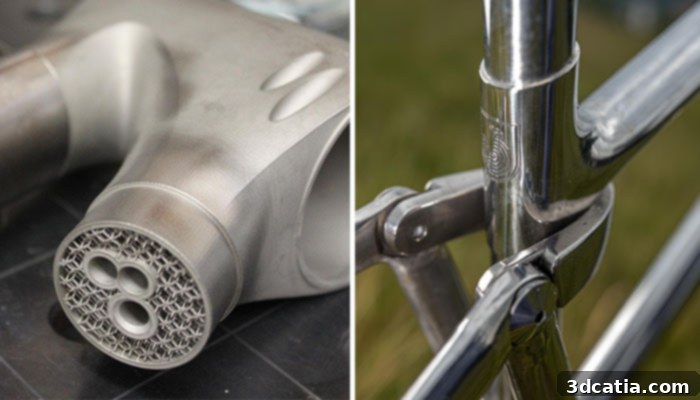
The joints were designed to be very light and stiff at the same time, thanks to a lattice structure inside the thin walls
In conclusion, the Moorhuhn bike stands as a powerful testament to the transformative potential of additive manufacturing when applied to real-world engineering challenges. Perhaps the most significant takeaway from this award-winning design is its profound impact on sustainability. The production process, combining advanced titanium tubes with 3D printed lugs, is not only environmentally friendlier by reducing chemical usage and waste but also champions a circular economy model. The resulting frames can be safely repaired and, unlike the problematic recycling of carbon fibre frames, are fully recyclable at the end of their long lifespan. This innovative approach offers a compelling vision for the future of bicycle design and manufacturing, where performance, customization, and environmental responsibility go hand in hand. For those eager to delve deeper into this groundbreaking project and explore the meticulous engineering behind it, more information can be found HERE. We invite you to share your thoughts on the revolutionary Moorhuhn bike! Please let us know what you think in a comment below or connect with us on our Facebook and Twitter pages. Don’t forget to sign up for our free weekly Newsletter, ensuring you receive all the latest news and insights in the dynamic world of 3D printing delivered directly to your inbox!