
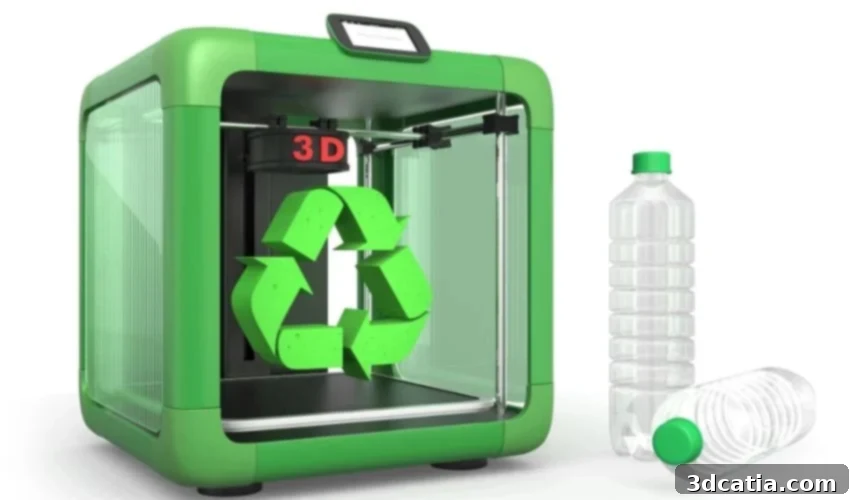
The Sustainable Revolution: 10 Ways 3D Printing is Shaping a Greener Future
As global industries grapple with the urgent need for more sustainable practices, additive manufacturing, commonly known as 3D printing, is increasingly recognized as a powerful tool for environmental stewardship. Often touted as a greener alternative to conventional manufacturing methods, which are notorious for high emissions and significant waste generation, 3D printing operates on a principle of efficiency. By precisely adding material only where it’s structurally required, this technology inherently minimizes material consumption and, consequently, waste. While the precise sustainability benefits of 3D printing can vary depending on the specific process, materials utilized, and components being produced, its overarching potential to make industries more sustainable and respectful of our finite resources is undeniable. In alignment with the UN’s Sustainable Development Goals, which advocate for climate action and responsible consumption and production, sectors worldwide are seeking innovative strategies for a greener future. This article delves into ten compelling reasons why 3D printing stands out as a more sustainable manufacturing approach, highlighting its transformative potential for an environmentally conscious industrial landscape.
#1: Reduction of Waste and Material Consumption
A cornerstone of 3D printing’s sustainability appeal is its remarkable ability to reduce waste compared to traditional manufacturing. Subtractive processes, such as milling, turning, drilling, or sawing, typically involve removing material from a larger block, generating substantial waste in the form of chips, shavings, or offcuts. In stark contrast, 3D printing builds objects layer by layer, directly utilizing the required material without excessive removal. This additive nature fundamentally minimizes material waste. However, it’s important to acknowledge that the degree of waste reduction can vary with different 3D printing technologies. For instance, powder bed fusion and resin-based processes may generate more waste due to the need for support structures or excess powder/resin that cannot always be fully reclaimed or reused. Despite these nuances, sophisticated software tools play a crucial role. By allowing precise planning and optimization of the 3D model, these programs can significantly minimize material usage, often enabling complex geometries that use less material overall. This meticulous approach ensures a more efficient use of precious resources, translating into reduced energy consumption and lower machine emissions throughout the production cycle.
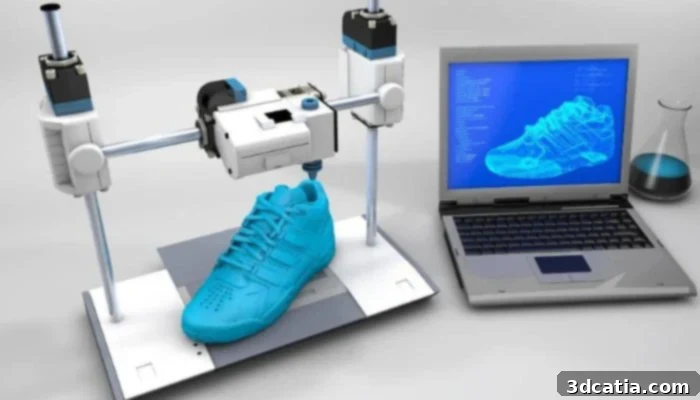
3D printing involves printing directly onto the building platform, which minimizes material waste (photo credits: Devrimb)
#2: Facilitating Local Production
The traditional global manufacturing model often relies on sourcing products from distant locations, fostering complex supply chains that contribute significantly to global carbon emissions and create dependencies vulnerable to disruptions. This reliance on long-distance transportation impacts both the environment and local economies. 3D printing offers a compelling alternative: local production. By enabling companies to manufacture products directly within their communities or regions, 3D printing significantly reduces the need for extensive shipping and logistics. This localized approach directly translates into a substantial reduction in CO2 emissions associated with freight transport. Furthermore, it mitigates the need for vast amounts of protective packaging typically used for shipping parts across continents, further lessening environmental impact. Beyond the environmental benefits, local production enhances supply chain resilience, supports regional economies, and allows for quicker response times to market demands, fostering a more sustainable and robust manufacturing ecosystem.
#3: Empowering On-Demand Manufacturing
Closely linked to the concept of local production, on-demand manufacturing is another powerful sustainable advantage of 3D printing. This approach allows companies to produce goods flexibly and precisely in line with actual demand, virtually eliminating the costly and environmentally detrimental problem of overproduction. Traditional manufacturing often necessitates large production runs to achieve economies of scale, leading to surplus inventory that may eventually become obsolete and discarded. With 3D printing, there’s no longer a need to maintain vast physical inventories; products, including spare parts, can be manufactured exactly when and where they are needed. This “virtual inventory” model not only frees up valuable warehouse space and capital but also significantly reduces the waste associated with unsold or outdated stock. The inherent flexibility of additive manufacturing also makes it possible to offer highly customized products tailored to individual customer needs. This shift towards demand-oriented, personalized production has the potential to fundamentally transform industrial processes, leading to a leaner, more responsive, and far more sustainable future where resources are used only when there is a confirmed need.
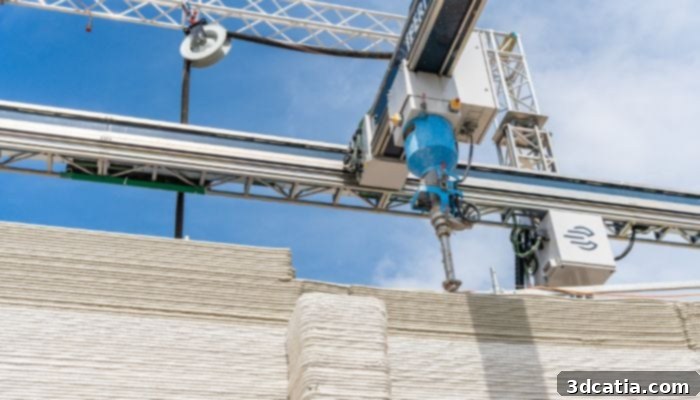
On construction sites in particular, 3D printing, especially concrete 3D printing, is used on site, making construction more sustainable (photo credits: Heidelberg Materials)
#4: Service Life Extension Through Repair and Refurbishment
Beyond creating new components, 3D printing significantly contributes to a circular economy by enabling the repair and refurbishment of existing parts, thereby extending their service life. Instead of discarding damaged components and manufacturing new ones from scratch, advanced additive manufacturing processes can breathe new life into them. In industrial applications, the Directed Energy Deposition (DED) process is particularly effective for this purpose. DED works by precisely melting and depositing material layer by layer onto an existing component, effectively repairing cracks, worn surfaces, or missing sections. This technique not only reduces the demand for new raw materials but also drastically cuts down on energy and emissions associated with manufacturing entirely new parts. The versatility of DED is further enhanced by its compatibility with almost all weldable metals, offering broad applicability across various industries. By facilitating economical and efficient repairs, 3D printing empowers industries to adopt a “repair rather than replace” philosophy, aligning perfectly with sustainability goals and contributing to a more resource-efficient future.
#5: Advancements in Recycling and Upcycling
The potential for recycling and upcycling materials within the 3D printing ecosystem represents a significant sustainable advantage, albeit with ongoing challenges. Failed prints, defective parts, or obsolete print projects can, in many cases, be melted down and repurposed for the creation of new products. This is particularly true for thermoplastic materials such as ABS, PETG, and PLA, which are well-suited for reprocessing. While the widespread industrial-scale implementation of this is still developing, the technology holds immense promise. Furthermore, 3D printing offers unique opportunities for upcycling by allowing waste products to be combined with 3D-printed workpieces, transforming discarded materials into innovative and often unique items. A key challenge in material recycling is maintaining consistent material quality for subsequent printing processes, as material properties can degrade after multiple heat cycles. Despite this, some advanced technologies are making strides. Multi Jet Fusion (MJF), for example, boasts an impressive reusability rate of up to 80% for its unused powder. Similarly, certain powder bed fusion technologies may offer even higher powder reuse rates, potentially up to 98%, though further studies are needed to fully validate these claims and ensure consistent performance. Continued research and development in this area are crucial for unlocking the full circular potential of 3D printing materials.

The Print your City project transforms plastic waste into furniture using 3D printing (photo credits: Print your City)
#6: The Rise of Eco-Friendly Materials
The expanding repertoire of sustainable materials available for 3D printing is a significant driver of its environmental benefits. Beyond conventional metals and plastics, a growing number of innovative materials are being developed and adopted specifically to reduce the ecological footprint of production. This includes both recyclable and bio-based options. Biodegradable materials, for instance, are gaining traction, with filaments now derived from sources like corn starch, coffee grounds, sugar cane, or wheat waste. These materials offer a more environmentally responsible end-of-life option, as they can decompose under specific conditions, reducing landfill burden. PLA (Polylactic Acid), made from natural raw materials such as corn, is a well-known example; with the addition of certain by-products, it can be nearly 100% bio-based and is biodegradable in industrial composting facilities, though its overall sustainability has been a subject of discussion due to specific composting requirements. Furthermore, non-fossil plastics like PET and PHA, produced from renewable resources, alongside recycled filaments made from post-consumer ABS and PET, are increasingly supporting a more robust circular economy. It’s crucial to understand that the true sustainability of any material is multifaceted, depending on factors such as raw material sourcing, manufacturing processes, compatibility with ecosystems, transportation distances, and end-of-life recyclability or biodegradability. Ongoing research, experimentation, and continuous improvement of existing materials are vital to maximize their environmental benefits and further reduce ecological impacts in the future.
#7: Enhancing Energy-Efficient Production
3D printing offers substantial opportunities for energy savings, both during the manufacturing process and in the lifespan of the end product. One significant advantage arises from the technology’s ability to consolidate multiple parts into a single, complex component, reducing assembly steps and associated energy use. More critically, 3D printing enables the creation of lightweight parts, which leads to considerable energy efficiencies in subsequent applications. A prime example is the aerospace sector, where 3D-printed components can be significantly lighter than their traditionally manufactured counterparts. This weight reduction directly translates into lower fuel consumption for aircraft, leading to a substantial decrease in emissions over the operational life of the plane. During the printing process itself, 3D printing can be more energy-efficient by utilizing less filler material and optimizing material usage, which often results in faster production cycles with reduced energy input per part. Beyond this, ongoing innovations aim to minimize energy consumption during printing: special filaments with lower melting points can reduce the energy needed for extrusion, while insulated print beds (e.g., with aerogel) can maintain temperatures with minimal additional power. Other measures include insulating the print head with materials like silicone or rock wool to prevent heat loss, or constructing an enclosure around the printer to maintain a stable internal temperature, all contributing to a more energy-conscious manufacturing operation.
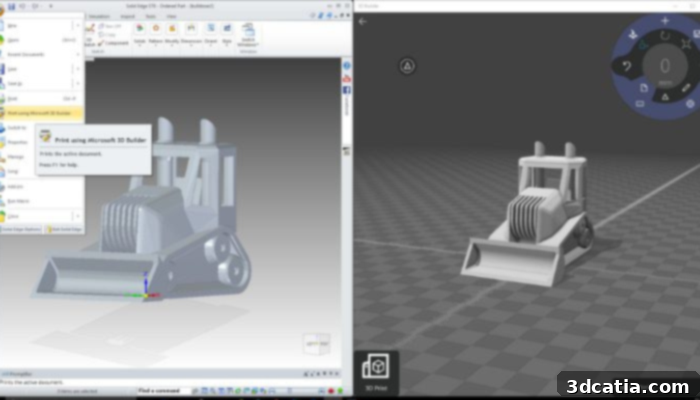
Using software, you can optimize your design to save material (photo credits: Solid Edge)
#8: Optimized Design Through Advanced Software
The sophisticated capabilities of 3D modeling software are instrumental in unlocking the full sustainable potential of additive manufacturing. These powerful tools enable highly effective design optimization, which directly translates into reduced material consumption, shorter printing times, and overall more environmentally friendly production processes. Virtual simulations within CAD (Computer-Aided Design) and CAE (Computer-Aided Engineering) environments allow engineers to meticulously refine designs, removing unnecessary details, optimizing internal structures for strength-to-weight ratios, and minimizing the need for wasteful support structures. Many software solutions also incorporate tools for early error detection and defect analysis during the design phase, preventing costly and material-intensive printing mistakes. The ability to digitally test and validate models eliminates the need for numerous physical prototypes, saving significant amounts of material, energy, and time. Furthermore, the digital transfer of CAD designs inherently reduces the necessity for extensive physical production facilities in various locations, thereby lowering transportation costs and associated emissions. Advanced techniques like topology optimization and generative design allow for the creation of incredibly lightweight yet strong parts by strategically placing material only where it is absolutely necessary. Manufacturing complex assemblies as single, consolidated components further reduces material usage and energy expenditure during both production and assembly. The ongoing integration of artificial intelligence into these software workflows promises even greater efficiencies, with real-time error detection and correction capabilities further enhancing sustainability.
#9: Driving Environmental Protection Projects
Beyond enabling more environmentally friendly production methods, 3D printing is actively making a tangible contribution to the preservation of species and the protection of our planet’s diverse ecosystems. This innovative technology is being deployed to replicate natural structures, such as coral reefs, nests, or beehives, offering artificial habitats that are identical to their natural counterparts. These 3D-printed dwellings provide crucial shelter for animals whose natural homes have been destroyed or compromised due to climate change, pollution, or human encroachment, thereby aiding in biodiversity conservation. Furthermore, 3D printing plays a vital role in ocean conservation projects, where it’s used to create artificial reefs that promote marine life and restore damaged ecosystems. Its impact extends even to sustainable food production, particularly in the creation of meat alternatives. The livestock industry is a major contributor to greenhouse gas emissions, with the production of just one kilogram of beef generating up to 12 kg of CO2. Various companies are now leveraging additive manufacturing to produce plant-based meat that closely mimics the texture and taste of conventional meat. This groundbreaking application promises a significantly lower environmental impact—up to 95% less—compared to traditional meat production, offering a sustainable solution to global food demands while simultaneously protecting animals and drastically reducing carbon footprints.

Divers bring a 3D-printed reef to the seabed (photo credits: xtreee.com / Greg Lecoeur)
#10: Accelerating Research and Innovation for Sustainability
Finally, one of the most powerful contributions of 3D printing to sustainability lies in its ability to dramatically lower the barrier for prototype development and experimentation. This accessibility allows companies, researchers, and innovators to rapidly implement new ideas, test concepts, and iterate on designs with unprecedented speed and cost-effectiveness. The inherent flexibility of additive manufacturing fosters continuous product and technology improvements, particularly in the realm of environmental protection. Many companies and startups are intensely focused on advancing additive manufacturing technologies to make them even more efficient, use greener materials, and consume less energy. This vibrant ecosystem of innovation facilitates the rapid development of sustainable solutions across various sectors, from lightweight automotive components to biodegradable medical devices. The innovative strength unleashed by 3D printing opens up new possibilities for creative applications and industrial processes that were previously unimaginable, ensuring that the technology itself is continuously optimized for even greater sustainability. This constant evolution positions 3D printing not just as a manufacturing method, but as a catalyst for a sustainable future, driving progress in every facet of design, production, and environmental conservation.
Do you believe 3D printing is truly a cornerstone for a more sustainable future? Are there other significant environmental advantages or challenges that we may have overlooked? We invite you to share your insights in a comment below or engage with us on our LinkedIn, Facebook, and Twitter pages! Don’t forget to sign up for our free weekly newsletter here to receive the latest 3D printing news directly in your inbox. You can also discover all our videos and in-depth content on our YouTube channel.