
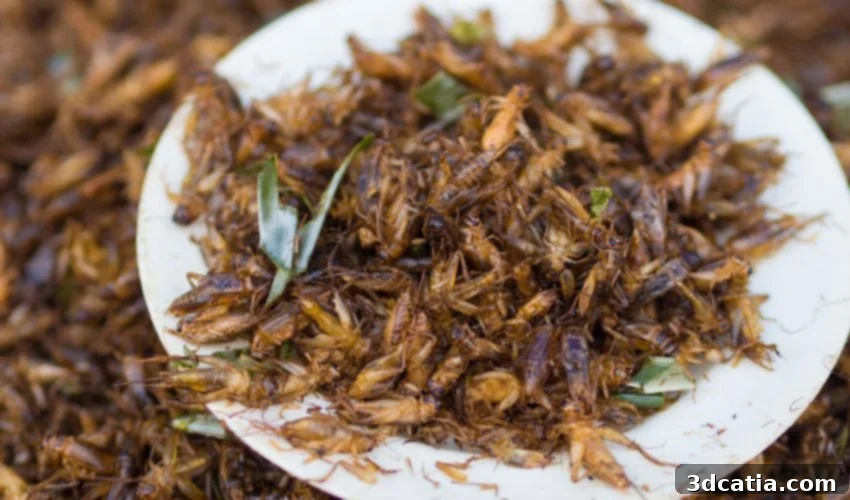
Revolutionizing Sustainable Food: How 3D Printing and Alternative Proteins Are Reshaping Global Diets
In a significant stride towards addressing urgent global food supply challenges and promoting environmental sustainability, researchers from the Singapore University of Technology and Design (SUTD) have unveiled a groundbreaking approach to 3D food printing. This innovative method integrates diverse alternative protein sources, including algae, various plants, and even insects, with more conventional nutrient-rich foods such as vegetables. The collaborative effort aims to forge a new path for sustainable food production that can effectively meet the nutritional demands of a growing global population while simultaneously mitigating the ecological footprint of our dietary habits. The findings of this pivotal study, titled ‘Systematic Engineering approach for optimization of multi-component alternative protein-fortified 3D printing food Ink‘, were recently featured in the prestigious scientific journal, Food Hydrocolloids.
Addressing the Global Food Crisis: The Imperative for Sustainable Protein
Our planet is facing an increasingly dire ecological crisis, with its devastating consequences becoming more apparent each day. While pollution from plastic waste and emissions from fossil fuels are widely recognized contributors, the extensive global demand for protein-rich food presents another pressing environmental dilemma that often goes understated. The world’s population continues to expand and age, leading to an unprecedented strain on existing food systems. Traditional animal agriculture, while a cornerstone of many diets, is notoriously resource-intensive. It contributes significantly to greenhouse gas emissions – primarily methane from livestock and nitrous oxide from fertilizers – and demands vast tracts of land, often leading to deforestation, and immense quantities of fresh water. These factors collectively exacerbate climate change, diminish biodiversity, and push our planet closer to critical ecological thresholds.
In recent years, numerous initiatives have emerged focusing on a simple switch from animal proteins to plant-based alternatives. While commendable, a significant portion of the global populace still gravitates towards animal-derived foods due to taste, texture, and cultural familiarity. This preference perpetuates the undesirable environmental effects, from increased greenhouse gases to the substantial land and water consumption associated with raising animals, contributing to a complex web of food supply challenges. It underscores the urgent need for innovative solutions that can offer sustainable, nutritious, and, crucially, widely accepted protein sources that don’t compromise the health of our planet or our palates.
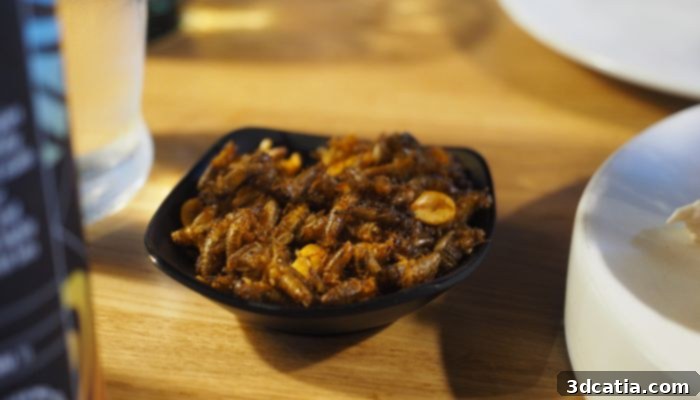
In many cultures worldwide, the consumption of insects is a traditional and common practice, highlighting their potential as a global protein source (photo credits: JIP via wiki commons)
3D Food Printing: Transforming Unfamiliar Proteins into Appealing Meals
One of the primary hurdles in integrating novel protein sources into mainstream diets, especially in Western cultures, is consumer perception. While the idea of eating insects is well-established in parts of Africa, Asia, and South America, it often elicits strong negative reactions—ranging from mild aversion and discomfort to outright disgust—among populations unfamiliar with entomophagy. This cultural barrier presents a significant challenge for the widespread adoption of sustainable alternative proteins. This is precisely where the pioneering work by Prof. Chua Chee Kai and his dedicated team from SUTD, as presented in their recent study, offers a revolutionary solution.
Their approach leverages the advanced capabilities of 3D printing technology to transform these alternate protein sources—such as algae, various plant extracts, and insect-derived proteins—into visually appealing, palatable, and nutritious meals. By meticulously processing and blending these proteins with commonly accepted and familiar foods, like carrots, the team can create food inks that can then be extruded into much more inviting and conventional shapes. This innovative technique effectively bypasses the psychological barrier of consuming unfamiliar ingredients in their raw or traditional forms, making them more acceptable to a broader consumer base.
Prof. Chua Chee Kai elaborated on this critical aspect: “The appearance and taste of such alternative proteins can be disconcerting for many. This is where the versatility of 3D food printing rises to the challenge as it can transform the way in which food is presented and overcome the inertia of consumer inhibitions.” His statement perfectly encapsulates the essence of their breakthrough: using technology to bridge the gap between nutritional necessity and consumer acceptance, paving the way for a more sustainable food future.
The Science Behind the Sustainable Plate: Engineering Food Inks
The genesis of these novel 3D-printable foods was a result of a fruitful interdisciplinary collaboration. Prof. Chua’s team at SUTD partnered with researchers from Khoo Teck Puat Hospital (KTPH) and the University of Electronic Science and Technology of China (UESTC). This collective expertise allowed the scientists to delve into the complex science of efficiently incorporating alternate protein sources into functional food inks. The process involved extensive experimentation and a systematic engineering approach, meticulously testing various formulations to achieve the desired rheological properties, nutritional content, and printability.
After exploring numerous approaches, the team successfully identified an optimal formulation comprising three key ingredients: carrot powder, proteins derived from insects, and xanthan gum. Each component was carefully selected for its specific contributions to the mixture. Carrot powder provided not only a familiar taste and vibrant color but also essential nutrients and fiber, making the food visually appealing and wholesome. The insect proteins served as the primary, high-quality protein source, offering a sustainable and complete amino acid profile. Xanthan gum, a common food additive, played a crucial role as a hydrocolloid, acting as a binder and thickener. Its inclusion was vital for achieving the optimal viscosity and elasticity required for the food ink to be smoothly extruded and maintain its printed shape, ensuring structural integrity in the final 3D-printed dishes.
While the specific 3D printing technology utilized and the precise dishes achievable with this initial food base are still under wraps, the potential is immense. The researchers have already broadened their scope, actively experimenting with an even wider array of alternative proteins. This includes common plant-based proteins like soy, nutrient-dense microalgae such as spirulina, various insect proteins beyond the initial formulation such as cricket and black soldier fly larvae, and even sericin, a protein derived from silkworms. This ongoing exploration signifies a commitment to expanding the versatility and nutritional diversity of 3D-printed sustainable foods.
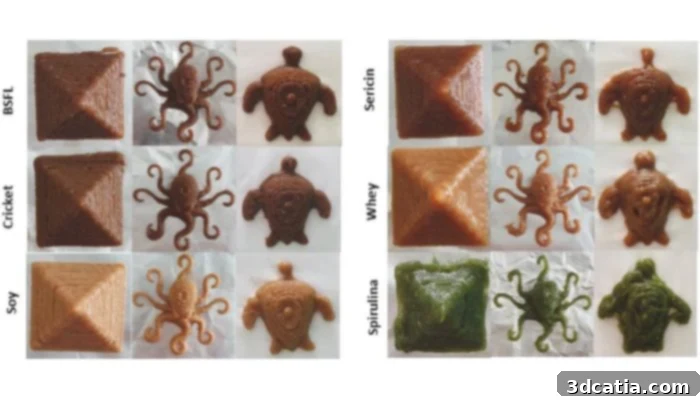
Examples of visually appealing and nutritionally enhanced dishes created by 3D food printing, demonstrating the potential of alternative proteins (photo credits: SUTD)
The Promise of a Sustainable and Personalized Protein Future
The enthusiasm for this research is palpable among the scientific community. Prof. Yi Zhang, a principal investigator at UESTC and a key figure in this collaboration, expressed immense satisfaction with the study’s outcomes. He firmly believes in the transformative power of these novel protein sources, stating, “Alternative proteins may become our main source of protein intake in the future. This study proposes a systematic engineering approach of optimizing food inks, thereby enabling easy creations and customizations of visually pleasing, flavourful, and nutritionally adequate food enhanced with alternative proteins. We hope our work would encourage consumers to eat more of these unfamiliar, but sustainable food items.”
This vision extends beyond merely addressing environmental concerns; it opens doors to a future of personalized nutrition. With 3D food printing, it becomes feasible to tailor meals precisely to an individual’s dietary needs, medical conditions, or even taste preferences. Imagine custom-designed meals for the elderly with specific texture requirements, athletes needing precise protein-to-carbohydrate ratios, or individuals with allergies needing allergen-free alternatives. This level of customization, coupled with the sustainable nature of the protein sources, marks a significant leap forward in food technology.
The Broader Impact: Towards Food Security and Reduced Waste
The implications of SUTD’s research are far-reaching. By making unfamiliar alternative proteins appealing, the project contributes directly to global food security. It offers a scalable solution to diversify protein supply chains, reducing reliance on conventional, often volatile, agricultural practices. Furthermore, 3D food printing has the inherent potential to minimize food waste. Ingredients can be precisely measured and printed on demand, reducing spoilage and excess production that plagues traditional food manufacturing. Utilizing underutilized protein sources, such as insects, also represents a form of upcycling, transforming what might be considered waste in one context into valuable nutrition in another.
While this research marks a monumental step, continued innovation is essential. Future efforts will likely focus on expanding the range of compatible protein sources, refining taste and texture profiles to further rival conventional foods, reducing production costs for industrial-scale implementation, and navigating the evolving regulatory landscape for novel food products. Consumer education and engagement will also be vital in fostering widespread acceptance and ultimately, integrating these sustainable alternatives into daily diets globally.
What are your thoughts on these innovative 3D-printed foods based on alternative protein sources? Would you be willing to try them as part of your diet? We invite you to share your opinions in the comments section below or join the conversation on our LinkedIn, Facebook, and Twitter pages! Don’t miss out on the latest advancements in 3D printing and sustainable technology—sign up for our free weekly Newsletter here to get news delivered straight to your inbox. You can also explore all our compelling videos on our YouTube channel for more insights.
*Cover Photo Credits: Takeaway via Wiki Commons