
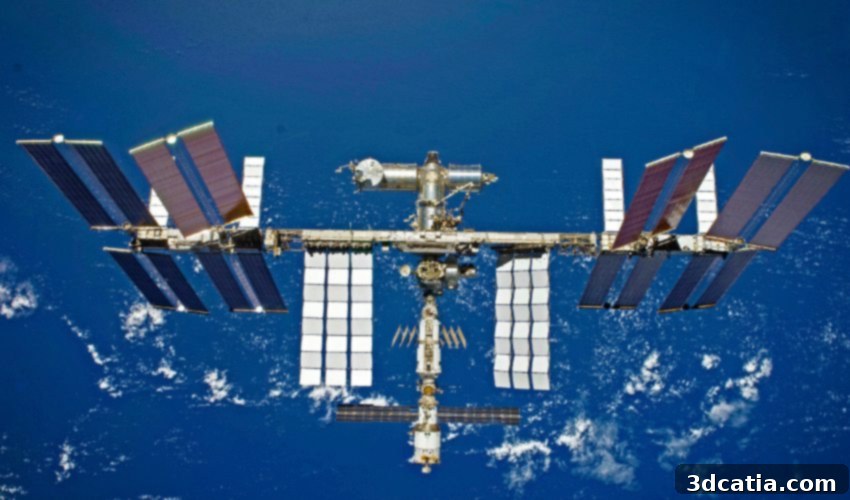
Revolutionizing Space: ESA Achieves Historic Metal 3D Printing on the International Space Station
Last week marked an extraordinary milestone in the history of space exploration and manufacturing. Aboard the International Space Station (ISS), the European Space Agency (ESA), in a groundbreaking collaboration spearheaded by Airbus, successfully completed the first-ever metal 3D printing in the challenging microgravity environment of space. This monumental achievement is set to redefine in-orbit manufacturing, offering unprecedented opportunities for sustainability, self-sufficiency, and the future of deep space missions. It represents a crucial step towards eliminating the arduous and costly process of returning to Earth for essential repairs, spare parts, or hardware components, paving the way for a truly circular economy in space.
The ESA’s ambitious vision for establishing a sustainable, closed-loop economy beyond Earth received a powerful and tangible boost with this success. Inside the sophisticated confines of the Columbus research module on the ISS, the Airbus-built metal 3D printer sprang to life. Utilizing a high-power laser and precise feeding of stainless-steel wire, the printer meticulously deposited its first molten “S curve.” This demonstration was not merely a proof of concept; it was a clear and compelling affirmation of the technology’s capability to fabricate intricate and robust metal structures in a weightless environment, a feat previously confined to Earth-based laboratories. The ability to create such precise geometries under microgravity conditions showcases the immense potential for complex component manufacturing in space.

The ESA’s “S curve” 3D print, printed from liquified stainless steal.
The development and deployment of the Metal 3D Printer (M3DP) on the ISS were the culmination of years of meticulous research, engineering, and international cooperation. This pioneering project involved a dedicated consortium, with Airbus taking the lead on the hardware development, working closely with the European Space Agency and the French space agency CNES (Centre National d’Études Spatiales). The collaborative effort spanned multiple engineering disciplines, from materials science and laser physics to robotic control and microgravity operations, highlighting the complex interdisciplinary nature of space innovation. The successful operation of the M3DP is a testament to the ingenuity and perseverance of these teams, pushing the boundaries of what is possible in extraterrestrial manufacturing.
Given the unique and sensitive environment of the International Space Station, safety measures during the printing process were not just important, but absolutely paramount. The metal 3D printer was meticulously designed to operate within a fully sealed, robust enclosure. This critical containment system served a dual purpose: it prevented the escape of any excess heat generated by the high-power laser and, more importantly, ensured that no fumes or metallic particles could contaminate the ISS’s atmosphere or pose a risk to the astronaut crew. Every aspect of the operation was remotely monitored by a specialized team of ESA, Airbus, and CNES researchers, stationed on Earth. This ground control team maintained constant vigilance, analyzing data streams and ensuring that the procedure adhered to the strictest safety protocols, thereby guaranteeing a secure and successful initial printing test.
The initial printing test’s successful outcome was met with palpable enthusiasm and profound optimism from all parties involved. Sébastien Girault, lead system engineer for the project at Airbus, succinctly captured the sentiment, remarking, “We’re very happy to have performed the very first metal 3D printing aboard the ISS. The quality is as good as we could dream.” This statement underscores not only the technical triumph but also the immense relief and excitement surrounding the validation of years of painstaking work. Achieving Earth-like quality in a microgravity environment is a significant validation, confirming that the printed components hold the structural integrity and precision required for potential space applications. This initial success sets a high bar for future in-space manufacturing endeavors and validates the robust design and operational protocols put in place.
Looking ahead, the ESA has meticulously planned a series of follow-up experiments to thoroughly test the metal 3D printer’s capabilities and performance envelope. The next phase involves creating four specific metal shapes, each designed to provide crucial data. These space-printed parts will undergo rigorous comparative analysis with identical reference prints that have been manufactured on the ground under normal gravity conditions. This direct comparison is vital; it will provide invaluable insights into the nuanced effects of prolonged microgravity on the metallurgical properties, structural integrity, and overall quality of metal prints. Understanding these subtle differences is paramount for refining future designs, material selections, and printing parameters for increasingly complex components in space.
Advenit Makaya, an ESA materials engineer deeply involved in the project, elaborated on the meticulous post-printing analysis plan: “Two of these printed parts will be analyzed in the Materials and Electrical Components Laboratory at ESTEC in the Netherlands to help us understand whether prolonged microgravity has an effect on the printing of metallic materials. The other two will go to the European Astronaut Centre and the Technical University of Denmark, DTU.” This multi-faceted approach ensures a comprehensive evaluation, leveraging diverse expertise. ESTEC’s advanced laboratories will delve into the microstructural integrity and mechanical properties, while the European Astronaut Centre might explore aspects related to human interaction and operational considerations. DTU’s involvement will likely focus on further research and development, potentially informing the next generation of space additive manufacturing technologies. The insights gained from these analyses will be critical for certifying future components for flight and expanding the range of applications for in-space metal 3D printing.
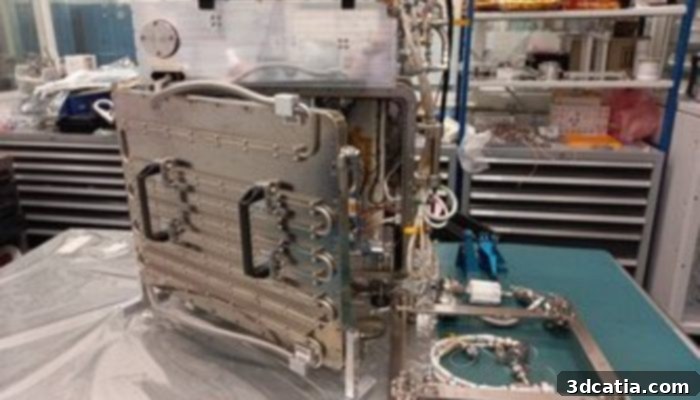
ESA’s 3D metal printer contained in a fully-sealed box for safety measures.
Beyond its immediate technological applications, the ESA’s achievement holds profound promise for the broader future of space exploration and global sustainability. By successfully demonstrating the feasibility of in-orbit manufacturing for complex metallic structures, this technology opens the door to a new era of self-sufficiency for humanity in space. Imagine a future where critical satellite components, robust habitat modules for lunar bases, or even specialized tools for Martian explorers can be fabricated on demand, directly in space. This paradigm shift will dramatically reduce the reliance on costly and time-consuming launches from Earth, decrease mission logistics complexity, and provide astronauts with unprecedented autonomy.
The implications for long-duration missions are particularly significant. For journeys to the Moon, Mars, and beyond, where resupply missions are impractical or impossible, the ability to print spare parts, tools, or even vital infrastructure from available raw materials becomes a game-changer. This capability is not just about repairs; it’s about enabling sustainable human presence across the solar system, fostering a genuine circular economy where resources are recycled and repurposed. Furthermore, it paves the way for greater customization and rapid iteration of designs, allowing for adaptation to unforeseen challenges or evolving mission requirements, making future space endeavors more resilient and ambitious. This breakthrough positions Europe at the forefront of additive manufacturing in space, fostering innovation and inspiring a new generation of scientists and engineers.
The success of metal 3D printing on the ISS is more than just a technological feat; it is a fundamental shift in how we approach space exploration and resource utilization. It lays the groundwork for future space factories, capable of constructing larger structures directly in orbit, like advanced telescopes or even solar power stations. Such capabilities could dramatically reduce the cost and risk associated with launching large, pre-fabricated components from Earth, unlocking new possibilities for scientific discovery, commercial enterprise, and human settlement beyond our home planet. As the technology continues to evolve, we can anticipate a future where space becomes a thriving hub of innovation, with on-demand manufacturing playing a central role in every aspect of our celestial endeavors. To delve deeper into this monumental achievement and explore more details about the mission, interested readers are encouraged to click here.
What are your thoughts on the European Space Agency’s groundbreaking accomplishment of metal 3D printing aboard the ISS? We invite you to share your insights and predictions for the future of space manufacturing in a comment below. You can also join the conversation and connect with us on our LinkedIn, Facebook, and Twitter pages for the latest updates and discussions! Don’t miss out on vital news; be sure to sign up for our free weekly newsletter here to receive the most recent 3D printing news directly to your inbox! Additionally, you can explore all our engaging videos and content on our dedicated YouTube channel.
*All Photo Credits: European Space Agency