

Revolutionizing Flexible Electronics: How Template-Constrained Additive (TCA) Printing Achieves Unprecedented Durability and Precision
Conformal electronics, characterized by their remarkable stretchability and flexibility, are at the forefront of innovation in various fields, from advanced robotics and intricate biomedical sensors to next-generation smart skins and wearable devices. These cutting-edge electronic components are designed to conform to irregular surfaces, allowing for seamless integration into diverse applications where traditional rigid electronics fall short. The ability to bend, stretch, and twist without compromising functionality opens up a myriad of possibilities, pushing the boundaries of what electronic devices can achieve.
While the concept of 3D printing conformal electronics has long been a subject of intense research and development, the practical implementation has historically been fraught with significant challenges. Traditional manufacturing processes, including early additive manufacturing techniques, often struggle to produce devices that can withstand the rigors of real-world use. A major drawback has been the inherent mechanical and thermal vulnerabilities of these electronics. Circuits made through conventional methods are frequently prone to damage such as tearing, cracking, and delamination, especially when subjected to repeated mechanical stress or fluctuations in temperature. These issues severely limit their performance, reliability, and overall lifespan, hindering their widespread adoption in critical applications.
Furthermore, the fabrication of high-resolution circuits that incorporate a diverse range of materials—from conductive inks to flexible polymers—presents considerable technical hurdles. Achieving both intricate precision and robust mechanical durability simultaneously has remained a complex engineering feat. This dual requirement necessitates innovative manufacturing techniques that can not only deposit materials with extreme accuracy but also ensure that the resulting structures possess superior resilience against environmental and mechanical stresses. The need for such advancements has become increasingly urgent as the demand for more reliable and adaptable electronic systems continues to grow across industries.
Addressing these critical limitations in conformal electronic fabrication, researchers at Xi’an Jiaotong University have pioneered a groundbreaking solution: Template-Constrained Additive (TCA) printing technology. Their significant findings, published in December 2024 in a paper titled “Root-inspired, template-confined additive printing for fabricating high-robust conformal electronics,” introduce a novel method poised to revolutionize the durability and precision of additively manufactured electronic circuits. This innovative approach promises to overcome the long-standing challenges associated with fabricating robust flexible electronics, paving the way for a new era of highly reliable and adaptable electronic devices.
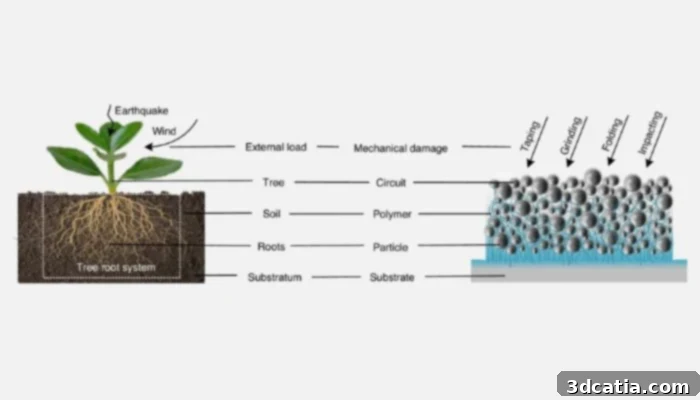
Image credit: Xi’an Jiaotong University
Template-Constrained Additive (TCA) Printing: Inspired by Nature’s Engineering Masterpiece – Tree Roots
The ingenuity behind the TCA printing technology stems from a profound appreciation for nature’s robust engineering. This truly biomimetic approach draws direct inspiration from the extraordinary strength and stability of tree root systems. Anyone who has witnessed a mighty tree standing firm against violent winds or enduring the tremors of an earthquake can attest to the incredible anchoring power of its roots. The secret to this unparalleled resilience lies in the intricate relationship between the roots and the surrounding soil. Tree roots do not simply sit in the soil; they intricately interlock with it, creating a dense, interwoven network that promotes the tight stacking and consolidation of soil particles. This mechanical interlock dramatically increases the system’s resistance to external forces, providing unparalleled stability.
Recognizing this fundamental principle, the researchers at Xi’an Jiaotong University sought to replicate these powerful natural mechanics at a microscopic level within electronic circuits. Their objective was to design a circuit structure that would mimic the interlocking relationship between tree roots and soil, but instead, integrate polymers and conductive materials in a similarly robust, interwoven fashion. This novel concept aimed to engineer internal structural strength, rather than relying solely on material properties, to significantly enhance the overall mechanical integrity of the electronic devices.
To achieve this biomimetic interlocking, the TCA method cleverly embeds an adhesive polymer deep within the functional materials of the electronic circuit. This process creates a sophisticated, deep interlocking interface that acts much like the interwoven roots and soil, dramatically strengthening the circuit’s mechanical integrity. Unlike conventional layering methods where materials simply sit on top of each other, this embedded adhesive ensures a strong, cohesive bond throughout the circuit’s structure. As a result, the circuits manufactured using TCA technology demonstrate exceptional resilience, maintaining their full electrical performance even when exposed to extreme environmental conditions, including significant mechanical deformation or wide temperature fluctuations. This robust structural integration directly translates to enhanced dependability and extended operational lifespans for conformal devices.
Beyond superior mechanical properties, TCA printing technology also offers remarkable fabrication capabilities. It facilitates the creation of multi-layered, self-aligned circuits with unprecedented ease and precision. This ability to accurately deposit and integrate multiple material layers, each precisely positioned, overcomes several critical limitations inherent in traditional printing techniques, which often struggle with layer registration and material compatibility. The self-alignment feature streamlines the manufacturing process, reduces errors, and allows for the creation of more complex and higher-density electronic designs, further expanding the potential applications for these advanced flexible devices.
The practical advantages of TCA are truly impressive. Circuits produced with this technology can withstand extreme temperatures, enduring conditions up to an astounding 350°C, making them suitable for environments where other flexible electronics would rapidly degrade. Furthermore, they exhibit exceptional resistance to intense mechanical wear, including repeated bending, stretching, and twisting, without compromising their functionality. This inherent durability is crucial for applications requiring long-term reliability in dynamic or harsh operating conditions. In terms of precision, the technology is capable of achieving high-resolution printing with an incredible accuracy of up to 300 nanometers. This level of detail allows for the creation of intricate and densely packed circuits, pushing the boundaries of miniaturization in electronics. Moreover, TCA printing is highly versatile in its material compatibility, working effectively with a variety of advanced substances, including flexible copolymers, conductive carbon nanotubes, and highly conductive silver nanoparticles. This broad material compatibility ensures that the method can support a diverse range of specialized applications, tailoring the electronic properties to specific functional requirements.
To rigorously test and validate TCA’s viability and versatility, the research team conducted a series of comprehensive experiments, printing circuits on an extensive array of arbitrary surfaces. These surfaces represented a wide spectrum of textures and materials, encompassing both remarkably smooth substrates like acrylic and glass, as well as organic and irregularly shaped surfaces such as chili peppers and nitrile gloves. The testing also included rough and challenging materials like animal pigskin, abrasive sandpaper, and even magnesium alloy. The fact that TCA technology consistently allowed for successful, high-quality circuit printing on all these disparate surfaces emphatically demonstrates the method’s unparalleled flexibility and adaptability. This broad compatibility is a critical advantage, enabling the integration of electronics into almost any form factor or substrate imaginable, without requiring specialized surface preparation.
On these diverse surfaces, the researchers successfully printed functional conformal temperature and humidity sensors, showcasing the technology’s ability to create responsive and accurate environmental monitoring devices. Additionally, they demonstrated the fabrication of ultra-thin energy storage systems, highlighting TCA printing’s potential for developing integrated power solutions for flexible and wearable electronics. The successful demonstration of these complex functionalities across such varied substrates vividly underscores the transformative capabilities of TCA printing. This breakthrough highlights its immense potential to fundamentally reshape the future of electronics manufacturing, moving beyond rigid constraints to enable truly ubiquitous and integrated electronic systems.
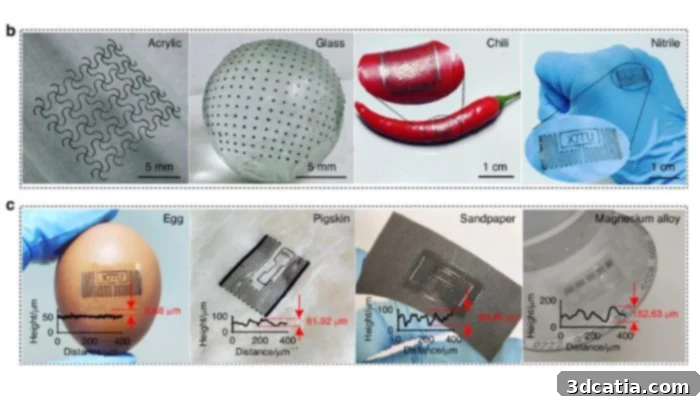
Image credit: Xi’an Jiaotong University
Dr. Jinyou Shao, a distinguished co-author of the study and the insightful group leader, articulated the profound significance of this innovation: “The TCA printing technology represents a major leap forward in the field of conformal electronics. By drawing inspiration from nature, we’ve developed a solution that not only enhances the durability of electronic circuits but also achieves remarkable precision and versatility. This makes it ideal for a wide array of applications, from wearables to advanced robotics.” His statement underscores the dual triumph of the research: achieving both unparalleled robustness and exquisite detail, which are often contradictory goals in materials science and manufacturing. This balance of attributes is what truly sets TCA printing apart as a pivotal advancement in the development of future electronic systems.
Transformative Applications Across Diverse Industries
The enhanced dependability and unparalleled capabilities of the TCA method – specifically its ability to produce electronic circuits that can reliably withstand extreme conditions such as high temperatures, intense mechanical stress, and varied environmental exposures – unlock an extensive range of opportunities across numerous industries. The potential applications appear virtually limitless, extending far beyond current capabilities of traditional electronics.
- Autonomous Vehicles: One particularly impactful area is the burgeoning field of autonomous vehicles. In these complex systems, sensors and electronic components must function flawlessly under incredibly harsh environmental conditions, including extreme temperatures, vibrations, and moisture exposure. TCA-printed circuits can provide the robust, reliable sensing and control systems crucial for the safe and efficient operation of self-driving cars, trucks, and drones, ensuring consistent performance in all weather and terrain.
- Advanced Robotics: For advanced robotics, especially those designed for interaction with humans or complex environments, TCA technology could revolutionize the creation of electronic components for robotic skin and joints. Imagine robots with tactile skins that are not only flexible and durable but also seamlessly integrated with embedded sensors for pressure, temperature, and proximity. This would enable robots to perceive and interact with their surroundings with unprecedented dexterity and sensitivity, crucial for applications in manufacturing, healthcare, and exploration.
- Wearable Devices and Smart Textiles: Beyond industrial applications, everyday objects are poised to benefit immensely from this technology. The creation of next-generation wearable devices and smart textiles will see a significant leap forward. TCA-printed circuits can be integrated directly into clothing or flexible accessories, offering continuous health monitoring, intuitive user interfaces, and enhanced comfort without the bulk or rigidity of conventional electronics. This allows for truly unobtrusive and high-performance smart apparel and personal electronics.
- Aerospace and Defense: In critical sectors like aerospace and defense, where durability, precision, and reliability are not merely advantageous but absolutely critical, TCA printing offers transformative potential. Components for aircraft, spacecraft, and defense systems must endure extreme temperatures, pressure differentials, radiation, and mechanical stress. TCA can produce lightweight, highly robust, and intricately designed electronic systems capable of operating flawlessly in these unforgiving environments, improving mission success rates and operational safety.
- Biomedical Projects: The biomedical field is another area ripe for innovation with TCA technology. Flexible, durable, and precise electronic circuits are essential for advanced medical implants, wearable diagnostic devices, and prosthetic interfaces. TCA’s ability to print on diverse surfaces and its enhanced durability could lead to more comfortable, long-lasting, and biologically compatible electronic solutions for monitoring vital signs, delivering medication, or enhancing sensory perception for individuals with disabilities.
The implications of TCA printing extend across almost every industry reliant on electronic components, promising a future where electronics are not only smarter but also significantly more resilient and adaptable to the world around them. For a more in-depth look at the study and its comprehensive findings, readers are encouraged to consult the full research paper available HERE.
What are your thoughts on this groundbreaking new method for printing conformal electronics? How do you envision TCA technology impacting future electronic designs and applications? Share your insights and perspectives by leaving a comment below, or join the conversation on our LinkedIn, Facebook, and Twitter pages! Don’t miss out on the latest advancements in 3D printing; sign up for our free weekly Newsletter here to get the news delivered straight to your inbox. You can also explore all our videos and in-depth content on our YouTube channel for further insights.