

Revolutionizing Particle Accelerator Technology: 3D Printed Copper RFQs for CERN’s LHC
In the realm of high-energy physics, CERN, the European Organization for Nuclear Research, stands as a beacon of scientific exploration. Home to the world’s largest and most powerful particle accelerator, the Large Hadron Collider (LHC), CERN constantly pushes the boundaries of human knowledge by propelling subatomic particles to incredible speeds, facilitating groundbreaking discoveries about the fundamental building blocks of our universe. The LHC’s primary objective is to transmit immense energy to these particles using sophisticated electric and magnetic fields. A pivotal component in this intricate process is the Radio Frequency Quadrupole (RFQ), an instrument critical for focusing and accelerating particle beams. This article highlights a pioneering development: the potential integration of a 3D printed copper RFQ into CERN’s advanced infrastructure, marking a significant leap in accelerator technology and additive manufacturing capabilities.
The RFQ is renowned for its complex design and challenging assembly, making it one of the most difficult parts to manufacture for particle accelerators. Recognizing these inherent difficulties, a consortium of leading institutions—Fraunhofer IWS, in collaboration with CERN, the Technical University of Riga, and the Polytechnic University of Milan—turned to additive manufacturing (AM), specifically laser powder bed fusion (LPBF), to produce this critical component. This innovative approach promises to redefine the fabrication processes for advanced scientific instrumentation, offering unparalleled precision and design freedom.
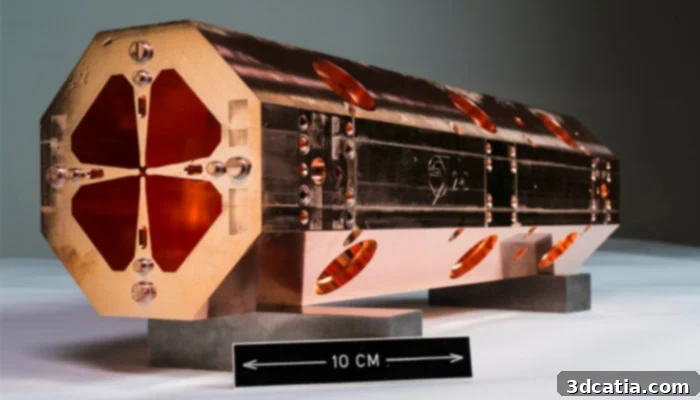
The classic model of a complete quadrupole (photo credits: CERN)
The I.FAST Project: Accelerating Innovation in Science
This collaborative endeavor is an integral part of the I.FAST (Innovation Fostering in Accelerator Science and Technology) Horizon 2020 project, generously funded by the European Union. With a robust network of 49 partners, I.FAST is dedicated to developing novel particle accelerator designs and accelerating innovation within this highly specialized and challenging field. The project acts as a catalyst, bringing together diverse expertise to tackle the most pressing manufacturing and design hurdles in accelerator science. The adoption of metal additive manufacturing in this context serves as a powerful testament to the technology’s burgeoning potential, demonstrating its capacity to deliver concrete solutions for high-stakes scientific applications. This synergy between advanced research and cutting-edge manufacturing techniques is crucial for pushing the boundaries of what is achievable in fundamental physics.
Overcoming Traditional RFQ Manufacturing Challenges with Additive Manufacturing
The Complexities of Conventional RFQ Production
Traditionally, the Radio Frequency Quadrupole (RFQ) is manufactured from highly conductive materials and specialized alloys. The process typically involves multi-axis milling of “prefabricated large-scale-forged single-piece components.” This method is inherently complex, requiring several modules—typically four—to be assembled through a process known as furnace brazing. While brazing forms a strong bond, it frequently introduces residual stresses into the material. These stresses can lead to geometric distortion, compromising the precision and structural integrity essential for an RFQ’s optimal performance. To mitigate these distortions and maintain the extremely high quality levels required for particle accelerator components, multiple heat treatments are necessary throughout the machining process. Each additional heat treatment, however, adds significant time and cost to the production cycle, simultaneously decreasing overall manufacturing efficiency. These conventional challenges highlight the urgent need for more streamlined and precise manufacturing methods.
The Additive Manufacturing Solution: Single-Piece Production and Enhanced Design
Recognizing the inefficiencies and limitations of traditional manufacturing, the project partners strategically pivoted towards additive manufacturing. A key advantage of AM, particularly laser powder bed fusion, is its remarkable ability to produce intricate components as a single, monolithic block. This single-piece construction completely eliminates the need for brazing and the associated problems of residual stresses and geometric distortion. By circumventing these assembly steps, AM offers a pathway to significantly reduce manufacturing time, lower production costs, and enhance the overall reliability of the component.
As explained by the researchers, the ultimate goal is to build “complete segments including all four ‘vanes’ of the RFQ system in one piece.” This not only avoids brazing but also unlocks unprecedented design freedom, allowing for the optimal integration of complex internal elements such as sophisticated cooling channels and precisely positioned external ports. The continuous advancements in additive manufacturing equipment, coupled with sophisticated design capabilities (including advanced simulation tools) and refined manufacturing methodologies, are opening entirely new avenues for RFQ design optimization and full-scale production. This includes the ability to work with challenging materials like pure copper, which presents unique difficulties for laser-based AM processes. Copper’s high reflectivity to laser light means that a significant portion of the energy needed for fusion can be reflected, making precise melting and solidification control more difficult. Nevertheless, ongoing research and technological advancements are making pure copper 3D printing increasingly viable, critical for components requiring exceptional electrical and thermal conductivity.
The Promise and Challenges of 3D Printing Copper for High-Performance Applications
The selection of pure copper for the RFQ component is not arbitrary; its exceptional electrical conductivity is paramount for efficiently guiding and accelerating particle beams. However, 3D printing with pure copper, especially using laser powder bed fusion (LPBF), presents unique challenges. Copper’s high thermal conductivity and, crucially, its high reflectivity to commonly used laser wavelengths (such as those of ytterbium fiber lasers) mean that a significant portion of the laser energy can be reflected away from the powder bed rather than being absorbed for melting. This can lead to inefficient processing, inconsistent melt pools, and difficulties in achieving full density and desired mechanical properties.
Researchers are actively developing solutions to overcome these obstacles. This includes using lasers with different wavelengths that copper absorbs more effectively, employing higher power lasers, optimizing scanning strategies, and pre-heating the build plate to reduce thermal gradients. Advanced process control and in-situ monitoring also play a crucial role in ensuring the quality and integrity of 3D printed copper parts. The ability to successfully 3D print pure copper opens up a world of possibilities for components in demanding applications beyond particle accelerators, such as high-performance heat exchangers, electrical contacts, and rocket engine components, where superior thermal and electrical properties are indispensable.
Designing an Optimized RFQ Prototype: A Glimpse into the Future
To meet the stringent production constraints, particularly regarding geometric precision, surface roughness, and electrical conductivity, the project partners specifically chose laser powder bed fusion utilizing a TruPrint1000 machine. This advanced LPBF system was instrumental in reproducing a quarter-scale prototype of the radio frequency quadrupole currently in use at CERN. The 3D-printed prototype measures 95 mm in length and incorporates several critical features, including the intricate tip of the vane, optimized internal surfaces, and significantly improved cooling channels. Furthermore, the internal structure was completely redesigned, adopting a honeycomb pattern. This intelligent design choice yielded substantial benefits, reducing the volume of material needed by an impressive 37% and consequently decreasing the total weight of the component by 21%. Such material and weight efficiencies are vital for complex scientific instruments where every gram and cubic millimeter count.
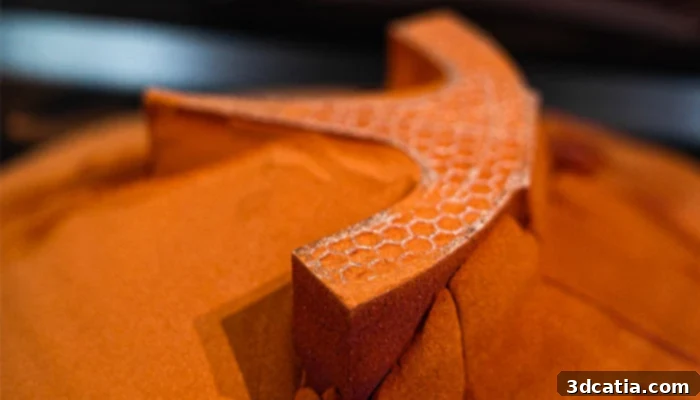
The partners opted for laser powder bed fusion to create the copper RFQ prototype (photo credits: Christoph Wilsnack/Fraunhofer IWS)
The production of this highly complex prototype required 16.5 hours of continuous printing. It was fabricated with an exceptionally fine layer thickness of 30 microns, resulting in a precise final height of 98.01 mm. This level of detail and control achievable with LPBF is what enables the creation of such advanced components, far surpassing the capabilities of conventional manufacturing techniques when it comes to integrating complex geometries and optimizing performance attributes. The successful fabrication of this prototype not only validates the technical feasibility of 3D printing copper RFQs but also demonstrates the immense potential for future innovations in particle accelerator design.
The Broader Impact of 3D Printed RFQs on Science and Technology
The teams involved in this groundbreaking project concluded that “AM technology is particularly well suited for the required mechanical complexity of RFQ and offers significant design and optimisation freedom to meet the stringent manufacturing requirements that cannot be achieved by conventional technologies.” This powerful statement underscores the transformative potential of additive manufacturing. It highlights how AM provides an unprecedented degree of design flexibility, enabling engineers to create geometries and internal structures that are simply impossible to achieve with traditional methods. This freedom is critical for optimizing the performance of RFQs, ensuring they precisely focus and accelerate particle beams with maximum efficiency.
Furthermore, the successful application of 3D printing for copper RFQs “also opens a way to major RFQ improvements and eventually a full-size production, even using pure-copper, which is a technologically demanding material.” This signifies that the current prototype is merely a stepping stone. The research indicates a clear path towards developing full-scale, production-ready RFQs entirely through additive manufacturing, including those made from pure copper. The ability to harness the superior properties of pure copper, combined with the design advantages of AM, could lead to particle accelerators that are more powerful, more efficient, and more compact than ever before.
In essence, 3D printing is poised to have a significant and lasting impact on the manufacture of tomorrow’s particle accelerators, potentially revolutionizing how these monumental scientific instruments are designed, built, and operated. This innovation could accelerate scientific discovery by enabling more sophisticated experiments and pushing the boundaries of what we can learn about the universe. For those interested in the detailed technical aspects of this pioneering work, further information is available HERE.
*Cover Photo Credits: Christoph Wilsnack/Fraunhofer IWS
What are your thoughts on this innovative 3D printed copper Radio Frequency Quadrupole (RFQ)? Do you believe additive manufacturing holds the key to the next generation of particle accelerators? We invite you to share your insights in a comment below or engage with us on our Linkedin, Facebook, and Twitter pages! Don’t miss out on the latest advancements in 3D printing; sign up for our free weekly Newsletter here to get cutting-edge news delivered straight to your inbox! You can also explore all our videos and interviews on our dedicated YouTube channel.