

Agile Space Industries Propels NASA’s Lunar Ambitions with Advanced 3D Printed Thrusters for Griffin Lander
Agile Space Industries, a pioneering firm renowned for its additively manufactured propulsion systems, has been strategically chosen by Astrobotic’s Griffin Mission One (GM1) team. This pivotal collaboration involves the development of custom 3D printed thrusters and sophisticated axial engines specifically engineered for the Griffin lunar lander. The Griffin lander is set to play a crucial role in NASA’s ambitious endeavors, tasked with delivering the Volatiles Investigating Polar Exploration Rover (VIPER) to the Moon’s enigmatic South Pole in an upcoming mission. This mission represents a significant leap in lunar exploration, and Agile’s advanced propulsion technologies are at its core.
Agile Space Industries leverages cutting-edge 3D printing techniques to craft its bespoke propulsion solutions, utilizing a diverse range of high-performance metal alloys. Their expertise in additive manufacturing (AM) has previously made them a trusted partner for esteemed organizations such as NASA, the Department of Defense (DoD), and other leading entities within the aerospace sector. Additive manufacturing is rapidly transforming the aerospace industry, particularly in space exploration. Manufacturers are increasingly recognizing that AM enables the creation of parts that are not only lighter and more cost-effective but also significantly more efficient. This is primarily due to the unique design freedoms offered by AM, allowing for complex geometries and optimized structures that are impossible with traditional manufacturing methods, alongside the utilization of advanced materials.
Astrobotic’s selection by NASA underscores the critical nature of the Griffin Mission. The objective is to transport NASA’s VIPER rover to the Moon’s South Pole, a region of immense scientific interest. This mission carries extraordinary importance because the VIPER rover is specifically designed as a water-seeking instrument, intended to meticulously map the distribution and presence of water ice on the lunar surface. Discovering and characterizing lunar water ice could revolutionize future human missions, providing a vital resource for drinking water, rocket fuel, and breathable air. However, the Moon’s South Pole presents formidable challenges, having never been visited by an American spacecraft. The harsh environment, extreme temperatures, and complex terrain demand an unprecedented level of innovation and reliability in every aspect of the project, especially propulsion.
Daniel Gillies, Astrobotic Mission One director, emphasized the innovative spirit driving the project: “The mission has a tremendous amount of innovation involved. It requires extremely mass efficient performance from the propulsion system, within a fixed budget and schedule.” In an environment where every gram counts, and stringent financial and timeline constraints are in place, additive manufacturing emerges as the ideal solution. Its inherent ability to produce highly optimized, integrated components with minimal waste makes it a perfect fit. Astrobotic’s decision to partner with Agile Space Industries for the development of custom-engineered thrusters, known as Attitude Control Thrusters (ACTs), directly addresses these needs. These ACTs are vital for providing precise steering capabilities in the unforgiving vacuum of space, ensuring the Griffin lander can navigate accurately to its target destination on the lunar South Pole.
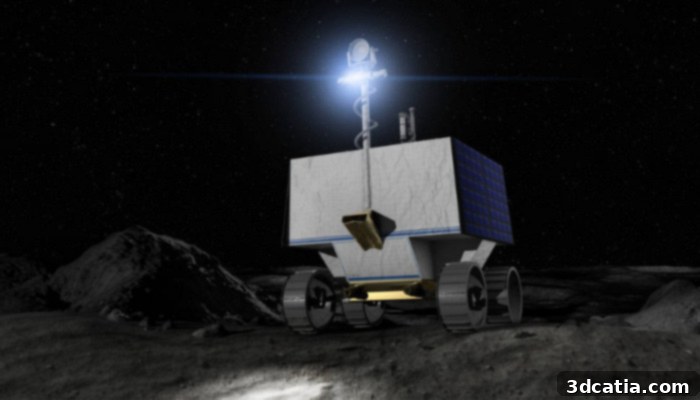
An Illustration of NASA’s VIPER on the surface of the Moon (photo credits: NASA Ames/Daniel Rutter)
Agile’s Groundbreaking 3D Printed Thrusters for Lunar Exploration
Agile Space Industries is no stranger to the development and production of advanced 3D printed thrusters. Their extensive experience in this specialized field is evident in their previous designs, such as the A110, a successor to the ACT developed for the Griffin mission. The A110 was meticulously 3D printed using proprietary aerospace alloys specifically chosen for their ability to withstand the extreme temperatures and immense stresses generated by rapid bursts of combustion in a vacuum. This proven technology and material expertise are directly transferable and will be fully implemented in the Griffin-optimized ACTs. These sophisticated thrusters are crucial for enabling the Griffin lander to accurately and reliably navigate thousands of miles through the vast expanse of space, ensuring a precise and safe touchdown at its intended lunar destination.
Beyond their manufacturing prowess, Agile is uniquely positioned with industry-leading testing capabilities. Their state-of-the-art test cell is engineered to rigorously simulate the harsh and unforgiving conditions of outer space, including extreme temperatures and vacuum environments. This meticulous testing process is indispensable for validating the performance and reliability of the thrusters under real-world operational stresses. By subjecting each component to these rigorous tests, Agile ensures that the thrusters are not only high-performance but also fully mission-ready, mitigating risks for such a critical lunar endeavor. This comprehensive approach, from design and additive manufacturing to exhaustive testing, exemplifies Agile’s commitment to quality and innovation in space propulsion.
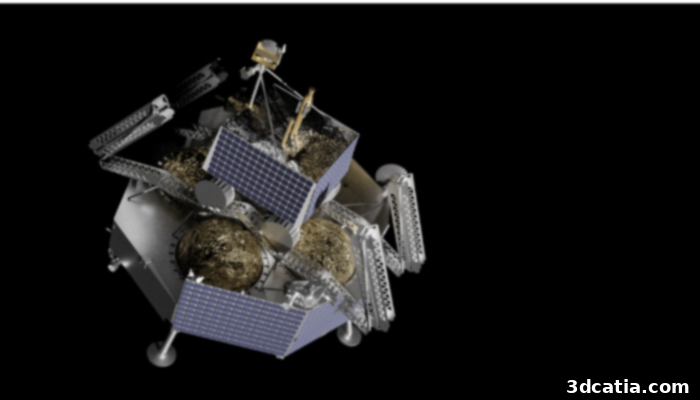
An illustration of The Griffin Lunar Lander carrying VIPER (photo credits: Astrobotic)
Jeffry Max, co-founder and CEO of Agile Space Industries, shed light on the strategic decision behind their selection, emphasizing the transformative power of additive manufacturing in their thruster production. Max articulated, “In an industry like aerospace, where new technology developments are expected to take years, the speed at which Agile develops propulsion solutions is opening up missions and opportunities that were previously unachievable.” This statement highlights a key advantage of 3D printing: its ability to drastically reduce development cycles, accelerate prototyping, and enable rapid iteration of designs. Traditional manufacturing often involves lengthy lead times and complex tooling, whereas AM allows for quick design modifications and direct part production, significantly compressing the time from concept to flight-ready hardware.
Max further elaborated on the core strength of Agile, stating, “The foundation for this unprecedented agility is our unique combination of propulsion engineering, additive manufacturing (3D alloy printing) and integrated testing facilities and expertise.” This holistic approach is critical for success in the demanding space sector. By integrating design, advanced manufacturing, and rigorous testing under one roof, Agile can ensure seamless development and optimal performance. This synergy allows them to create highly customized, high-performance propulsion systems that meet the stringent requirements of lunar missions, all while adhering to tight budgets and schedules. This integrated methodology not only fosters innovation but also significantly enhances the reliability and efficiency of their 3D printed thrusters, positioning Agile Space Industries as a pivotal partner in the future of space exploration. For more detailed information about Agile Space Propulsion’s ACTs, interested readers can refer to the official press release HERE.
The collaboration between Agile Space Industries, Astrobotic, and NASA represents a significant milestone in space exploration, showcasing the indispensable role of advanced additive manufacturing. The deployment of Agile’s 3D printed Attitude Control Thrusters on the Griffin lander for the VIPER mission is a testament to the power of innovation in overcoming the challenges of lunar exploration. As humanity continues to push the boundaries of space travel, technologies like 3D printing will be instrumental in making missions to the Moon and beyond more feasible, sustainable, and successful. The ability to create lighter, more efficient, and rapidly developed propulsion systems is not just an incremental improvement; it is a fundamental shift that opens up entirely new possibilities for scientific discovery and human presence in the cosmos.
What are your thoughts on the crucial role of 3D printing in the creation of the ACTs for the Griffin Mission and its broader implications for future lunar endeavors? We encourage you to share your insights in a comment below or join the discussion on our Linkedin, Facebook, and Twitter pages! Don’t miss out on the latest advancements in additive manufacturing and space technology – sign up for our free weekly Newsletter here, and get the most recent 3D printing news delivered straight to your inbox!
*Thumbnail photo credits: Agile Space Industries