
Dynamic Interface Printing (DIP): Revolutionizing Bioprinting with Unprecedented Speed and Precision
The landscape of manufacturing has been fundamentally reshaped by the advent of 3D printing technologies, enabling advancements from rapid prototyping to the intricate fabrication of complex biomedical structures. Among the various additive manufacturing methods, Digital Light Processing (DLP) has distinguished itself through its notable speed and ability to produce highly detailed objects. However, even DLP, with all its advantages, has encountered inherent limitations, particularly concerning the uniformity of printed materials and the efficient dissipation of heat during the printing process. These challenges have often restricted its application in highly sensitive fields like bioprinting, where material integrity and cellular viability are paramount. But now, a groundbreaking innovation from researchers at the University of Melbourne promises to overcome these longstanding hurdles. Introducing Dynamic Interface Printing (DIP) – a novel technique poised to fundamentally transform the capabilities of bioprinting and broader additive manufacturing.
The pioneering DIP process, which garnered significant attention upon its publication in the prestigious journal *Nature*, represents a truly disruptive approach to light-based 3D printing. Its core innovation lies in strategically shifting the printing point from a static, fixed plane to the dynamic surface curve of the precursor liquid itself, known as the meniscus. This ingenious redirection of the printing interface allows for an unprecedented level of control over material flow and significantly optimizes heat dissipation within the system. These two critical elements – precise material control and effective thermal management – are absolutely essential for achieving the high-precision and high-speed requirements demanded by next-generation 3D printing applications, especially in the delicate realm of creating biological constructs.
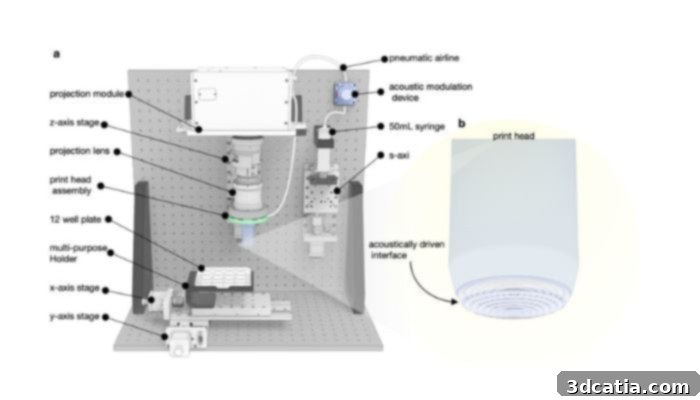
CAD model of the DIP printing system and its mechanical components.
Understanding the Groundbreaking Technology Behind DIP
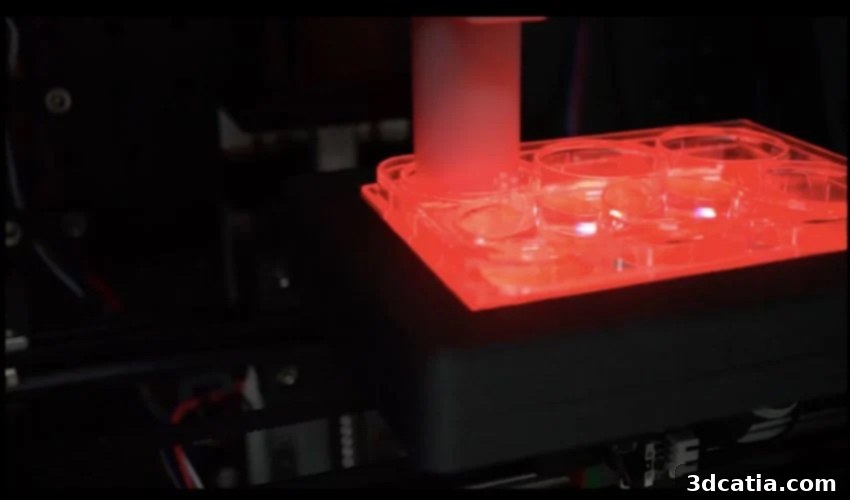
At the heart of the Dynamic Interface Printing process lies a sophisticated mechanism designed for unparalleled control. It utilizes a pressurized tubular printhead positioned precisely above a tank containing the precursor liquid, which can range from biocompatible hydrogels to specialized resins. This printhead is engineered to project meticulously controlled light patterns onto the meniscus – the curved surface of the liquid – not through direct contact, but through the precise application of controlled acoustic vibrations. These vibrations are key; they dynamically shape and stabilize the printing surface, allowing for an incredibly precise and constantly renewed interface where photopolymerization occurs. This dynamic control over the meniscus ensures that material builds up uniformly and continuously, layer by intricate layer, effectively mitigating the common problems of localized heating and subsequent printing errors that plague traditional methods. The result is a printing speed that can reach an impressive 0.7 millimeters per second, representing a significant leap forward in additive manufacturing throughput, particularly when compared to previous iterative light-based techniques.
This innovative acoustic control not only enhances speed but also profoundly impacts the quality and integrity of the printed structures. By continuously refreshing the liquid interface and preventing localized heat accumulation, DIP ensures a more uniform polymerization, leading to stronger, more consistent prints. This is especially crucial for bioprinting, where variations in temperature and material properties can compromise the viability of living cells or the functionality of biological constructs. The ability to print continuously, rather than in discrete, static layers, also reduces the potential for delamination and improves the overall structural integrity of the final product. This combination of speed, uniformity, and thermal control positions DIP as a game-changer for applications demanding both high resolution and robust material characteristics.
The Transformative Potential of DIP in Bioprinting
The potential applications of this novel process are truly immense, particularly within the rapidly evolving field of bioprinting. In bioprinting, where the fabrication of living tissues and organs demands unparalleled precision, sterility, and biocompatibility, DIP offers solutions to some of the most persistent challenges. Its capacity to print at exceptionally high resolutions and, significantly, directly onto standard laboratory plates, marks a pivotal advancement. This direct-to-plate capability streamlines workflows, reduces contamination risks, and accelerates the often-tedious process of creating complex cellular structures for research and therapeutic purposes. Imagine the impact on drug discovery, where intricate organ-on-a-chip models can be fabricated with greater fidelity, or in regenerative medicine, where personalized tissue grafts can be rapidly produced.
During rigorous testing, the scientists behind DIP vividly demonstrated its effectiveness. They observed a marked increase in cell survival rates within printed constructs – a critical metric for any bioprinting technology – alongside a substantial reduction in overall printing time. Furthermore, the DIP method inherently eliminates the need for extensive physical manipulation of delicate biological samples post-printing, a factor that not only preserves cell viability but also ensures the sterility of the entire process. This combination of enhanced cell survival, accelerated production, and inherent sterility positions DIP as a leading contender for bringing bioprinting out of the lab and closer to clinical reality. It promises to unlock new possibilities for creating sophisticated biological models for disease research, developing personalized therapeutic implants, and ultimately, advancing the frontiers of human tissue engineering.
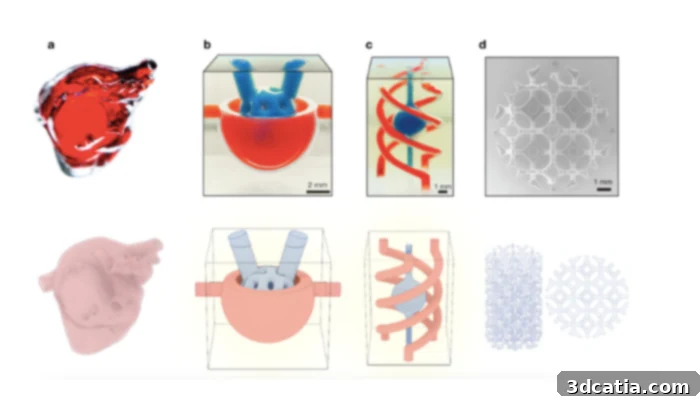
Above, parts printed with the new DIP system and, below, their CAD models.
The applications for DIP span a wide spectrum, from the creation of robust biological models for pharmaceutical testing to the ambitious goal of engineering functional living tissues for transplantation. Callum Vidler, one of the brilliant lead authors of the study, eloquently articulates the current state and future promise: “Biologists recognize the immense potential of bioprinting, but until now, it has been limited to applications with a very low output.” This highlights a critical bottleneck that DIP is specifically designed to address. By offering significant improvements in speed, accuracy, and consistency, the new DIP process is uniquely positioned to overcome these previous throughput limitations. Vidler further emphasizes the profound impact of their work, stating, “This creates a crucial bridge between lab research and clinical applications,” suggesting a future where groundbreaking biological discoveries can be more readily translated into tangible patient benefits and widely adopted medical solutions.
The global interest and collaborative spirit surrounding this technology are further underscored by the extensive network of researchers involved. The Australian team collaborated with an impressive roster of over 60 scientists, including distinguished specialists from world-renowned institutions such as Harvard Medical School and the Sloan Kettering Cancer Center. This broad interdisciplinary collaboration from leading medical and research hubs signifies the widespread recognition of DIP’s potential and its critical role in advancing biomedical science. As Vidler notes, the feedback from this esteemed community has been “overwhelmingly positive,” indicating strong endorsement and anticipation for the technology’s widespread adoption and future development. Such strong validation from the scientific community suggests that DIP is not just an incremental improvement, but a significant leap forward with far-reaching implications.
Paving the Way for a New Era in Additive Manufacturing
Dynamic Interface Printing represents a truly significant advance not only for bioprinting but for the entire field of 3D manufacturing. This innovative technique fundamentally redefines how light can be harnessed to achieve unprecedented levels of precision and control in additive processes. The synergistic combination of remarkable speed, inherent biocompatibility, and exquisite precision offered by the new DIP process is poised to usher in a new era for 3D printing. It moves beyond conventional layer-by-layer constraints, offering a dynamic and continuous fabrication method that could enable the creation of structures previously deemed impossible or impractical to produce. This paradigm shift will likely stimulate further research and development, pushing the boundaries of what is achievable with light-based manufacturing.
As its visionary creators aptly point out, this cutting-edge technology successfully “fills a gap” in existing bioprinting capabilities, addressing long-standing issues that have impeded its broader application. It marks the beginning of a future where many current technical limitations in creating complex biological and industrial structures are systematically overcome. This opens up exciting avenues for innovation across various sectors, from personalized medicine and drug screening to advanced materials science and micro-device fabrication. The possibilities are vast, and DIP provides a powerful new tool to explore them. To delve deeper into this groundbreaking research and its implications, you can learn more by visiting the original University of Melbourne article HERE.
What are your thoughts on the revolutionary Dynamic Interface Printing 3D printing technology and its potential impact on bioprinting and beyond? We invite you to share your insights in a comment below or join the conversation on our active social media channels. You can find us on LinkedIn, Facebook, and Twitter! And for those who want to stay at the forefront of additive manufacturing news, don’t forget to sign up for our free weekly newsletter here to receive the latest 3D printing updates directly in your inbox. You can also explore all our engaging videos and deeper dives into 3D printing innovations on our dedicated YouTube channel.
*All Photo Credits: Nature