
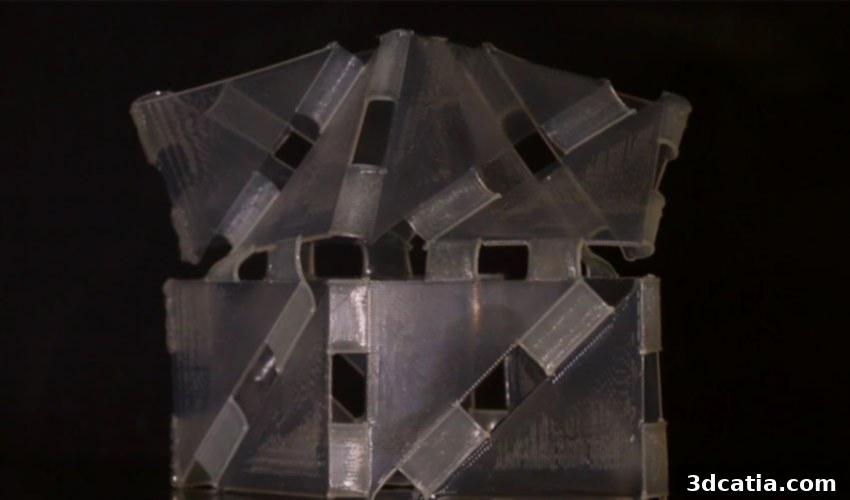
Revolutionizing Soft Robotics: The Power of 3D Printing and Self-Folding Smart Materials
Soft robotics represents a groundbreaking subfield within robotics, dedicated to the creation of robots from highly compliant and deformable materials. Unlike their rigid, traditional counterparts, soft robots are designed to mimic the flexibility, adaptability, and resilience observed in living organisms. This bio-inspired approach seeks to enable robots to move, interact, and navigate complex, unstructured environments with unprecedented dexterity and safety. Historically, a significant challenge for soft robots has been their reliance on external power sources and intricate control systems, which often limits their autonomy and potential applications. However, pioneering research from Harvard University and the California Institute of Technology is dramatically shifting this paradigm. Their innovative work involves developing origami-inspired soft-robotic systems, brought to life through advanced additive manufacturing techniques. These cutting-edge 3D printed soft robots possess the remarkable ability to move and change shape autonomously, responding directly to external stimuli without the need for cumbersome external power units or constant human intervention.
The Indispensable Role of 3D Printing Technologies in Soft Robotics
The advent of 3D printing, particularly in its capacity for multi-material and high-resolution fabrication, has become absolutely crucial for advancing the field of soft robotics. This technology provides an unparalleled ability to integrate diverse materials and complex geometries into a single, cohesive structure. Dr. Jennifer A. Lewis, the distinguished Hansjorg Wyss Professor of Biologically Inspired Engineering at Harvard SEAS and a co-lead author of the pivotal study, eloquently states: “The ability to integrate active materials within 3D printed objects enables the design and fabrication of entirely new classes of soft robotic matter.” This statement underscores the transformative impact of additive manufacturing. It’s not just about creating shapes; it’s about embedding intelligence and functionality directly into the material structure. The researchers specifically found that leveraging the principles of origami – the ancient art of paper folding – allowed them to overcome many design hurdles and create truly multifunctional soft robots. Origami provides a blueprint for creating intricate, dynamic forms from a simple, flat sheet, offering a powerful metaphor and practical methodology for designing robots that can dramatically alter their shape and functionality based on environmental cues.
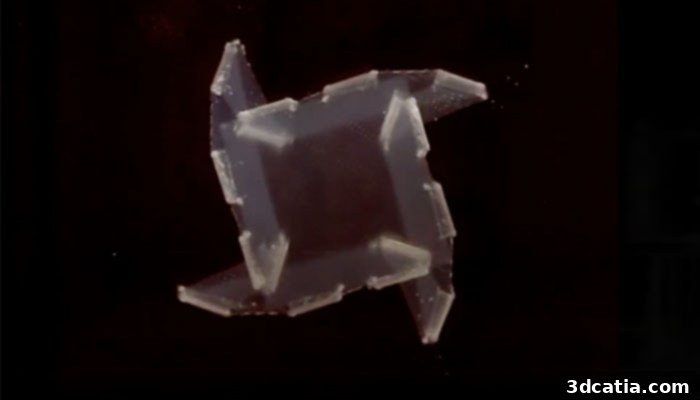
The 3D printed soft robot is folding, showcasing its ability to dynamically change shape.
Engineering Self-Folding Mechanisms: The Innovation of Liquid Crystal Elastomers
At the heart of these innovative self-folding robots lies the intelligent application of smart materials, specifically liquid crystal elastomers (LCEs). LCEs are a fascinating class of materials that exhibit unique properties, combining the elasticity of conventional elastomers with the anisotropic order of liquid crystals. This means that, when exposed to certain stimuli, such as heat, the molecular structure of the LCEs undergoes a phase transition, leading to a predictable and significant change in shape or dimension. The Harvard and Caltech teams harnessed this property by 3D printing two distinct types of liquid crystal elastomers, each meticulously engineered to respond to different specific temperatures. This ingenious approach allowed the researchers to precisely program the structure to fold in a predefined, sequential order. The ability to deposit these different LCEs with micron-level precision using 3D printing is what truly enables the intricate control over the robot’s morphing behavior.
Connor McMahan, a dedicated graduate student at Caltech and co-first author of the pivotal paper, elaborated on the advantages of this design: “Using hinges makes it easier to program robotic functions and control how a robot will change shape. Instead of having the entire body of a soft robot deform in ways that can be difficult to predict, you only need to program how a few small regions of your structure will respond to changes in temperature.” This insight is critical for the scalability and practical application of soft robots. By concentrating the responsive elements into discrete “hinges” or active zones, the researchers significantly simplified the control architecture, moving away from complex distributed actuation mechanisms. This localized control allows for more predictable and robust shape changes, making it far easier to design robots capable of performing specific, programmed tasks. It’s a paradigm shift from trying to control a continuously deforming blob to orchestrating a series of precise, articulated folds, much like a complex piece of origami.
Demonstrating Autonomous Movement: The Rollbot in Action
To powerfully illustrate the groundbreaking findings of their research, the scientists engineered and showcased a remarkable soft robot named “Rollbot.” This innovative creation begins its existence as a simple, flat sheet, approximately 8 centimeters long and 4 centimeters wide. The magic unfolds when the Rollbot is placed upon a hot surface, typically around 200°C. Upon contact with this thermal stimulus, one meticulously programmed set of LCE hinges within its structure rapidly activates and folds. This controlled folding action causes the robot to curl and transform itself into a stable, pentagonal wheel. This transformation is not only visually striking but also functionally significant, as the robot can then roll across the hot surface, demonstrating untethered locomotion powered solely by the environmental heat. This elegant demonstration vividly proves the concept of self-actuation and shape-morphing using precisely 3D printed smart materials. The video below provides a compelling visual account of the Rollbot’s transformation and movement, offering a clear glimpse into the future of autonomous soft robotic systems.
The Promise of Untethered and Multi-Stimuli Responsive Robotics
The ability of these soft robots to operate autonomously without external tethers for power or control is one of the most exciting aspects of this research. As Kotikan, another key author of the paper, succinctly explained: “These untethered structures can be passively controlled. In other words, all we need to do is expose the structures to specific temperature environments and they will respond according to how we programmed the hinges.” This concept of “passive control” is revolutionary. It means that the intelligence for movement and adaptation is embedded directly within the material and structural design of the robot, rather than relying on complex electronic circuits or remote commands. This inherent autonomy opens vast possibilities for deployment in environments where conventional robotics struggle, such as inaccessible areas, delicate biological systems, or hazardous zones where human intervention is difficult or dangerous.
While the initial focus of this particular paper centered on temperature-induced responses, the underlying principles of smart material integration via 3D printing extend far beyond thermals. Researchers anticipate that these versatile soft robots can also be engineered to respond to a diverse array of other external stimuli, including changes in light intensity, pH levels, humidity, chemical presence, or even magnetic fields. This multi-stimuli responsiveness heralds the dawn of truly adaptive and versatile robotic systems. Imagine robots that can navigate aquatic environments by responding to pH gradients, or deploy in rescue missions, detecting and reacting to hazardous chemicals through shape changes. This expanded range of responsiveness vastly broadens the potential applications, paving the way for next-generation robotics in fields as diverse as medical diagnostics, environmental monitoring, exploration in extreme conditions, and even advanced manufacturing processes where self-assembly and self-repair capabilities are paramount.
Blurring Boundaries: The Future Vision of Intelligent Materials and Robotics
Looking ahead, the implications of this research are profound, hinting at a future where the distinction between inanimate material and an active robot becomes increasingly blurred. Chiara Daraio, a distinguished Professor of Mechanical Engineering and Applied Physics at Caltech and a co-lead author of the study, articulates this visionary perspective: “In the future, such materials can be programmed to perform ever more complex tasks, blurring the boundaries between materials and robot.” This vision suggests a future where materials are not merely static components but dynamic, functional entities capable of sensing, adapting, and acting. We are moving towards “programmable matter” – materials whose properties and behaviors can be precisely tailored and changed on demand through their inherent structure and composition. This approach could lead to self-assembling structures, adaptive interfaces, or even “living” architecture that responds to environmental conditions.
The potential applications stemming from this research are enormous and span across numerous industries. In **medicine**, self-folding soft robots could revolutionize minimally invasive surgery, targeted drug delivery, or advanced prosthetics that seamlessly integrate with the human body. For **exploration**, whether in the depths of space, the ocean floor, or disaster-stricken areas, autonomous soft robots could offer unparalleled capabilities for reconnaissance, sample collection, and structural inspection in environments too dangerous or delicate for humans or rigid robots. In **consumer products**, imagine self-assembling furniture, clothing that adapts its insulation based on temperature, or packaging that automatically adjusts to its contents. Furthermore, in **advanced manufacturing**, these materials could lead to self-repairing components, adaptable tooling, or entirely new processes based on dynamic material transformation. While challenges remain in scaling these technologies, increasing their speed of response, and enabling more complex, sequential tasks, the foundational work by Harvard and Caltech provides a robust framework for the next era of robotics, where intelligence is intrinsic to the very fabric of the machine.
For those eager to delve deeper into the scientific specifics of this groundbreaking research, more comprehensive information can be found HERE.
What are your thoughts on these innovative 3D printed soft robots and their potential to transform various industries? We invite you to share your insights in a comment below or connect with us on our Facebook and Twitter pages. Your feedback helps us gauge the usefulness of our articles! And to stay abreast of all the latest advancements and news in the dynamic world of 3D printing, don’t forget to sign up for our free weekly Newsletter, delivered directly to your inbox!