
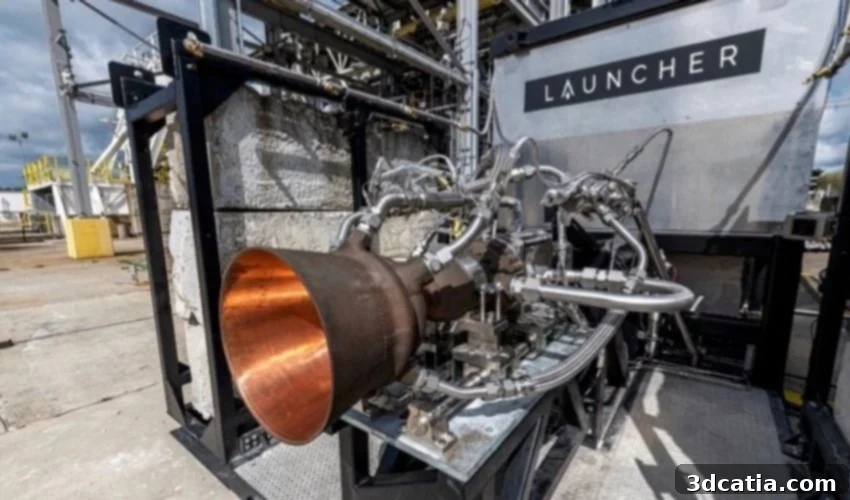
Launcher’s E-2 Rocket Engine: Pioneering 3D Printing for High-Performance Space Propulsion
In the rapidly evolving landscape of aerospace technology, the integration of additive manufacturing is revolutionizing how rockets are designed, built, and tested. Among the innovators leading this charge is Launcher, a US-based company established in 2017. Launcher has consistently captured significant attention for its ambitious projects, particularly its dedicated efforts to develop rockets capable of deploying small satellites into Earth’s orbit. This mission-critical endeavor relies heavily on cutting-edge propulsion systems, and the company recently celebrated a monumental achievement: the successful demonstration of nominal thrust, combustion pressure, and the precise oxidizer-to-fuel mixture ratio for their 3D-printed E-2 rocket engines. This milestone represents a transformative step forward not only for Launcher but for the entire space propulsion industry, underscoring the immense potential of advanced manufacturing techniques in achieving unprecedented performance and reliability.
The path to this success was paved through an extensive series of rigorous tests conducted at the renowned NASA Stennis Space Center, a facility synonymous with groundbreaking rocket engine development. While numerous prior tests laid the groundwork, the breakthrough came on April 21st, 2022. On this pivotal day, Launcher’s E-2 liquid rocket engine not only achieved but flawlessly sustained full thrust, demonstrating an impressive 10 metric tons of thrust (equivalent to 22,046 lbf). Simultaneously, the engine maintained a combustion pressure of 100 bar (1,450 psi) and achieved a highest-performance propellant mixture ratio of 2.62 for its Liquid Oxygen (LOX) and Kerosene propellants, all at the critical 100 bar pressure. These figures are not merely numbers; they represent a significant validation of the E-2’s design and manufacturing process, proving its capability to operate efficiently under extreme conditions. The successful demonstration of “nominal” parameters indicates that the engine performed precisely as designed, meeting all target specifications for sustained operation. This achievement is crucial as it de-risks future development phases and builds confidence in the engine’s readiness for integrated flight tests. Looking ahead, Launcher has outlined its next critical step: a comprehensive three-minute test of the E-2, which will integrate its closed-cycle, high-performance liquid rocket engine with an E-2 turbopump, projected for the fourth quarter of 2022. This extended test duration will further validate the engine’s endurance and the turbopump’s ability to reliably feed propellants under operational conditions, moving Launcher closer to full flight qualification.
Leveraging Advanced 3D Printing for Launcher’s E-2 Rocket Engine
A cornerstone of the E-2’s innovative design is its combustion chamber, which ingeniously incorporates liquid oxygen cooling. What truly sets it apart is the fact that this critical component is 3D printed from a high-performance copper alloy in a single, monolithic piece. Launcher specifically selected a copper-chromium-zirconium (CuCrZr) alloy, sourcing it directly from the industrial supply chain. This strategic choice offers multiple benefits: it significantly reduces manufacturing costs and mitigates potential supply chain constraints often associated with specialized aerospace materials, all while rigorously upholding the stringent quality and performance standards required for spaceflight applications. The CuCrZr alloy provides excellent thermal conductivity and mechanical strength at elevated temperatures, which are essential properties for a combustion chamber exposed to extreme heat and pressure during engine operation. By consolidating multiple parts into a single 3D-printed component, Launcher eliminates complex assembly processes, reduces potential failure points, and ultimately creates a more robust and reliable engine.
Launcher stands as a pioneer in the application of 3D-printed copper alloys for rocket engines, positioning itself at the forefront of additive manufacturing technology within the space launch sector. This innovative approach is made possible through key strategic partnerships. For its additive manufacturing needs, Launcher collaborates closely with AMCM, a leader in advanced metal 3D printing solutions. Together, they have successfully developed a custom, large-format 3D printer capable of producing components up to 100 x 45 x 45 cm. Specifically, the E-2’s intricate one-piece combustion chamber, crafted from the copper alloy, is fabricated on an AMCM M4K 3D printer. This machine’s capabilities are vital for producing the large, complex geometries required for rocket engine components with the precision and material integrity demanded by aerospace standards. Furthermore, the E-2’s state-of-the-art fuel injector, another highly complex and critical component, is fabricated using a Velo3D Sapphire 3D printer. Velo3D’s advanced metal additive manufacturing technology allows for unparalleled design freedom and the production of parts with intricate internal geometries, which are crucial for optimizing propellant flow and mixing. These cutting-edge 3D printing technologies are instrumental in enabling Launcher to achieve higher performance metrics for their engines. This directly translates into increased payload capacity for their rockets, allowing for more satellites to be launched per mission, and concurrently facilitates a reduction in overall launch prices, making space access more affordable and frequent.
Known for its relentless pursuit of innovation and exceptional technical expertise, Launcher is already focused on the next stages of development that will eventually lead to the E-2’s inaugural launch into orbit. Following the successful full-thrust test, the company swiftly moved into planning further validation activities. At the beginning of May, Launcher initiated a new round of testing, with the core chamber and injector designs remaining largely consistent, albeit with minor refinements. A key objective in these subsequent tests is the strategic removal of the entire cooling film from the combustion chamber. While cooling films offer thermal protection, their elimination can lead to significantly increased performance by allowing for a higher effective combustion temperature and pressure. The E-2 engine currently boasts a characteristic velocity (C*) efficiency of 90%, a measure of how efficiently the chemical energy of the propellants is converted into kinetic energy. With the planned modifications and optimization efforts, Launcher aims to elevate this C* efficiency to an impressive 98% after the upcoming test campaigns. Achieving such a high C* efficiency is critical for maximizing specific impulse and overall engine performance, directly impacting the rocket’s ability to carry heavier payloads or reach higher orbits. The culmination of these rigorous development and testing phases is targeted for the first launch of a rocket powered by the E-2 engine, currently scheduled for 2024. This ambitious timeline reflects Launcher’s confidence in its technology and its commitment to providing reliable and cost-effective launch services for the growing small satellite market. To delve deeper into the intricacies of this groundbreaking 3D-printed project, further details and updates can be found on Launcher’s official progress page.
The successful full-thrust demonstration of Launcher’s 3D-printed E-2 rocket engine marks a pivotal moment in aerospace engineering and the practical application of additive manufacturing for critical propulsion systems. This achievement not only validates years of research and development but also paves the way for a new era of more efficient, cost-effective, and powerful launch vehicles. By leveraging advanced copper alloys and bespoke 3D printing solutions from partners like AMCM and Velo3D, Launcher is setting new benchmarks for performance and reliability in space propulsion. The E-2 engine’s journey from concept to a fully-tested, flight-ready component exemplifies the transformative potential of combining innovative design with cutting-edge manufacturing techniques. As Launcher continues its development path towards a 2024 launch, its advancements promise to significantly impact the accessibility and capabilities of small satellite deployment, ultimately accelerating progress in space exploration and commercial ventures. What are your thoughts on Launcher’s remarkable progress with their 3D-printed E-2 rocket engine achieving full thrust? We invite you to share your insights in a comment below or join the conversation on our LinkedIn, Facebook, and Twitter pages! Don’t forget to sign up for our free weekly Newsletter here to receive the latest 3D printing news directly in your inbox! You can also find all our compelling videos and further content on our YouTube channel for more in-depth perspectives on additive manufacturing and space technology.