
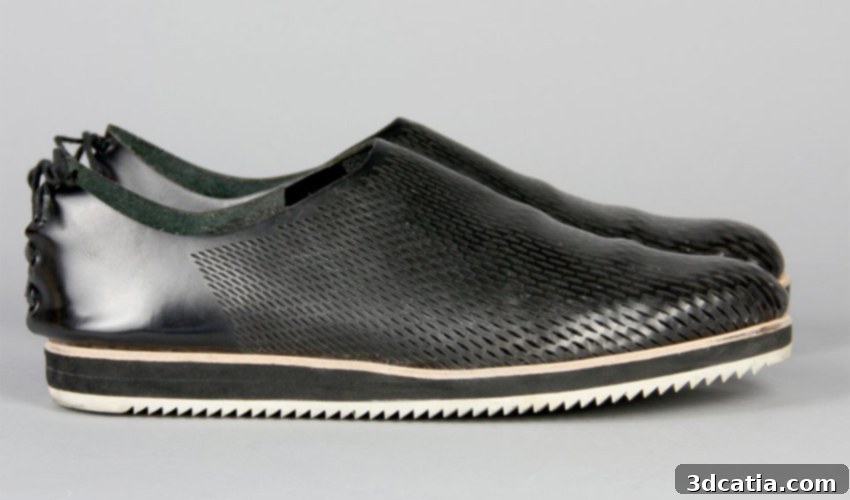
Revolutionizing Footwear: Alex Reed Blends Bespoke Craftsmanship with 3D Printing Innovation
The rapid advancement of 3D printing, also known as additive manufacturing, has dramatically expanded our capabilities, particularly in the realm of personalization and custom fabrication. While some traditional craftspeople might view this innovative technology with skepticism, others readily integrate it into their creative processes. English shoemaker Alex Reed, the visionary behind Alex Reed Shoes, stands out as a prime example of someone fully embracing this disruptive shift. Reed has masterfully fused time-honored English bespoke shoemaking traditions with cutting-edge additive manufacturing to develop an exclusive collection of footwear that pushes the boundaries of design, comfort, and sustainability.
We recently had the distinct pleasure of speaking with Alex Reed, delving into his fascinating journey, his insights into the burgeoning 3D printing industry, and his ambitious plans for the future of footwear. His perspective offers a unique glimpse into how ancient crafts can find new life and unparalleled possibilities through modern technological integration.

Alex Reed
Meet Alex Reed: The Visionary Shoemaker Bridging Tradition and Technology
Alex Reed’s journey into shoemaking and, subsequently, 3D printing, is anything but conventional. It’s a testament to curiosity, self-taught expertise, and a relentless pursuit of innovation within a deeply traditional craft.
3DN: Can you tell us about yourself and your first experiences in 3D printing?
I am 31 years old and was born and raised in London. For over seven years, I’ve dedicated myself to making custom, tailor-made shoes, mastering the production of a wide variety of unisex shoe styles. My initial academic path was in photography at art school. It was during this period that I serendipitously met a seasoned shoemaker who was keen to pass on his extensive knowledge of footwear creation. He took me under his wing, teaching me the intricate art of shoemaking in our Notting Hill workshop. Following my apprenticeship, he employed me as a full-fledged shoemaker. We started small, with me meticulously crafting custom orders in the back of our shop. Our success led to rapid expansion; we soon began wholesaling to renowned retailers like Selfridges, Harrods, and ASOS. We also established a larger factory in London, where I had the privilege of training new apprentices, passing on the very skills I had acquired.
As someone who didn’t receive a formal college education in footwear or manufacturing design, I always found myself questioning the sometimes outdated shoemaking procedures and techniques I was taught. This inherent curiosity fueled a constant desire to research and innovate new methods of footwear production. This drive ultimately led me to explore 3D printing as a viable means to produce durable, high-quality shoes with enhanced design possibilities.
My journey into 3D printing began with familiarizing myself with various 3D modeling and scanning software. It was during this exploration that I discovered the Autodesk brand and their renowned artist-in-residence program at their incredible San Francisco studio, Pier 9. I applied to the program, and to my immense delight, I was accepted into their intensive four-month residency. When I arrived, I had virtually no prior experience in 3D modeling or 3D printing. However, the team at Pier 9 was incredibly supportive of my vision, providing exceptional training and support to rapidly bring me up to speed. My inaugural project at Pier 9 was ambitious: to produce my very own pair of solid polycarbonate (PC-10) shoes using a Fortus M450mc machine. This hands-on experience was transformative, solidifying my belief in the potential of additive manufacturing for footwear.
The Fusion of Craft and Technology: Alex Reed’s Additive Manufacturing Process
Alex Reed’s approach to creating footwear with 3D printing is a thoughtful blend of artistic vision and engineering precision, demonstrating how modern tools can augment, rather than replace, skilled craftsmanship.
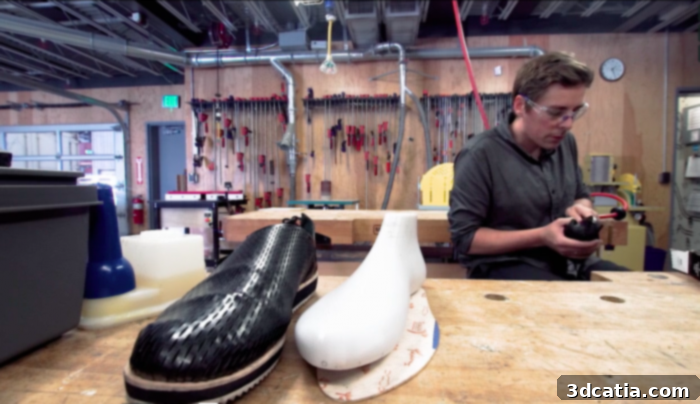
Production of the Alex Reed shoes
3DN: What is the process that is used to create a pair of shoes through additive manufacturing technologies with Alex Reed Shoes?
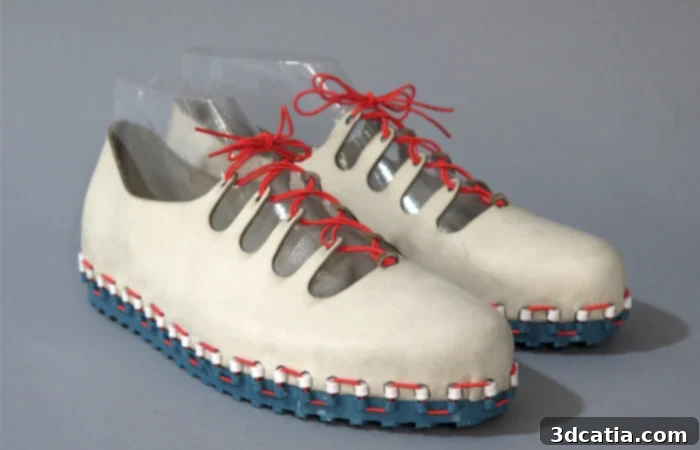
When I embark on creating a new footwear style using additive manufacturing, my first step is always to consider the desired aesthetic and performance characteristics for the final product. The choice of material is absolutely crucial at this stage, as it directly impacts both the look and functionality of the shoe. To date, many of my shoe designs have been produced using a combination of different components and materials, primarily leather, polyester mesh, and TPU filaments like Ninjaflex. This multi-material approach allows me to leverage the strengths of each, creating complex and highly functional designs.
Interestingly, much of the work I’ve undertaken with 3D technology still draws heavily on heritage practices commonly employed by traditional cobblers. This ensures that while the manufacturing method is new, the underlying principles of shoe construction and wearer comfort remain rooted in established expertise. The synergy between these methods is what truly defines my unique approach.
At Pier 9, the printers primarily consisted of the FDM (Fused Deposition Modeling) variety. While FDM has proven invaluable for many applications, I am still eager to fully explore the immense potential of SLS (Selective Laser Sintering) technology. The inherent limitations of FDM printers for producing the intricate, complex shapes required in footwear designs mean that it is often suboptimal for achieving the finest details and mechanical properties required for advanced shoe components. SLS offers greater design freedom, finer resolution, and the ability to work with a wider range of engineering-grade materials, which I believe will unlock even more innovative possibilities for shoe construction.
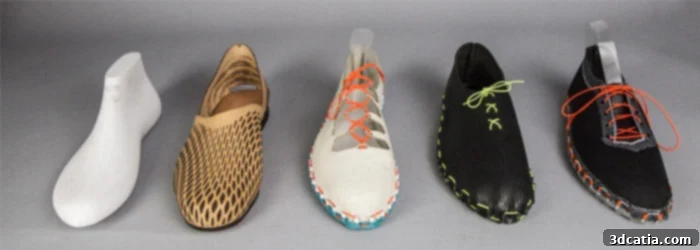
Some Alex Reed shoes, created with 3D printing technology
Most of the initial design work for a new shoe concept tends to happen quite quickly. I usually begin by outlining my ideas in a notebook before transitioning to digital modeling, primarily using Fusion360. Once I have a decent 3D model, the real joy of this medium comes to light: rapid iteration. The ability to quickly modify and test designs saves an incredible amount of time compared to traditional methods. This efficiency allows me to dedicate more effort to developing both the aesthetic style and technical elements, while swiftly addressing any design or fit issues that emerge during testing. This iterative process is a cornerstone of how 3D printing accelerates innovation.
After several components have been 3D printed and, in some cases, laser-cut, the final assembly is meticulously done by hand. This crucial step leverages my extensive prior knowledge of traditional shoe manufacturing, ensuring that each pair not only features innovative 3D-printed elements but also retains the quality, comfort, and durability expected from bespoke craftsmanship. It’s a true hybrid approach, where precision technology meets human artistry.
Unlocking Opportunities: The Autodesk Pier 9 Experience
The residency at Autodesk Pier 9 proved to be a pivotal moment for Alex Reed, opening doors to unprecedented opportunities and connections within the world of digital fabrication.
3DN: What opportunities in the footwear industry have opened since you were part of the Autodesk Pier 9?
Being part of the Autodesk family for those few months at Pier 9 was a truly transformative experience. I was exposed to an extraordinary network of fascinating individuals, both within the Pier community and from external industry partners. I had the privilege of meeting people who are actively building the next generation of 3D printers and cutting-edge software, as well as those who work for companies producing the advanced filaments that feed these machines. This direct access to innovators across the entire additive manufacturing ecosystem was invaluable.
Furthermore, I was fortunate enough to be introduced to numerous other pioneers who are eager to integrate 3D technology into footwear manufacturing. This ranged from representatives of giant sports brands exploring mass customization to burgeoning small businesses pushing the boundaries of niche designs. These connections have provided a broad perspective on the industry’s direction and potential collaborations. Another significant advantage was the extensive exposure I gained through the Autodesk internal PR team. Their efforts led to opportunities like this very interview with 3Dnatives, significantly raising the profile of Alex Reed Shoes and my innovative approach to shoemaking. The platform and visibility provided by Autodesk were instrumental in accelerating my venture.
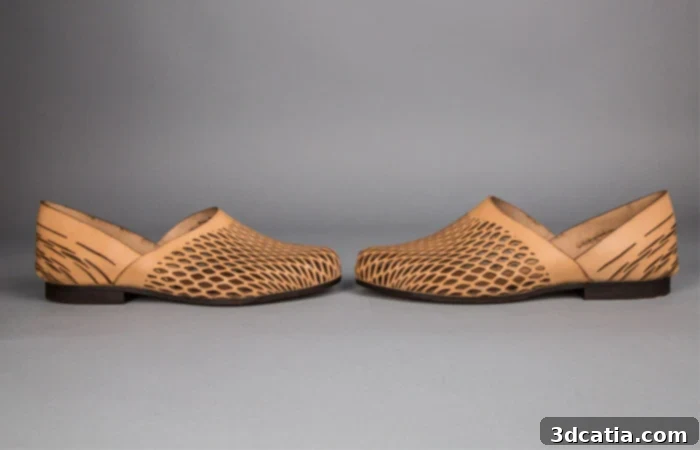
Pioneering the Future: 3D Printing’s Role in Footwear
Alex Reed offers a nuanced perspective on the future of 3D printing in footwear, acknowledging its vast potential while also maintaining a pragmatic view of current challenges and applications.
3DN: What do you foresee for the future of 3D printing technologies in footwear?
The future of 3D printing in footwear is undeniably brimming with potential, yet I’m not entirely convinced that anyone truly understands where its greatest impact will ultimately lie. This uncertainty, paradoxically, makes it an incredibly exciting time, particularly for small, independent manufacturers like myself. It also allows many larger manufacturers the freedom to experiment with an entirely new set of tools and truly enjoy the process of discovery. We’re seeing major players like Adidas, for instance, investing heavily in integrating 3D technology into some of their production lines. However, at present, I tend to view some of these high-profile initiatives more as public relations gimmicks than truly valuable or transformative investments in mass production, at least so far. The economics and scalability for mass market footwear are still significant hurdles for 3D printing.
One subsidiary area of shoe manufacturing that has already seen remarkable absorption of this technology is the production of orthotic templates. The ability to 3D scan an individual’s foot and then 3D print a perfectly customized orthotic to optimize fit, comfort, and support is undoubtedly one of the most useful and impactful trends we’re witnessing today. This application highlights 3D printing’s unparalleled ability to deliver true personalization, addressing individual biomechanical needs with precision that traditional methods simply cannot match. Beyond orthotics, I believe we’ll see significant growth in personalized components, specialized athletic footwear, and small-batch custom designs, where the benefits of customization outweigh the current costs and speed limitations of additive manufacturing for high-volume production.
Sustainable Footwear: Alex Reed Shoes’ Vision for Tomorrow
Beyond innovative design, Alex Reed is driven by a powerful mission to address the pervasive environmental impact of the footwear industry, positioning 3D printing as a key tool in this sustainability revolution.
3DN: What are your future projects with Alex Reed Shoes?
I am currently on a profound mission to help fundamentally change the way people consume footwear, from the moment of purchase to the very end of a shoe’s life cycle. 3D printing represents just one incredibly powerful method I can employ to create footwear that is not only high-quality but also easily repairable, shifting away from the prevalent “fast fashion” model where shoes are used once or twice and then hastily sent to a landfill. The overall energy consumption and environmental impact of the global footwear industry are immense and largely unsustainable. I envision numerous opportunities with emerging technologies to significantly lower this energy impact and foster a future where more pairs of shoes are produced locally, reducing logistical footprints and supporting local economies.
To embody these principles, I am currently developing a new line of footwear. This collection is designed not only to reflect these critical environmental concerns but also to offer shoes that are utterly full of style, highly desirable, and exceptionally comfortable for the wearer. The challenge lies in harmonizing innovative design, advanced manufacturing techniques, and sustainable practices without compromising on aesthetics or functionality. My goal is to prove that environmentally conscious footwear can be just as, if not more, appealing than traditionally manufactured alternatives, providing a viable and attractive option for the discerning, eco-aware consumer.
Final Thoughts and Resources
Alex Reed leaves us with an encouraging message for aspiring innovators and invites us to delve deeper into his pioneering work.
3DN: Do you have any last words for our readers?
I wholeheartedly recommend exploring the residency programs available at places like Pier 9. Such environments offer unparalleled opportunities for learning, experimentation, and networking. For those interested in a more detailed look at my specific projects and developments during my Autodesk residency, all of my completed work is openly available on my Instructables page.
To truly appreciate the artistry and innovation behind Alex Reed Shoes, we invite you to watch the following video:
The Journeyman Shoemaker from Pier 9 on Vimeo.
For more comprehensive information about Alex Reed Shoes and the ongoing developments in his unique approach to footwear, please visit the official website.
Are you interested in hearing about more exciting developments in the world of 3D printing and its diverse applications? Let us know your thoughts in a comment below or engage with us on our Facebook and Twitter pages! Don’t forget to sign up for our free Newsletter to receive all the latest news in 3D printing straight to your inbox!