
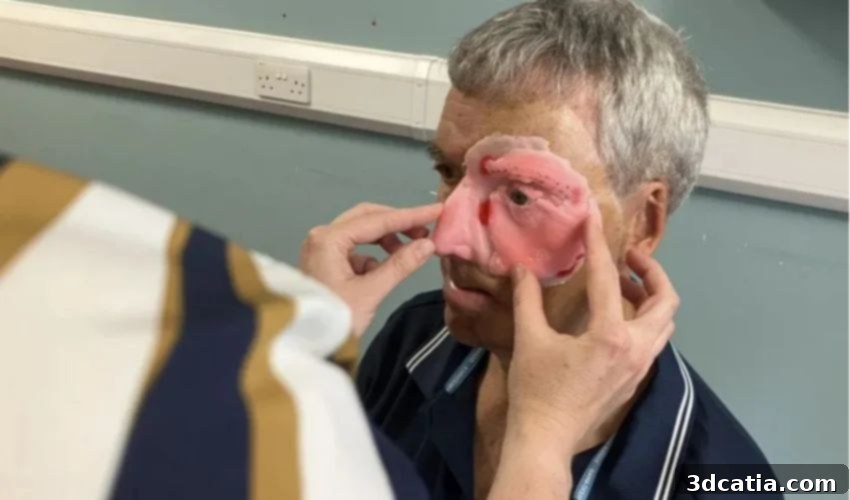
Revolutionizing Recovery: How 3D Printing Transforms Lives with Custom Facial Prosthetics
In July 2021, Dave Richards’ life took an unexpected and dramatic turn during what should have been a routine bike ride with two friends in the picturesque Somerset region of the UK. The group of cyclists was involved in a horrific collision with a drunk driver, who was reportedly on the phone at the wheel, compounding the recklessness of the incident. Dave bore the brunt of the impact, suffering catastrophic injuries. He was dragged under the vehicle, resulting in the loss of his left eye, severe burns down one side of his body and face, and agonizingly crushed ribs on his right-hand side. The road to recovery was arduous and protracted, involving multiple complex reconstruction operations and intensive rehabilitation. Yet, with incredible resilience and determination, this ardent sports enthusiast has painstakingly begun to rebuild his life. Now, the 75-year-old has received a groundbreaking new 3D printed facial prosthesis, a testament to modern medical innovation and a significant step forward in his journey towards complete well-being.
The advanced orbital prosthesis, designed to perfectly replicate his lost eye and surrounding facial contours, was meticulously manufactured at the Bristol 3D Medical Centre NHS. This state-of-the-art facility stands as a beacon of innovation, specializing in cutting-edge 3D imaging technologies and advanced 3D printing applications within the medical field. It holds the distinction of being one of the pioneering hospitals in the UK to integrate industrial-grade 3D printers directly into its operational infrastructure, enabling rapid, on-demand production of patient-specific medical devices. The center, a truly remarkable addition to the NHS, had only recently opened its doors in April, making Dave Richards a landmark patient – the very first to receive a custom 3D printed prosthesis from the facility. This significant achievement underscores the center’s commitment to personalized patient care and its role at the forefront of medical additive manufacturing.
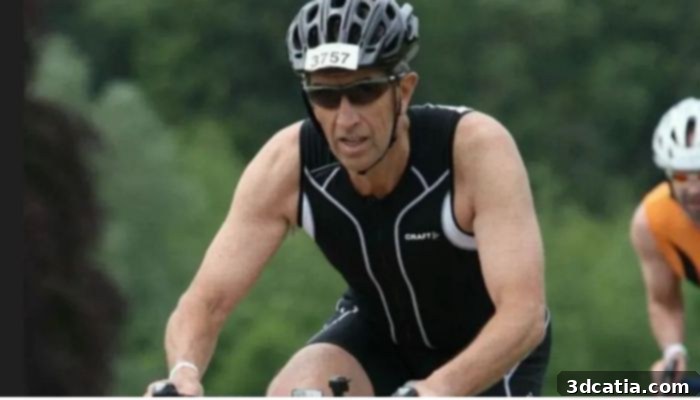
Dave Richards is passionate about biking, and his new prosthesis helps him regain confidence.
The creation of Dave’s custom orbital prosthesis began with an extremely precise and non-invasive digitization process. His face was first meticulously scanned using a high-resolution surface scanner. This advanced scanning technology captures thousands of data points, creating an incredibly accurate 3D digital model of his facial anatomy, including the intricate details of the damaged area and the healthy, contralateral side for reference. This digital blueprint served as the foundational data for the subsequent design phase. Using sophisticated CAD (Computer-Aided Design) software, expert technicians and medical designers then utilized these results to generate multiple virtual models of orbital prostheses. This iterative design process allowed for careful adjustments and refinements, ensuring that the final design would not only achieve a perfect aesthetic match but also provide optimal functionality and comfort. The paramount aim was to design a customized prosthesis that would fit the patient’s unique facial structure flawlessly, integrate seamlessly with his existing features, and crucially, not restrict any of his natural movements or expressions. The goal was to restore both appearance and confidence without hindering his daily life.
Once the optimal design was finalized and approved, the chosen material for Dave’s prosthesis was Polyether Ether Ketone, commonly known as PEEK. PEEK is a high-performance thermoplastic polymer widely recognized for its exceptional properties, making it an ideal choice for medical applications. It is a biocompatible polymer, meaning it can safely interact with the human body without adverse reactions, and boasts excellent mechanical strength, rigidity, and resistance to high temperatures and chemical degradation. These characteristics ensure the durability and longevity required for a permanent medical implant. The actual printing of the PEEK prosthesis was carried out on a specialized 3D printer manufactured by miniFactory. This particular printer is engineered for industrial and medical applications, featuring a highly advanced heated chamber that can reach temperatures up to an impressive 250°C. This precise temperature control within the print chamber is critical when working with high-performance polymers like PEEK. It ensures optimal material fusion, minimizes warping, and guarantees the structural integrity and dimensional accuracy essential for medical purposes. The result is a robust, lightweight, and perfectly customized prosthesis that meets the stringent quality and safety standards demanded in healthcare.
The impact of this custom 3D printed prosthesis on Dave Richards’ life has been profoundly positive, extending far beyond mere aesthetics. He is genuinely enthusiastic about his new 3D printed face, recognizing its immense value in restoring not just his appearance but his confidence and overall quality of life. As he eloquently shared with the BBC, the difference is tangible and deeply personal: “If I want to socialise a lot I feel a lot more comfortable in myself if I look in a mirror and look reasonable.” This statement encapsulates the psychological and emotional benefits of such advanced medical interventions. For someone who has endured severe facial trauma, regaining a sense of normalcy and confidence in their appearance is crucial for engaging in social activities, pursuing hobbies, and simply enjoying everyday life. The prosthesis has empowered Dave to step out with renewed self-assurance, enabling him to participate fully in social interactions without the burden of self-consciousness, significantly improving his mental well-being and interaction with the world.
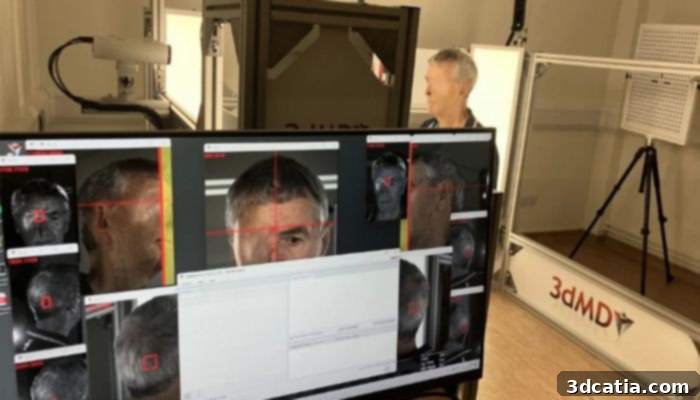
3D imaging techniques were used to determine the appropriate design for the facial prosthesis, showcasing precision in medical design.
Beyond the immediate and life-changing benefits for patients like Dave, the Bristol 3D Medical Centre envisions a much wider range of transformative applications for 3D technologies within the healthcare sector. In addition to producing customized prostheses and patient-specific implants, the center is actively exploring and implementing additive manufacturing for various critical medical procedures. One particularly promising area is the creation of highly detailed anatomical models for surgical planning. These patient-specific models, precisely replicating a patient’s unique anatomy, allow surgeons to meticulously plan complex operations in a risk-free environment. This pre-surgical preparation can significantly reduce operating times, minimize complications, and ultimately lead to improved patient outcomes. Furthermore, these models serve as invaluable educational tools for medical students and residents, providing hands-on experience with intricate anatomical structures.
The story of Dave Richards stands as a powerful and inspiring example, unequivocally demonstrating how modern additive manufacturing technologies are not merely advancing medical science but are profoundly enriching human lives. By providing highly customized, perfectly fitting, and biocompatible solutions, 3D printing is putting an end to the suffering of many patients who previously had limited or imperfect options for reconstruction and rehabilitation. This technology offers a future where personalized medicine is not just a concept but a tangible reality, enabling medical professionals to tailor treatments precisely to individual patient needs. The ability to restore function, form, and most importantly, confidence and dignity, positions 3D printing as a cornerstone of future healthcare innovation. To delve deeper into Dave’s remarkable journey and the broader implications of this technology, click HERE for the full BBC report.
We invite you to engage with us: What are your thoughts on the groundbreaking use of additive manufacturing in the reconstruction of the human body? Share your perspectives and insights in a comment below or join the conversation on our LinkedIn and Facebook pages. Stay informed with the latest advancements in this rapidly evolving field by signing up for our free weekly Newsletter, delivering the most current 3D printing news directly to your inbox. You can also explore our extensive library of insightful videos on our YouTube channel. For those particularly interested in more medical and dental 3D printing news, we encourage you to visit our dedicated page HERE to discover a wealth of information and updates.
*All Photo Credits: BBC