
Innovations in Additive Manufacturing: BigRep, Massivit, BMW, and DyeMansion Lead the Way
Welcome back to our weekly deep dive into the most significant advancements and breaking news in the additive manufacturing sector! This edition of #3DEXPRESS brings you comprehensive insights into groundbreaking developments from leading industry players. We’ll explore how companies are pushing the boundaries of what’s possible with 3D printing, from introducing next-generation large-format printers capable of handling high-performance materials to integrating innovative 3D printed components into iconic designs, and revolutionizing post-processing services. The additive manufacturing landscape is evolving rapidly, with new solutions emerging that promise to unlock fresh realms of application across diverse industries. Join us as we unpack the details of these exciting announcements, highlighting the innovation and strategic vision driving the future of manufacturing.
BigRep Unveils ALTRA 280 and IPSO 105: Expanding High-Temperature FFF Capabilities
Our journey into this week’s 3DExpress updates begins with BigRep, a renowned leader in large-format 3D printing. The company has significantly expanded its product portfolio with the introduction of two new state-of-the-art solutions: the ALTRA 280 and the IPSO 105. These machines are not just additions; they represent a strategic leap into high-temperature FFF (Fused Filament Fabrication) 3D printing, specifically designed to open up new fields of application that demand superior material performance and precision. Both models are engineered for speed, reliability, and accuracy, boasting advanced automation features that make them ideal for producing industrial-quality, large-format components. They are tailored to meet the rigorous demands of industries such as aerospace, automotive, and specialized manufacturing, where robust parts and high operational temperatures are critical.
A key differentiator for these new printers is their capability to process high-performance engineering thermoplastics. The ALTRA 280, with its slightly larger build volume compared to the IPSO 105, also features an open material system. This crucial characteristic grants users unparalleled flexibility, allowing them to utilize a wider array of specialized filaments from various suppliers, thereby optimizing for specific application requirements and fostering innovation. This commitment to an open system underscores BigRep’s dedication to empowering its customers with choice and versatility. These advanced printers are the direct result of BigRep’s strategic acquisition of the Austrian company HAGE3D, an integration that has brought proven high-temperature extrusion technology into BigRep’s fold. Previously known in Europe as PRECISE and MEX, these systems now benefit from BigRep’s extensive market reach and industrial expertise.
Sven Thate, CEO of BigRep GmbH, emphasized the significance of this expansion: “We are proud to extend our portfolio towards high-performance filament extrusion with our open system approach, thereby aiming to double the addressable market of our solutions with the technology from HAGE3D, our recently announced planned acquisition.” This statement highlights not only BigRep’s ambition to broaden its market presence but also its confidence in the capabilities these new machines bring. The ALTRA 280 and IPSO 105 are already available for purchase across Europe, the Middle East, and Africa, signifying their immediate impact on the global additive manufacturing market. Their ability to consistently produce large, high-quality parts from engineering-grade materials at elevated temperatures positions BigRep firmly at the forefront of industrial large-format 3D printing innovation, empowering businesses to tackle complex challenges and accelerate their product development cycles.
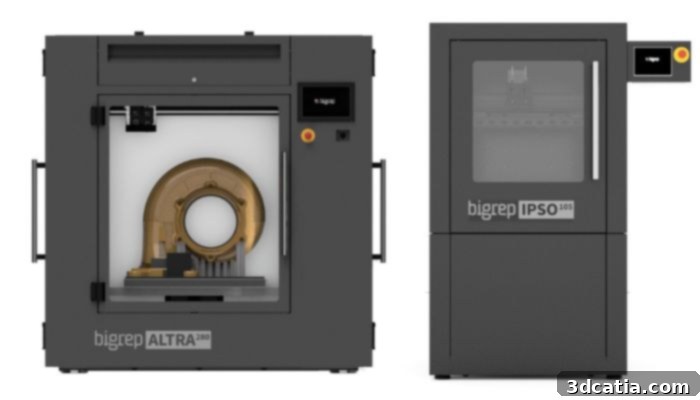
The ALTRA 280 (left) and the IPSO 105 (right) expanding BigRep’s high-temperature FFF portfolio. (Photo Credits: BigRep)
Massivit Presents the Massivit 3000: Revolutionizing Large-Format Industrial 3D Printing
The vibrant atmosphere of TCT 3Sixty, a premier event in the additive manufacturing calendar, provided the perfect stage for Massivit to unveil its latest innovation: the Massivit 3000. Opening its doors in the UK on June 5, TCT 3Sixty welcomed industry professionals eager to witness the future of 3D printing, and Massivit certainly delivered. The Massivit 3000 is not merely another large-format industrial solution; it represents a significant advancement in high-speed, colossal-scale additive manufacturing. This machine boasts an impressive print volume of 1.2 x 1.5 x 1.8 meters, offering capabilities that push the boundaries for creating truly massive objects.
At the heart of the Massivit 3000 lies the company’s renowned patented Gel Dispensing Printing (GDP) technology. GDP technology stands apart by rapidly curing thermoset gel materials on the fly, allowing for exceptional printing speeds and the creation of hollow, lightweight structures without the need for extensive support materials. This unique process not only accelerates production times but also reduces material waste and post-processing efforts, making it an incredibly efficient solution for a wide range of industrial applications. From producing full-scale prototypes and molds for composite manufacturing to creating large theatrical props, architectural models, and custom signage, the Massivit 3000 is poised to transform industries where size and speed are paramount.
Erez Zimerman, the CEO of Massivit, conveyed his excitement regarding the launch: “We are thrilled to introduce the Massivit 3000 printer to the advanced manufacturing and 3D printing arenas at TCT 3Sixty. The new printer represents a significant leap forward in large-format 3D printing technology, providing an affordable, game-changing solution for businesses and professionals seeking to unlock new possibilities in additive manufacturing.” Zimerman’s statement underscores Massivit’s vision to make large-format additive manufacturing more accessible and cost-effective, thereby democratizing the creation of incredibly large and complex parts. The Massivit 3000 is expected to empower businesses to explore innovative design concepts and accelerate time-to-market for products that were previously difficult or impossible to produce using traditional manufacturing methods. Its introduction marks a pivotal moment for industries looking to leverage the speed and scale of GDP technology for diverse and demanding applications, solidifying Massivit’s position as a leader in large-format additive solutions.
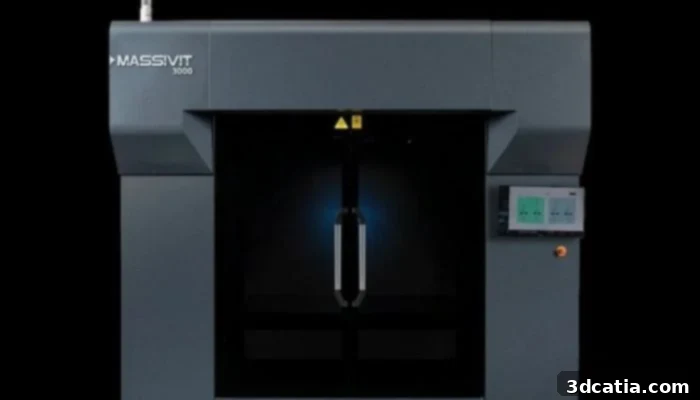
The Massivit 3000 leveraging Gel Dispensing Printing (GDP) for large-format applications. (Photo Credits: Massivit)
BMW Motorrad’s R20 Concept Bike Showcases 3D Printed Aluminum Component
BMW Motorrad, the highly esteemed motorcycle division of the renowned German car manufacturer, has once again demonstrated its commitment to innovation and cutting-edge technology with the unveiling of its new concept bike, the R20. This exceptional model not only features the brand’s legendary Big Boxer engine and a strikingly distinctive pink sculpted tank, but it also proudly incorporates a meticulously crafted 3D printed aluminum component. This integration highlights BMW’s ongoing exploration and successful implementation of additive manufacturing in its advanced vehicle designs, pushing the boundaries of both aesthetics and functionality in motorcycle engineering.
The specific 3D printed element on the R20 is the sophisticated ring that encircles the LED headlight. This component is not merely decorative; it ingeniously doubles as a daytime running light, showcasing how additive manufacturing can combine multiple functions into a single, complex part. While BMW has remained tight-lipped about the exact details of the printing process, industry experts widely speculate that powder bed laser melting (also known as Selective Laser Melting or SLM) was utilized. This technology is particularly well-suited for producing high-strength, lightweight, and geometrically complex metal components with excellent surface finishes, making it an ideal choice for premium automotive applications where precision and performance are paramount.
This development on the R20 concept bike is a clear testament to BMW’s advanced 3D printing capabilities and its strategic embrace of additive manufacturing across its entire vehicle portfolio. The company has made significant investments in this technology, culminating in their recent announcement of having produced over 400,000 additive parts. This impressive milestone spans various applications, from prototyping and tooling to end-use components in both cars and motorcycles, showcasing the scalability and versatility of BMW’s 3D printing initiatives. The use of a 3D printed aluminum component in a high-profile concept vehicle like the R20 underscores additive manufacturing’s potential to enable intricate designs, optimize weight, and accelerate product development cycles. It signals a future where custom, high-performance parts are seamlessly integrated into production, further solidifying BMW’s reputation for engineering excellence and innovation in the automotive and motorcycle industries.
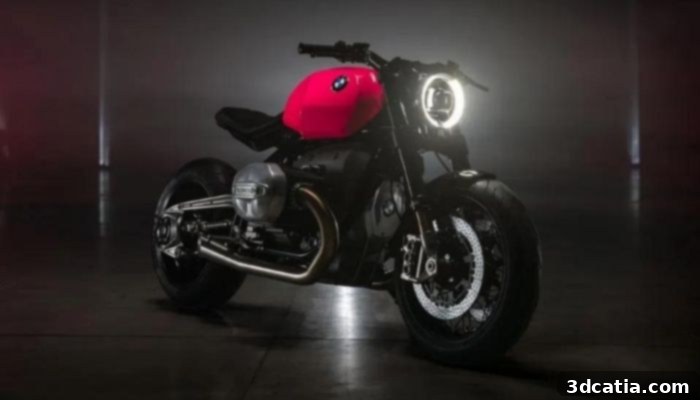
The BMW R20 concept bike featuring a distinctive 3D printed aluminum headlight ring. (Photo Credits: BMW)
DyeMansion Launches Black Diamond Finishing Hub for On-Demand Post-Processing Services
DyeMansion, a global leader in post-processing solutions for industrial 3D printing, has announced a significant expansion of its offerings, moving beyond just machines to provide a comprehensive service platform. The company has introduced an innovative online platform for industrial post-processing of 3D printed parts, aptly named the Black Diamond Finishing Hub. This new initiative is designed to make DyeMansion’s renowned finishing quality accessible to a broader audience, providing a vital service that closes the gap between raw 3D printed parts and high-quality, end-use products.
The Black Diamond Finishing Hub offers a suite of essential post-processing services, including chemical smoothing, shot blasting, and black coloring. Chemical smoothing (DyeMansion’s VaporFuse Surfacing technology) transforms rough, porous surfaces into smooth, sealed parts with injection molding-like finishes, significantly improving aesthetics and functionality. Shot blasting refines surfaces, preparing them for subsequent steps or providing a consistent matte finish. Black coloring, a highly sought-after finish, adds a premium aesthetic and enhances the durability of parts, particularly for nylon materials. These services cater to a wide spectrum of users, from large industrial manufacturers utilizing advanced additive solutions to individual designers and small businesses working with desktop systems, ensuring that everyone can achieve optimal part quality without the need for significant capital investment in their own machinery.
Felix Ewald, CEO of DyeMansion, highlighted the strategic importance of this new platform: “The Black Diamond Finishing Hub is a finishing service for everybody who wants to have the highest quality powder bed parts that are available on the market. Since no CAPEX investment is needed to use this service, it’s the easiest way to get access to industrial finishing. This platform exemplifies our commitment to innovation and customer-centric solutions, enabling businesses of all sizes worldwide to create products with industrial 3D printing.” The concept of “Post-Processing as a Service” (PPaaS) is revolutionary, lowering the barrier to entry for businesses looking to leverage the full potential of 3D printing. By removing the need for upfront capital expenditure on specialized finishing equipment, DyeMansion empowers companies to focus on design and production, leaving the intricate and often complex post-processing steps to the experts. This hub ensures that even smaller enterprises or those prototyping can achieve consistent, high-quality results for their 3D printed components, making industrial 3D printing more viable and accessible for a multitude of applications and industries.
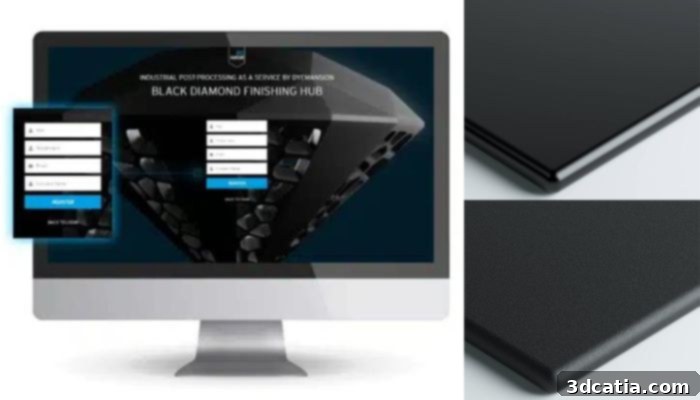
The DyeMansion Black Diamond Finishing Hub offering industrial post-processing services for 3D printed parts. (Photo Credits: DyeMansion)
This week’s roundup clearly demonstrates the dynamic and innovative nature of the additive manufacturing industry. From BigRep’s expansion into high-temperature FFF with the ALTRA 280 and IPSO 105, enabling advanced material applications, to Massivit’s colossal Massivit 3000, pushing the boundaries of large-format printing with GDP technology, manufacturers are continuously developing solutions for greater speed, scale, and performance. BMW Motorrad’s elegant integration of a 3D printed aluminum component in its R20 concept bike further exemplifies the growing adoption of additive manufacturing for functional, aesthetic, and performance-driven parts in leading industries. Moreover, DyeMansion’s Black Diamond Finishing Hub addresses a critical need in the ecosystem by making industrial-grade post-processing services accessible to all, irrespective of their scale of operation. These developments collectively underscore the maturation of 3D printing, moving from niche prototyping to an essential tool for industrial production and innovation across various sectors.
What are your thoughts on these significant announcements from BigRep, Massivit, BMW, and DyeMansion? Which innovation do you find most impactful for the future of additive manufacturing? Share your insights and join the conversation in the comments below, or connect with us on our LinkedIn, Facebook, and Twitter pages! Don’t miss out on the latest advancements and sign up for our free weekly newsletter here to get all the essential 3D printing news delivered straight to your inbox. You can also explore our extensive library of videos and content on our YouTube channel for more in-depth analyses and interviews with industry leaders.