
The Most Revolutionary 3D Printing Innovations of 2019: A Comprehensive Video Recap
The year 2019 marked an extraordinary period for the additive manufacturing industry, witnessing remarkable progress across diverse sectors. It was a year defined by the introduction of cutting-edge machines, the breaking of numerous application records, and the development of high-performance materials that pushed the boundaries of what was previously thought possible. Fortunately, many of these groundbreaking innovations were captured on video, allowing us to vividly revisit the transformative moments that shaped the industry. Esteemed companies and institutions such as HP, Desktop Metal, and Harvard University frequently dominated 3D printing headlines, offering a clear glimpse into the industry’s current state and its immense future potential. Join us as we journey through 2019, month by month, to highlight the most impactful and inspiring 3D printing videos that captivated the world.
1- NovaMeat’s Visionary Plant-Based 3D Printed Meat
Addressing the pressing global issues of excessive meat consumption and its significant environmental footprint, the Spanish startup NovaMeat unveiled a revolutionary solution in 2019. They developed a meat substitute crafted from a sophisticated blend of rice and pea proteins, meticulously designed for 3D printing. This innovative approach seeks to provide a sustainable alternative to traditional animal agriculture. The process is incredibly intricate, requiring advanced CAD modeling to precisely replicate the complex muscle structures and desirable consistency found in conventional meat. NovaMeat’s method promises an astonishing 95% increase in efficiency across key environmental metrics, including land usage, water consumption, and greenhouse gas emissions, when compared to traditional meat production. This pioneering development represents a crucial step towards a more sustainable food system and offers a compelling alternative for conscious consumers worldwide.
2- Israeli Researchers Achieve a Milestone with a 3D Printed Human Heart
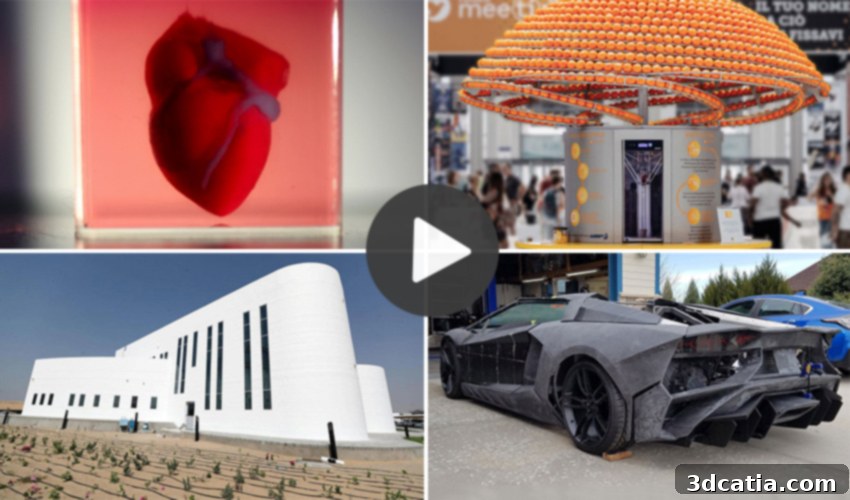
In an extraordinary feat of medical science, a team of Israeli scientists achieved a groundbreaking milestone in 2019 by developing a bioprinted heart. What made this achievement particularly remarkable was their success in creating an organ that they believe perfectly matches the immunological, cellular, biochemical, and anatomical properties of a patient’s own heart. This represents an immensely significant advancement in the field of regenerative medicine, primarily because the researchers were able to engineer its intricate blood vessels and delicate tissues directly from the patient’s stem cells. While the initial prototype was approximately the size of a cherry or a rabbit’s heart, this proof-of-concept demonstrated the immense potential of bioprinting. The entire printing process, a testament to precision and biological engineering, took approximately 3 to 4 hours to complete, opening new avenues for personalized medicine, organ transplantation, and drug development.
3- The Met Gala’s Dazzling 3D Printed Rose Dress
The Met Gala, renowned as one of the world’s most prestigious fashion events, became the stage for a spectacular display of additive manufacturing in 2019. Celebrated designer Zac Posen unveiled a collection that showcased the stunning capabilities of 3D printing in haute couture. In a groundbreaking collaboration with GE Additive and Protolabs, Posen designed a truly unique garment known as the “Rose” dress. Worn by supermodel Jourdan Dunn, this exquisite gown comprised 21 individually 3D printed rose petals, each meticulously crafted to perfection. Each petal measured an impressive 53 cm in length and weighed 0.4 kg, contributing to the dress’s overall weight of approximately 13 kilos. The creation of this masterpiece demanded an extraordinary investment of time: 700 hours for 3D printing and an additional 400 hours for post-processing. The individual rose petals were produced using a 3D SLA (Stereolithography) printer at Protolabs’ advanced 3D printing facility in North Carolina. This project stands as a magnificent testament to how additive manufacturing can revolutionize the design and fashion industry, pushing the boundaries of creativity and material innovation.
4- Sandvik Achieves an Industry First with 3D Printed Diamond Composite
2019 saw the Swedish engineering giant Sandvik achieve an unparalleled industrial breakthrough: the development of a 3D printed composite diamond. This marked an industry first, leveraging diamond’s status as the hardest natural material, making it exceptionally valuable across numerous sectors, particularly in mining for cutting tools and in the medical field for designing robust implants. Sandvik employed advanced light-curing technology, a process akin to stereolithography, to meticulously create this complex 3D printed composite diamond structure. After the precision printing phase, a sophisticated post-processing regimen was critical in endowing the material with its characteristic extreme hardness and superior strength. This innovation opens up vast possibilities for manufacturing custom-designed diamond tools and components with geometries previously impossible to achieve, offering enhanced performance and durability in demanding applications.
5- Rady Children’s Hospital & HP: Revolutionizing Innovative Medicine with 3D Printing
In a significant stride for medical innovation in 2019, Rady Children’s Hospital partnered with HP to integrate the Multi Jet Fusion 580 color 3D printer into their operations for producing advanced medical models. This collaboration empowered the hospital to create incredibly accurate anatomical models that precisely replicate a patient’s organs, directly from high-resolution 3D scans. The impact of this technology on surgical practice is profound: doctors, especially surgeons, can now significantly reduce operating times by meticulously preparing and rehearsing complex procedures on these lifelike 3D printed models. This pre-operative planning also drastically diminishes the risk of errors during actual surgeries. HP’s Multi Jet Fusion technology excels in delivering unparalleled precision and intricate detail, two critical advantages in the medical sector. Furthermore, the full-color printing capability is a game-changer, allowing surgeons to clearly distinguish between various structures like blood vessels, arteries, and other tissues, enhancing understanding and improving patient outcomes.
6- A Circular Economy Masterpiece: Orange Peel to 3D Printed Cups
Carlo Ratti, an innovative architect, introduced a truly imaginative and environmentally conscious project in 2019 named “Feel the Peel.” This initiative unveiled a highly unconventional juice bar designed not just to serve orange juice, but also to transform the leftover orange peels into functional 3D printed cups. The machine itself is an impressive piece of engineering, standing 3.10 meters tall and capable of holding up to 1,500 oranges. Central to its circular economy mission is an integrated WASP 3D printer, which processes the discarded peels. The project vividly demonstrates the principles of a circular economy in everyday life, showcasing how what was once considered waste can be valorized and transformed into valuable products. By creating added value from common food waste, “Feel the Peel” offers a tangible and engaging example of sustainable practices, encouraging a paradigm shift in how we perceive and manage resources. The ingenious process, where the natural by-product of juicing becomes the container for the juice itself, is best understood by watching the video.
7- A Father and Son’s Remarkable 3D Printed Lamborghini in Their Garage
One of the most heartwarming and ambitious 3D printing projects of 2019 involved a father and son duo who embarked on an incredible journey to build a life-size Lamborghini using 3D printers. Physicist Sterling Backus initiated this colossal undertaking with his son, driven by a desire to illustrate the immense possibilities of 3D technology and to foster a deeper engagement with science in a practical, hands-on manner. Their goal was to construct a full-scale replica of the iconic supercar, making scientific and engineering principles as tangible as possible. After more than a year of dedicated work and utilizing an astonishing 220 reels of various filaments, including PLA, ABS, and ASA, the fully assembled car was finally ready. While additive manufacturing played a central role in fabricating numerous components, it’s important to note that other traditional manufacturing processes were also employed to ensure the vehicle’s structural integrity and functionality. This inspiring project not only demonstrated the capabilities of desktop 3D printing but also highlighted the power of curiosity, perseverance, and familial collaboration in bringing an extraordinary dream to life.
8- Unveiling the World’s Largest 3D Printed Boat
2019 marked a monumental achievement in large-format additive manufacturing with the unveiling of the world’s largest 3D printed boat. A dedicated team of researchers from the University of Maine’s Advanced Structures and Composites Center (ASCC) spearheaded this ambitious project. Named “3Dirigo,” the vessel measures an impressive 7.62 meters in length and weighs a substantial 2.2 tons. Its creation was facilitated by a colossal large-format polymer printer custom-designed by the UMaine ASCC itself. This groundbreaking endeavor earned the project team three prestigious world records: for the largest 3D printed part, the largest 3D printed boat, and the largest 3D printer ever created. This initiative holds immense promise for the maritime transport sector, suggesting a future where additive manufacturing could enable more innovative, efficient, and rapidly prototyped designs for custom vessels and large marine structures. The “3Dirigo” stands as a beacon for the scalability and transformative potential of 3D printing in industries requiring massive components.
9- Dubai Municipality Presents the World’s Largest 3D Printed Building
Under the visionary leadership of its government, Dubai took a giant leap forward in construction technology in 2019 by completing the world’s largest administrative building, partially constructed using concrete 3D printing. This impressive structure boasts a height of 9.5 meters and covers an expansive area of 640 square meters. What makes this achievement even more remarkable is its completion during Dubai’s scorching summer, directly on site, thanks to the robust Apis Cor’s 3D printers, which were specifically engineered to withstand extreme environmental conditions. This project is a key component of Dubai’s ambitious urban development strategy, aiming to have 25% of its buildings constructed through 3D printing by the year 2030. Concrete 3D printing offers significant advantages in terms of speed, cost reduction, labor efficiency, and the ability to create complex architectural geometries, positioning Dubai as a global leader in sustainable and innovative construction practices.
10- A Multi-Nozzle 3D Printer Redefines Material Versatility
Researchers at the Harvard Wyss Institute for Biologically Inspired Engineering and the John A. Paulson School of Engineering unveiled a groundbreaking new technique in 2019 called Multi-Material Multi-Nozzle 3D Printing (MM3D). This innovative approach significantly enhances the versatility of 3D printing by enabling a single print head to seamlessly switch between up to eight different materials or “inks” at an astonishing speed of up to 50 times per second. The core of this technology lies in its use of high-speed pressure valves, which facilitate rapid and consistent material switching. Beyond its remarkable speed, the printer also offers flexibility in nozzle configuration, allowing it to operate from a single nozzle to multiple nozzles simultaneously. This breakthrough expands the range of printable materials to include various epoxies, silicones, and organic colors, opening up exciting new areas of application. MM3D holds immense potential for creating complex, multi-functional objects, from soft robotics and flexible electronics to advanced biomaterials and intricate microfluidic devices, pushing the boundaries of what multi-material 3D printing can achieve.
11- Formnext 2019: A Grand Recap of the Additive Manufacturing Hub
From November 19th to 22nd, 2019, Frankfurt became the undisputed epicenter of additive manufacturing, hosting Formnext, the world’s largest and most influential trade fair for the industry. 3Dnatives was on the ground to capture the energy and innovation of this landmark event. The 5th edition of Formnext shattered previous records, featuring over 850 exhibitors and attracting approximately 34,500 participants—a significant increase from the 27,000 attendees in the preceding year. The event spanned across four massive halls, encompassing more than 53,000 square meters of exhibition space. Our comprehensive video recap summarizes the most significant trends unveiled at the show, provides insights from leading exhibitors, and gathers valuable perspectives from visitors. This annual gathering is crucial for networking, showcasing breakthrough technologies, and setting the future trajectory of the additive manufacturing industry. We invite you to experience the highlights of Formnext 2019 through our recap and look forward to what future editions will bring!
12- #Talk3D with Ric Fulop: Desktop Metal’s Vision for Metal Additive Manufacturing
In 2019, 3Dnatives had the privilege of conducting its inaugural #TALK3D interview with Ric Fulop, the visionary CEO and co-founder of Desktop Metal. This American manufacturer has been a pivotal force in making metal 3D printing more accessible, a mission bolstered by over $438 million in funding from prominent investors like Google, BMW, and Ford over the past four years. During this insightful discussion, Ric Fulop delved into Desktop Metal’s ambitious vision for the future of manufacturing and shared his profound perspectives on the evolving market dynamics of metal additive manufacturing. He elaborated on how Desktop Metal is disrupting traditional manufacturing paradigms by developing cost-effective and user-friendly metal 3D printing solutions. This interview provided invaluable insights into the strategies behind their disruptive innovations, the company’s long-term goals, and its significant impact on accelerating the adoption of metal 3D printing for both prototyping and end-use production across various industries.
We trust this comprehensive recap of 2019’s leading 3D printing innovations has been insightful. Did we miss any pivotal videos or breakthroughs from that remarkable year? We’d love to hear your thoughts! Share your insights in a comment below or connect with us on our Facebook and Twitter pages. To stay continuously informed about the latest developments and trends in the rapidly evolving world of additive manufacturing, don’t forget to sign up for our free weekly Newsletter, delivering all the essential news directly to your inbox!