
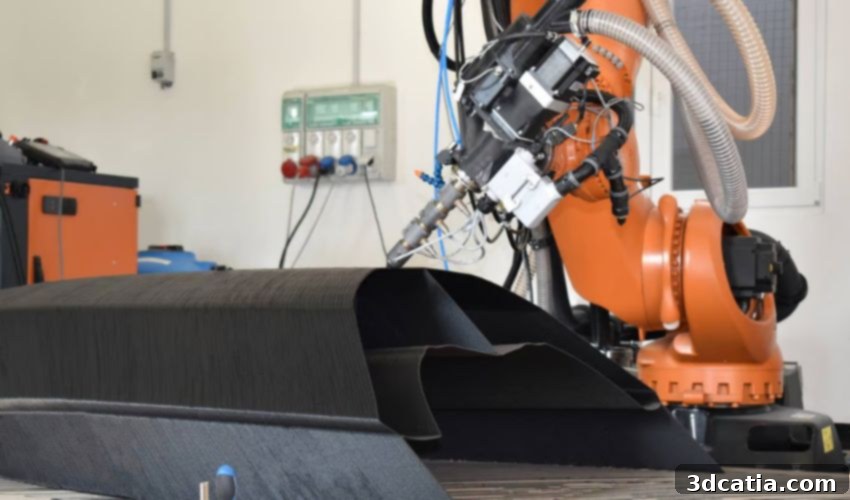
Robotic Arm 3D Printing: Eight Key Advantages Revolutionizing Additive Manufacturing
Robotic arms, long celebrated for their precision, speed, and programmability, have been fundamental to industrial automation. With their multi-jointed structures mirroring human limbs, they excel at streamlining repetitive tasks and enhancing efficiency across manufacturing floors. This impressive capability for optimization and adaptability bears striking parallels to the core advantages offered by additive manufacturing, commonly known as 3D printing. Given these synergistic benefits, it’s only natural to consider the powerful combination of the two technologies: integrating 3D printers with robotic arms to unlock unprecedented opportunities in industrial production.
The fusion of 3D printing and robotics introduces a new paradigm of manufacturing flexibility, adaptability, and workflow optimization. This innovative approach promises to redefine how products are designed, produced, and even repaired. In this comprehensive article, we will delve into eight compelling reasons why businesses should consider adopting robotic arm 3D printing. While some automated additive manufacturing processes might utilize non-3D printing robotic arms for tasks like part handling or post-processing, our primary focus here will be on robotic arms that directly perform the 3D printing process itself. The market already offers numerous advanced robotic arm 3D printing solutions, each boasting unique advantages. Familiarize yourself with these transformative benefits to understand their potential impact on your operations.
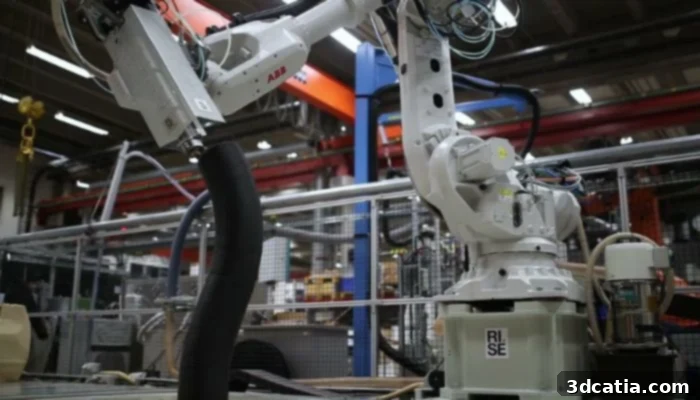
A robotic nonplanar 3D printer creating a curved pipe (Photo Credit: Emil Johansson)
1. Unprecedented Design Flexibility and Multiplanar Toolpaths
Traditional 3D printers, particularly FDM (Fused Deposition Modeling) and many powder bed fusion systems, typically operate within a Cartesian coordinate system, printing layer-by-layer on a single, flat plane defined by perpendicular X and Y axes. While some advanced systems offer minor deviations, they are fundamentally constrained by this horizontal stacking methodology. Robotic arm 3D printers, however, often overcome this limitation. Many are equipped with multiple axes of motion (typically five, six, or even seven axes), allowing them to follow complex multiplanar toolpaths. This means they can print not just horizontally, but vertically, diagonally, and along curved surfaces, liberating designers from the traditional layer-by-layer constraints. This increased design freedom enables the creation of highly optimized, organic geometries, functional prototypes, and end-use parts with improved mechanical properties, previously impossible with conventional additive manufacturing methods. Manufacturers can now explore intricate designs that genuinely maximize material efficiency and structural integrity, pushing the boundaries of what’s achievable.
2. Significant Reduction in Support Structure Requirements
Directly stemming from their ability to follow multiplanar toolpaths, robotic arm 3D printers can dramatically reduce the need for extensive support structures. In conventional 3D printing, overhangs and complex geometries necessitate sacrificial support materials to prevent collapse during the printing process. These supports consume extra material, increase print time, and require laborious and often costly post-processing to remove. Robotic arms, with their capacity for multi-axis movement, can reorient the part or the print head during fabrication, enabling them to print at optimized angles that minimize or even eliminate overhangs. Depending on the number of axes the robotic arm utilizes, it can achieve impressive unsupported spans, thereby significantly cutting down on material waste. This not only lowers production costs but also accelerates the manufacturing process by reducing the need for post-processing steps like sanding, grinding, or chemical baths, leading to more efficient and sustainable production cycles.
3. Expansive and Flexible Build Volumes
Unlike many enclosed 3D printers that are limited by fixed build plates or chambers, robotic arm 3D printers offer unparalleled flexibility in terms of build volume. They are not inherently confined to a specific print bed and can be scaled to various sizes, ranging from compact desktop units to massive systems capable of constructing entire buildings. This scalability is a game-changer for industries requiring large-format additive manufacturing. Furthermore, many robotic arm 3D printers can be mounted onto mobile tracks or gantries. This mobility extends their reach far beyond their static arm length, allowing them to print exceptionally long components or even collaborate on massive structures. This capability is particularly beneficial for sectors like aerospace, where large fuselage sections or wing components can be printed, and in automotive, for producing large tooling or even vehicle chassis. The ability to print in situ on existing structures or components also opens new possibilities for manufacturing and repair in diverse environments, from factory floors to remote construction sites, revolutionizing logistical challenges and project scopes.
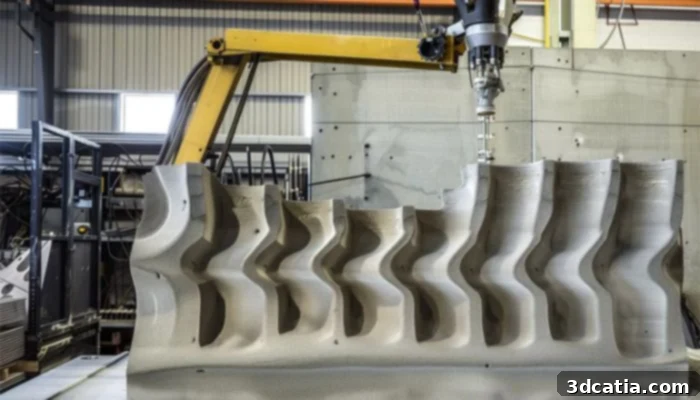
An example of large-format robotic arm 3D printing (Photo Credit: Replique)
4. Enhanced Versatility Through Interchangeable Tool Heads
A robotic arm 3D printer is far from a single-purpose machine; its inherent modularity allows for remarkable versatility. These systems are designed to accommodate interchangeable tool heads, enabling them to perform a multitude of functions beyond just 3D printing. Users can integrate different additive manufacturing technologies, such as various extrusion systems (pellet, filament), wire arc, or laser-based deposition, all on the same robotic platform. More impressively, they can also incorporate non-additive manufacturing processes. For instance, a robotic arm might be equipped with a 3D print head for depositing material, which can then be swapped for a CNC milling tool for subtractive finishing, drilling, or machining complex features. Other potential tool heads include inspection sensors, polishing tools, or even assembly grippers. This multi-functional capability transforms a single robotic arm into a comprehensive hybrid manufacturing cell. This not only streamlines the production workflow by reducing the need for transferring parts between different machines but also optimizes valuable floor space and reduces overall capital investment, offering a highly efficient and adaptable manufacturing solution.
5. Repurposing Existing Robotic Arms for Cost-Effective 3D Printing
For businesses that already possess industrial robotic arms, transitioning into additive manufacturing can be surprisingly straightforward and cost-effective. Instead of investing in entirely new, dedicated 3D printing systems, existing robotic arms can often be repurposed and equipped with 3D printing capabilities. This presents a significant economic advantage, leveraging prior investments in automation infrastructure. Specialized software solutions, such as AdaOne by Adaxis, play a crucial role in this transformation. These platforms are designed to convert standard industrial robotic arms into powerful, large-scale 3D printers. They support a wide array of hardware configurations, deposition technologies (like welding or extrusion), and diverse materials, making them compatible with numerous industrial applications. If your facility has a robotic arm that is currently underutilized or performing less critical tasks, upgrading it for 3D printing can breathe new life into the equipment, unlocking advanced manufacturing potential without the prohibitive cost of a brand-new setup. This approach champions sustainability by maximizing the lifespan and utility of existing machinery.
6. The Advantage of Comprehensive, Single-Cell Solutions
Beyond repurposing existing hardware, the market also offers highly integrated robotic arm 3D printing solutions designed as comprehensive, single-cell manufacturing units. These systems are engineered for optimal performance, safety, and efficiency, often enclosing the robotic arm and printing process within a dedicated environment. A prime example is Meltio’s Robot Cell, a metal 3D printing solution featuring a robotic arm housed within a controlled cell. Such enclosures are critical for processes involving high temperatures, lasers, or inert gas requirements, ensuring safety and process stability. These integrated cells are typically compatible with various robot brands, though many come with a standard configuration, such as an ABB robotic arm. The design of these single-cell solutions emphasizes compactness, versatility, and full integration. By consolidating the entire manufacturing process – from material deposition to environmental control – into one unit, they significantly reduce lead times, optimize production throughput, and ensure consistent part quality. This “plug-and-play” approach simplifies implementation and accelerates the adoption of advanced additive manufacturing technologies.
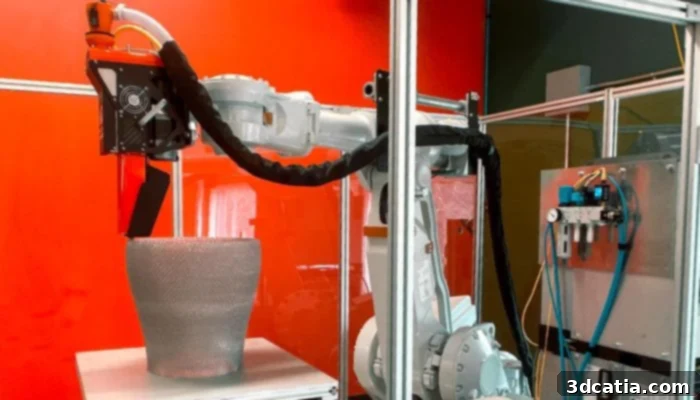
A robotic arm solution from Massive Dimension (Photo Credit: Massive Dimension)
7. Capability to Print on Diverse Surfaces and Facilitate Repairs
One of the most powerful attributes of robotic arm 3D printers is their ability to deposit material directly onto diverse, non-planar surfaces. This capability makes the technology exceptionally effective for maintenance, repair, and overhaul (MRO) applications. Instead of replacing entire components, which can be costly and time-consuming, a robotic arm can precisely apply material to repair worn, damaged, or corroded sections of existing equipment. This sustainable approach reduces waste and extends the lifespan of valuable assets, lessening dependence on new part procurement and traditional manufacturing tools. For instance, when parts are decades old, custom-made, or from defunct manufacturers, finding replacements can be impossible. Robotic arm 3D printing provides a viable solution, often making a part functional again that would otherwise be scrapped. Siemens Energy, for example, has successfully leveraged wire arc additive manufacturing (WAAM) on robotic arms to maintain and repair critical equipment such as turbine blades, restoring them to operational efficiency. This capability also extends to adding new features or modifying existing geometries on components, expanding their functionality post-manufacture.
8. Versatility Across Materials and Additive Manufacturing Technologies
The adaptability of robotic arms makes them compatible with an extensive array of materials and additive manufacturing (AM) technologies, offering unparalleled versatility to manufacturers. From robust metals like steel and titanium to engineering plastics, composites, and even concrete, robotic arm AM can process diverse feedstocks. Furthermore, the ability to utilize pellets for extrusion, rather than solely filaments, significantly broadens the choice of available materials, often at a lower cost and with higher deposition rates. This opens doors for innovative applications across numerous industries. For example, fashion designers are exploring robotic 3D printers to fabricate intricate designs directly onto textiles, and textile designers have experimented with printing unusual materials such as wool. In terms of AM technologies, robotic arms are suitable for, but not limited to, Wire Arc Additive Manufacturing (WAAM), Wire Laser Additive Manufacturing (WLAM), Laser Metal Deposition (LMD), pellet extrusion, filament extrusion, and large-scale concrete extrusion. This broad compatibility means that a single robotic platform can be configured for various applications, from high-strength metal components to large-scale construction, making it an incredibly flexible and future-proof investment for advanced manufacturing.
The integration of robotic arms with 3D printing technology marks a significant leap forward in manufacturing. It addresses many limitations of traditional additive manufacturing, offering unparalleled flexibility, scalability, and material versatility. From enabling complex, multiplanar geometries and drastically reducing support structures to providing large build volumes and facilitating on-demand repairs, the benefits are clear and profound. Furthermore, the ability to repurpose existing equipment and integrate multi-functional tool heads makes this technology not only innovative but also economically viable and sustainable. As industries continue to seek more efficient, agile, and customizable production methods, robotic arm 3D printing stands out as a transformative solution, poised to redefine the landscape of industrial automation and additive manufacturing for years to come.
Would you consider leveraging a robotic arm 3D printer for your projects? Share your thoughts and experiences in a comment below or connect with us on our LinkedIn, Facebook, and Twitter pages! Don’t forget to sign up for our free weekly Newsletter here to get the latest 3D printing news delivered straight to your inbox. You can also explore all our insightful videos on our YouTube channel for more content.
*Cover Photo Credit: KUKA