
Grib3D: Revolutionizing Accessible 3D Modeling and Printing with Augmented Reality for Everyone
The world of product manufacturing, particularly in the burgeoning field of 3D printing, relies heavily on proficient 3D modeling. Traditionally, mastering 3D design software demands a significant investment in time, specialized knowledge, and complex skill acquisition. This steep learning curve often presents a formidable barrier for aspiring creators, educators, and small businesses alike. Recognizing this challenge, a new wave of innovative software companies has emerged, dedicated to developing more accessible and user-friendly solutions tailored for beginners in 3D design. Among these pioneers is Grib, a dynamic Finnish startup that has introduced a groundbreaking cloud-based application, Grib3D, designed to democratize 3D creation without requiring any prior expertise.
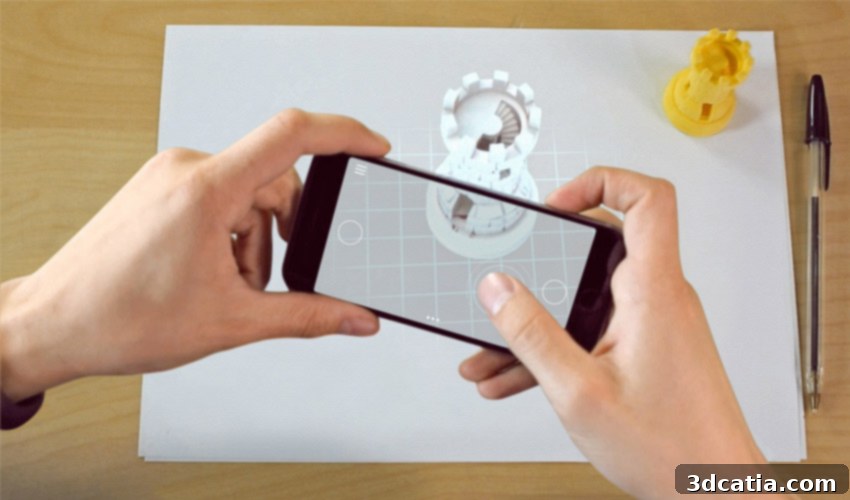
Grib3D stands out as a free, intuitive application compatible with the majority of smartphones and tablets, transforming complex 3D design into an effortlessly engaging experience. Its most compelling feature lies in its innovative integration of augmented reality (AR), allowing users to interact directly with their physical environment. Imagine sketching a simple shape on a piece of paper; Grib3D can instantly recognize and model this sketch in three dimensions, bridging the gap between a two-dimensional idea and a tangible 3D object. This capability makes it an exceptionally valuable tool for 3D printing enthusiasts, as models can be easily exported in universal formats like .OBJ, enabling users to bring their digital creations to life quickly, affordably, and with unparalleled ease. We recently had the opportunity to connect with the visionary team behind Grib to delve deeper into how this accessible 3D software is poised to redefine the creative landscape.
Introducing Grib3D: A Leap Forward in Accessible 3D Design and its Connection to 3D Technologies
Grib, headquartered in Helsinki, Finland, was founded by a team driven by a shared passion for creating compelling 3D objects. Their initial frustration stemmed from the inherent complexity and user-unfriendliness of existing 3D design tools, which often stifled creativity rather than enabling it. This dissatisfaction became the catalyst for Grib3D. The founders envisioned a world where anyone, regardless of their technical background, could effortlessly translate their ideas into 3D models. Their ambition was not merely to create another 3D software, but to build the most intuitive, quickest-to-learn, and universally accessible platform available.
Grib3D embodies this philosophy by stripping away the unnecessary complexities often associated with professional CAD (Computer-Aided Design) software. Unlike traditional applications that demand hours of tutorials and a deep understanding of intricate interfaces, Grib3D is designed for immediate usability. Its cloud-based infrastructure further enhances accessibility, removing the need for powerful, expensive hardware and making it available to a broader audience. This focus on ease of use is intrinsically linked to the broader advancement of 3D technologies, particularly 3D printing. By lowering the barrier to entry for 3D modeling, Grib3D empowers a new generation of creators to participate in the additive manufacturing revolution, fostering innovation from the ground up. It’s not just about creating models; it’s about enabling anyone to design, visualize, and ultimately produce physical objects with unprecedented simplicity.
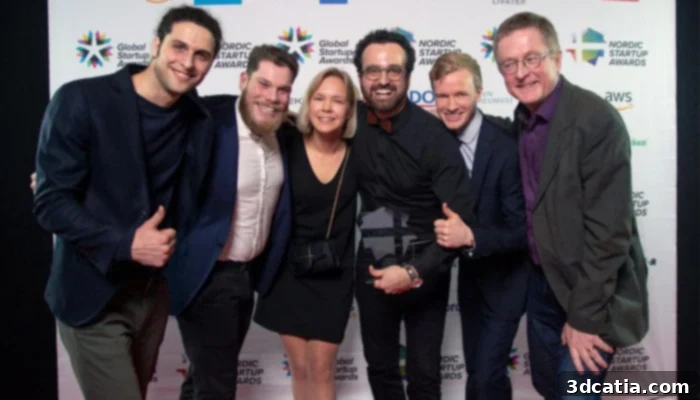
Some of the Grib team collaborating on their innovative 3D design solution.
The Genesis of Grib3D: From Frustration to a Revolutionary Solution
The inspiration behind Grib3D stems directly from a common frustration experienced by many aspiring designers and engineers. Pouria Kay, Grib’s founder and CEO, encountered this firsthand during his design studies at the University of Helsinki. Among design students, it was a popular pastime to commiserate and lament the sheer difficulty and steep learning curve associated with conventional 3D design software. These tools, while powerful, were often perceived as impenetrable fortresses, requiring endless hours of dedicated study just to grasp the basics. Pouria himself spent a considerable amount of time grappling with these tools, often feeling like he was “banging his head on the wall.”
Instead of succumbing to this widespread frustration, Pouria decided to channel his energy into solving the problem that so many faced. This decision marked the true beginning of Grib3D. His journey involved extensive experimentation, exploring various design angles, and a significant amount of pivoting to refine the core concept. The ultimate goal was to create the “lowest threshold solution” – a 3D modeling tool so intuitive and accessible that it would virtually eliminate the traditional barriers to entry. The result of this dedicated effort is Grib3D, an application so straightforward that it serves as an excellent entry point for individuals who have never before ventured into the realm of 3D creation. It transforms what was once a daunting and complex process into an enjoyable and empowering experience, truly opening up 3D design to a much wider audience.
Exploring the Innovative Features of the Grib3D App for Seamless Creation
Grib3D’s core mission is to eliminate unnecessary obstacles, allowing users to fully unleash and enjoy their creativity without technical hindrances. The app is engineered for maximum accessibility, operating seamlessly on the vast majority of smartphones and tablets, making 3D design a truly mobile endeavor. Furthermore, it’s completely free to download and use, removing financial barriers that often accompany high-end design software. A key innovation in Grib3D’s user interface is its command system, which is not reliant on written language. Instead, it utilizes intuitive visual cues and gestures, meaning users don’t need to learn a new specialized “lingo” or memorize complex commands to begin creating. This universal design approach makes it accessible across different languages and cognitive styles.
Perhaps Grib3D’s most distinguishing feature is its robust integration of Augmented Reality (AR). This cutting-edge technology allows users to interact with their environment in unprecedented ways. For instance, a user can simply sketch a two-dimensional shape on a physical piece of paper, and the app’s AR capabilities will recognize it, enabling them to directly extrude or manipulate it into a 3D object within their real-world space. This ingenious functionality not only simplifies the initial design phase but also offers an unparalleled visualization experience. Users can instantly see how their 3D creation would look, feel, and fit in its intended environment before it’s ever physically printed. This dramatically reduces guesswork, allowing for precise adjustments and ensuring the final product meets expectations.
Beyond its powerful AR and intuitive controls, Grib3D is remarkably versatile. While it’s an exceptional tool for 3D printing preparation, its utility extends far beyond. Users can just as easily opt for creating purely virtual objects and scenes for digital art, game design assets, or even educational purposes. The app comes equipped with a diverse array of surface textures and materials, empowering creators to render entire 3D scenes for personal enjoyment or various professional use cases. This comprehensive suite of features truly positions Grib3D as an all-encompassing, user-friendly platform for boundless 3D creativity, right from the palm of your hand.
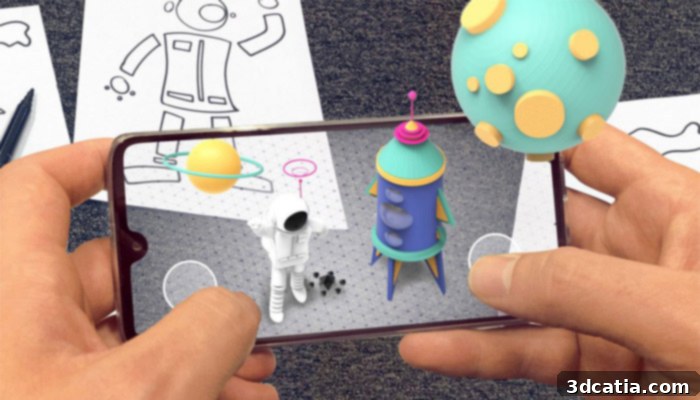
Photo Credit: Grib – Demonstrating the innovative augmented reality capabilities of Grib3D.
Seamless Transition: From Grib3D Creation to Any 3D Printer
One of the critical aspects of any effective 3D modeling software, especially for those venturing into additive manufacturing, is its compatibility with existing 3D printing technologies. Grib3D excels in this regard, ensuring that the transition from a digital design on your mobile device to a physical object is as smooth as possible. As implied earlier, the 3D models created within the Grib3D app can be printed on virtually all commercially available 3D printers, making it a truly universal solution for makers and designers. This widespread compatibility is a significant advantage, as users are not locked into specific hardware or ecosystems, offering freedom and flexibility in their printing choices.
Currently, creations from Grib3D are exported using the industry-standard .OBJ format. The .OBJ file format is widely supported across various 3D software applications and 3D printing slicers, ensuring that your model can be easily prepared for printing, regardless of your chosen printer’s brand or type. This current offering provides a robust and reliable pathway for users to transform their designs into tangible reality. Looking ahead, the Grib team is actively working on expanding the range of export options, promising to introduce additional formats in the future. This commitment to broader compatibility will further enhance Grib3D’s utility, catering to diverse user needs and advanced printing workflows. The ability to quickly design on a mobile device and then confidently send that design to almost any 3D printer empowers rapid prototyping and fosters a truly agile creative process.
Grib3D’s Diverse Clientele: Empowering Every Creative Mind
Grib3D is currently in its beta phase, but its core vision is clear: to be the introductory platform for individuals new to 3D software. The app is meticulously designed for simplicity, making it the ideal starting point for anyone taking their “first steps” into the world of 3D modeling. While the interface is incredibly user-friendly, its creative potential is vast. With a bit of imagination, users can quickly produce remarkably cool and complex objects. Consider, for example, the task of designing a custom phone or tablet holder. With Grib3D, a user could conceptualize, model, and prepare such an item for 3D printing faster than it would typically take to simply boot up a computer and launch traditional, more intricate 3D design software. This speed and efficiency are game-changers for casual users and those with spontaneous creative urges.
The primary target audience for Grib3D isn’t necessarily the seasoned 3D professional who has spent years honing skills with advanced CAD programs. These established designers have already invested significant time and effort into their existing workflows and are unlikely to switch. Instead, Grib3D appeals to a broader demographic: curious minds across all walks of life. This includes individuals who currently rely on professional 3D designers for their custom needs, but now seek to take creative control themselves. It also encompasses hobbyists, educators, students, and small business owners who desire to unleash their creativity without the substantial time commitment, financial investment, and steep learning curve traditionally associated with 3D design. Grib3D empowers these users to quickly iterate ideas, create prototypes, or simply design for fun, making 3D creation an accessible and enjoyable pursuit for everyone.
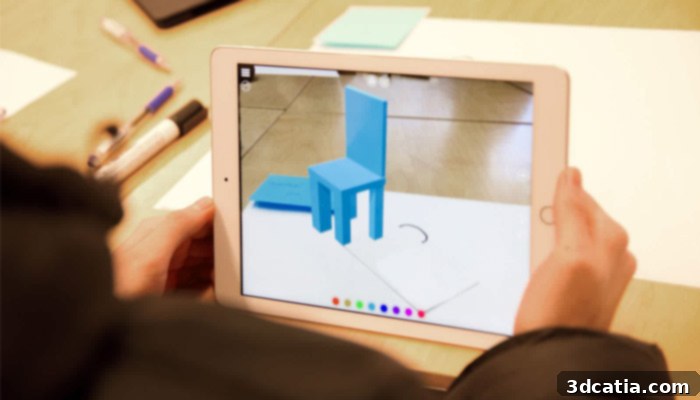
The app is made for anyone who wants to model their ideas quickly, transforming abstract concepts into tangible designs.
The Inseparable Link Between Augmented Reality and 3D Printing: A Synergistic Approach
The connection between Augmented Reality (AR) and 3D printing is a deeply synergistic one, with AR significantly enhancing the efficiency and effectiveness of the 3D printing workflow. Whenever you embark on creating something intended for physical fabrication, AR serves as an invaluable tool, providing a crucial preliminary visualization. Before committing to the most time-consuming and resource-intensive phase – the actual 3D printing process – AR allows you to realistically perceive what your creation will look like in the real world. This capability eliminates much of the guesswork and potential for costly errors.
With AR, you can place a virtual model of your design directly into its intended physical environment, using your smartphone or tablet screen as a window. This allows you to assess its scale, proportions, and how it interacts with surrounding objects. Often, you won’t even need to meticulously measure dimensions, as AR enables you to “eyeball” them with remarkable accuracy by observing the virtual object in context. This interactive visualization helps in making immediate adjustments, ensuring the design fits perfectly, looks aesthetically pleasing, and functions as intended before any material is consumed. By identifying potential issues early in the design phase through AR, creators can significantly reduce waste, save valuable time, and streamline the entire iterative process of 3D printing, making the journey from concept to tangible product much more efficient and precise.
Grib3D is truly pushing the boundaries of accessible 3D modeling, making creativity more approachable than ever before. To discover more about Grib3D and its features, we encourage you to visit their official website. Experience firsthand how augmented reality can transform your ideas into 3D models with unparalleled ease.
What are your thoughts on Grib3D’s innovative app and its potential to democratize 3D design? We’d love to hear your feedback! Share your insights in a comment below or join the conversation on our Facebook and Twitter pages. Don’t miss out on the latest advancements and news in the world of additive manufacturing; sign up for our free weekly Newsletter and get all the essential 3D printing updates delivered straight to your inbox!