
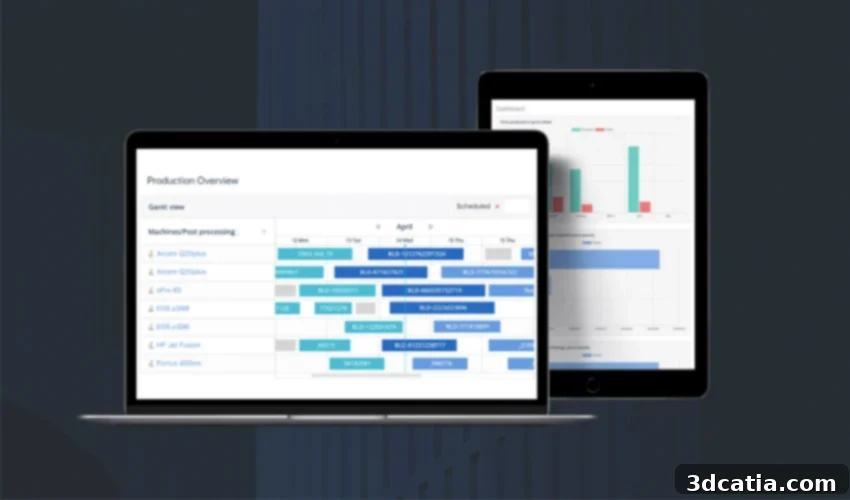
Unlocking Efficiency: How AMFG’s End-to-End Software Automates Additive Manufacturing Workflows
As industries worldwide increasingly embrace the transformative potential of 3D printing, moving beyond mere prototyping to large-scale production, the critical need for sophisticated tools to manage additive manufacturing (AM) workflows has become undeniable. For any sector aiming to achieve peak efficiency and sustainable growth, robust software solutions are indispensable for overseeing operations. Within the dynamic 3D printing landscape, the London-based company AMFG has astutely recognized this burgeoning demand, stepping forward to provide cutting-edge AM workflow automation software designed specifically for businesses navigating this evolution. Their innovative software suite stands out as a comprehensive, end-to-end workflow management solution. But what precisely does this entail? What tangible benefits can companies expect from integrating such an advanced system? And which industries are already reaping the rewards of adopting these automated software solutions? To delve deeper into these crucial questions and gain expert insights, we had the privilege of speaking with Keyvan Karimi, the visionary Founder and CEO of AMFG.
3DN: Could you introduce yourself and elaborate on your connection with additive manufacturing?

Keyvan Karimi, Founder and CEO of AMFG
My academic foundation is rooted in Industrial Engineering, where I specialized in optimizing complex systems. Following my graduation, I accumulated several years of invaluable experience across diverse sectors, including automotive, retail, and banking. During this period, I was consistently at the forefront of leading significant global enterprise automation projects, honing my expertise in streamlining operations and enhancing productivity through technological innovation. My professional journey within additive manufacturing spans over six years now, but my fascination with the technology’s profound potential began much earlier. I hold a firm belief that AM possesses the unique capability to utterly revolutionize traditional manufacturing processes and reshape global supply chains, thereby exerting a deep and positive impact on society at large. This conviction fuels my dedication to fostering its widespread adoption and development.
3DN: Could you tell us more about AMFG? How would you describe the company to someone unfamiliar with your work?
AMFG is at the forefront of providing advanced workflow automation software specifically tailored for the additive manufacturing industry. Our company name, AMFG, is an acronym for ‘Autonomous Manufacturing,’ which encapsulates our core vision: to enable and realize fully autonomous additive manufacturing processes through sophisticated automation. The genesis of AMFG stemmed from our keen observation of a critical void in the market. The additive manufacturing industry was clearly undergoing a significant paradigm shift, transitioning from a focus primarily on prototyping to genuine manufacturing applications. An increasing number of companies were beginning to integrate 3D printing into their operations, having recognized its immense potential for a broader spectrum of applications beyond just initial design validation.
Despite significant investments in cutting-edge hardware and advanced materials, many companies found themselves lacking the internal capabilities and software infrastructure required to effectively manage their burgeoning AM operations. The focus had predominantly been on the physical aspects of 3D printing, with the crucial software component often overlooked. Consequently, a vast majority of processes, from managing incoming requests to meticulously scheduling production runs, were still executed manually. In contrast, traditional manufacturing sectors have long relied on Manufacturing Execution Systems (MES) to optimize and control production processes. We firmly believe that additive manufacturing deserves, and indeed requires, a similar level of sophisticated software support to unlock its full potential. This conviction was the driving force behind AMFG’s establishment: to empower companies to automate, streamline, and seamlessly connect their entire AM workflows. We’ve encountered numerous clients who, prior to adopting our solution, were grappling with inefficient methods such as spreadsheets, a patchwork of disparate software systems, or even entirely paper-based processes to oversee their production. Such manual approaches are inherently unsustainable and simply not scalable for modern manufacturing demands.
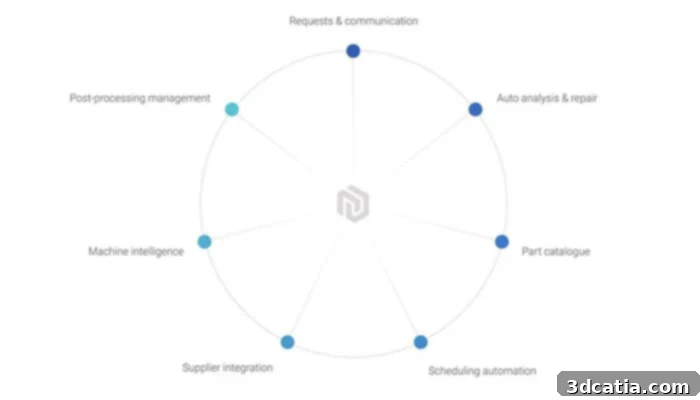
The AMFG software solution is a complete, end-to-end workflow management solution for AM
What truly distinguishes our solution in the market is its unparalleled comprehensiveness. AMFG offers the only software platform that provides a complete, end-to-end workflow management solution specifically designed for additive manufacturing. This holistic approach means we are capable of managing every single stage of the AM workflow. This includes robust request management, detailed printability analysis, real-time machine analytics for performance monitoring, efficient production scheduling, thorough post-processing management, and seamless communication with external suppliers. Our software effectively consolidates all these crucial functions into one integrated platform, eliminating silos and enhancing overall control. Another significant advantage our software offers is an exceptional level of flexibility. I can confidently state that AMFG provides the greatest degree of adaptability available on the market today. We understand implicitly that every company operates with its own unique approach and specific requirements for additive manufacturing. Recognizing this diversity, we have prioritized developing flexible software solutions that can be precisely tailored to meet the individual needs of our clients. Our diverse clientele includes leading OEM customers across a wide range of industries, such as automotive, consumer goods, and industrial goods. Furthermore, we also cater to specialized service bureaus, offering distinct, customized solutions designed to optimize operations for both these critical segments of the AM ecosystem.
3DN: What are the benefits of implementing workflow automation solutions for additive manufacturing? For which sectors is it most beneficial?
Implementing workflow automation software is absolutely vital for any company that seeks to maximize its return on investment (ROI) from additive manufacturing. Such a solution radically reduces the considerable amount of time currently spent on laborious manual tasks, including data collection, detailed cost tracking, precise build scheduling, and numerous other administrative chores. By automating these processes, the entire production workflow becomes significantly more efficient, allowing resources to be reallocated to higher-value activities. To illustrate this, consider the scenario of managing a Rapid Prototyping (RP) department, which typically handles a large volume of diverse requests on a daily basis. Manually performing tasks such as ensuring the printability of incoming files, coordinating communication with internal users across different departments, and standardizing the entire request submission process can be incredibly time-consuming and prone to bottlenecks.
A well-designed workflow software solution automates these complex processes, transforming a chaotic manual system into a streamlined, efficient operation. In the described RP department scenario, AMFG offers an integrated order management system specifically engineered to simplify and accelerate the entire order processing workflow. As a direct result, the RP department experiences a multitude of benefits, including drastically faster lead times for projects, a significantly improved user experience for all stakeholders, and enhanced transparency throughout the production cycle. This elevated level of efficiency and clarity empowers the department to scale its activities far more effectively, accommodating increased demand without compromising performance. Furthermore, regardless of whether a company utilizes AM for rapid prototyping, robust tooling, or the production of critical end-use parts, a common struggle often arises from inadequate planning tools and a lack of a clear, real-time overview of their machine status. This becomes a particularly severe bottleneck when operations are distributed across multiple geographical locations, leading to a critical deficit in overall visibility and control.
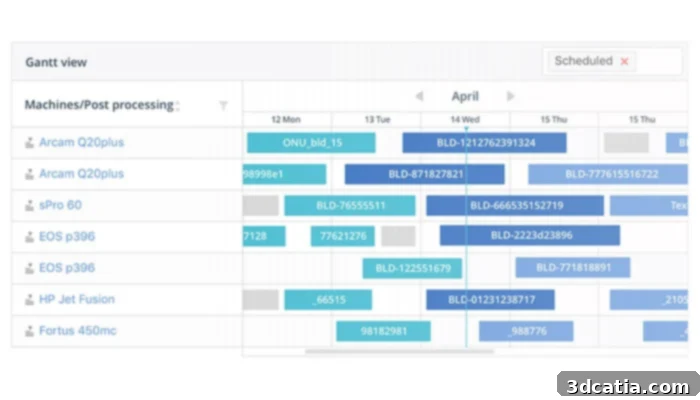
Centralised production planning and scheduling system for AM
We address this prevalent challenge head-on by providing a highly sophisticated, centralized production planning and scheduling system. This innovative system enables users to meticulously track individual parts and monitor the progress of entire projects, thereby ensuring greater traceability and accountability throughout the manufacturing process. Moreover, we are actively developing capabilities to connect directly to the additive manufacturing machines themselves. This integration will mark a significant leap forward, moving us closer to realizing the ultimate goal of a fully automated AM production line. Ultimately, establishing a robust business case for additive manufacturing is paramount for its sustained adoption. Workflow software plays a pivotal role in achieving this by demonstrably delivering the necessary ROI. It accomplishes this through substantial cost savings derived from optimized operations, significantly improved machine utilization rates that maximize hardware investments, and the critical elimination of risks associated with human error, leading to higher quality and more consistent output. For sectors like automotive, aerospace, medical, and consumer goods, where precision, speed, and cost-effectiveness are paramount, these benefits are particularly transformative.
3DN: Could you give some concrete examples of how your software works in practice?
Certainly. In the demanding automotive industry, some of the world’s largest and most reputable car manufacturers are actively leveraging AMFG’s software to meticulously manage their entire end-to-end additive manufacturing workflows. This includes everything from the initial order management phase and precise production scheduling to even the complex coordination and management of their external suppliers. For instance, one prominent automotive manufacturer, having already successfully established a compelling business case for integrating additive manufacturing internally, is now deploying our software to comprehensively support both their ordering and manufacturing processes. Through the seamless implementation of our solution, they have been able to achieve a remarkable increase in the overall efficiency of their operations and significantly enhance communication flows between their various, often disparate, departments.
In another compelling example, a different leading automotive manufacturer took the strategic step of establishing a brand-new business unit specifically dedicated to additive manufacturing. From the very outset of this initiative, they recognized the critical need for a robust workflow software to effectively manage these nascent processes. A key requirement was the seamless integration of this new system with their extensive, pre-existing ERP software infrastructure. AMFG was uniquely positioned to meet both of these complex needs. As a result, this manufacturer now benefits from a smooth, highly synchronized workflow that integrates their advanced AM operations directly into their broader enterprise systems, ensuring consistency and data integrity. These examples highlight how our platform adapts to different scales and integration needs within a highly regulated and demanding industry.
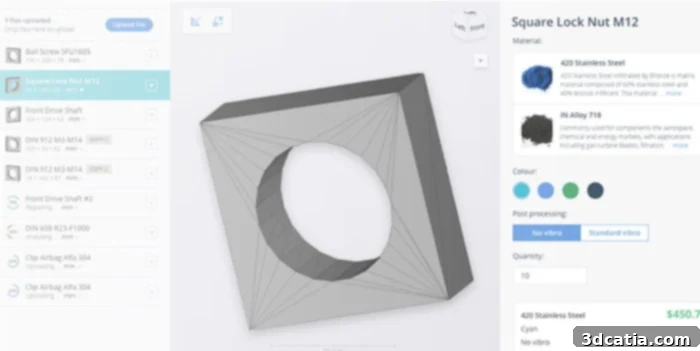
Order management system
Beyond the automotive sector, we also boast a wealth of highly successful case studies on the service bureau side, illustrating the versatile applicability of our software. We recently published an insightful case study detailing how Graphite Additive Manufacturing, a large and well-established UK-based service bureau, experienced a significant increase in revenue after implementing several key modules of our workflow software. This demonstrates the direct financial impact of improved operational efficiency. Similarly, Bowman International, a leading global manufacturer of bearings, utilizes our software to effectively manage crucial backend tasks, including comprehensive project management and intricate production scheduling. These examples collectively underscore how diverse companies are successfully leveraging AMFG’s solutions to overcome significant operational challenges, streamline their processes, and ultimately drive greater productivity and profitability within their additive manufacturing endeavors. The adaptability of our platform allows it to address unique challenges, whether they are related to internal production or external service offerings.
3DN: Do you anticipate many companies adopting AM workflow automation software in the coming years? What types of companies will benefit most?
Absolutely. I firmly believe that the demand for sophisticated workflow automation software will only intensify and grow exponentially as more and more companies continue their internal adoption and integration of 3D printing technologies into their core manufacturing strategies. While manufacturers producing only a relatively small volume of parts annually – perhaps a few hundred – might still manage to operate without specialized workflow software, as these lower volumes can often be handled adequately through less sophisticated means, this situation rapidly changes as production scales. That being said, companies with a clear and ambitious vision of significantly scaling their additive manufacturing operations – and here we are talking about moving into production volumes of tens, and even hundreds of thousands of parts per year – will undoubtedly find workflow software an indispensable tool. Such solutions will be absolutely critical to running their extensive operations with the necessary efficiency, control, and precision required to sustain growth and competitiveness.
Fortunately, there is a clear and growing recognition among businesses of this critical need for dedicated AM workflow software. As they transition from experimental pilot projects to full-scale industrial production, the complexities multiply, making manual management untenable. Observing the overall robust growth trajectory of the additive manufacturing industry, we are incredibly positive and optimistic about the vast opportunities that lie ahead for the workflow software market in the coming years. The industry is maturing, and with that maturity comes the understanding that software is not just an accessory but a fundamental pillar for effective and scalable AM. This market segment is poised for significant expansion, driven by the inherent need for greater efficiency, traceability, and automation across the entire AM value chain. As 3D printing moves deeper into mainstream manufacturing, the supporting software infrastructure, like ours, becomes ever more crucial.
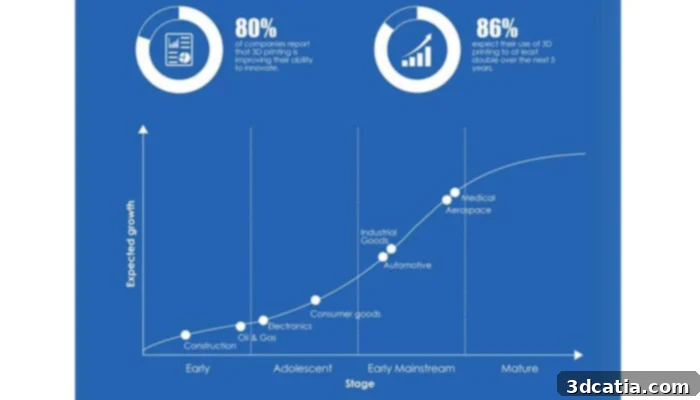
AMFG’s infographic on the adoption of 3D printing by different industries | Credits: AMFG
3DN: Any final words for our readers?
The field of 3D printing is truly an incredibly exciting space right now, vibrant with innovation and rapid advancements. We are witnessing monumental progress within the industry, particularly in terms of its increasing maturity and profound industrialization. It’s no longer just a niche technology; we can now confidently assert that 3D printing has evolved into a fully viable and robust manufacturing technology, capable of meeting stringent industrial demands and producing high-quality, functional parts on a significant scale. Our unwavering aim at AMFG is, and has always been, to stand at the very forefront of enabling autonomous manufacturing. By providing the essential software infrastructure for this autonomy, we empower companies to genuinely unlock the full spectrum of benefits that additive manufacturing offers, transforming potential into tangible competitive advantage and operational excellence.
What are your thoughts on AMFG’s innovative platform and the future of AM workflow automation? We encourage you to share your insights in a comment below or join the conversation on our Facebook and Twitter pages! Don’t miss out on the latest news and developments in the world of 3D printing—sign up for our free weekly Newsletter and have all the breaking stories delivered directly to your inbox!