
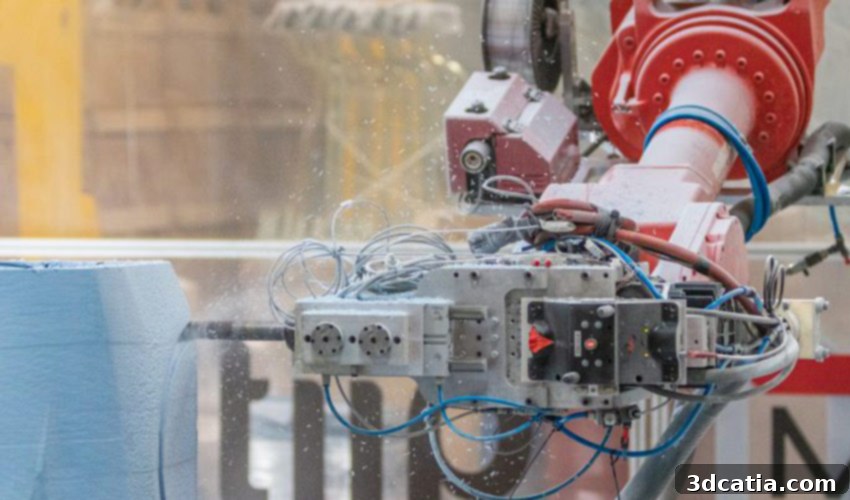
Revolutionizing Large-Scale Manufacturing: The KRAKEN Hybrid 3D Printing System Unveiled
For three impactful years, a consortium of European researchers has dedicated their expertise to the KRAKEN project, an ambitious endeavor poised to redefine the landscape of industrial manufacturing. This groundbreaking initiative has culminated in the development of a hybrid manufacturing system that seamlessly integrates advanced additive manufacturing technologies with robust subtractive production methods. The KRAKEN system is a technological marvel, featuring three interchangeable additive manufacturing heads complemented by a fourth, powerful subtractive manufacturing head. This unique configuration empowers the KRAKEN to fabricate exceptionally large objects, boasting lengths of up to an astonishing 20 meters. Following extensive development and rigorous testing, the machine’s design and construction were successfully completed at the end of September, marking its official availability to the global market.
The adoption of additive manufacturing technologies for producing end-use parts is experiencing an unprecedented surge across various industries. This growing confidence is underscored by findings from the latest report from EY, which indicates that 18% of surveyed companies are already utilizing 3D printing for final product components, with a significant 46% planning to integrate this capability by 2022. This trend highlights a fundamental shift in professional perception, demonstrating increased trust in the reliability and efficacy of additive processes for critical applications. However, it’s crucial to acknowledge that additive manufacturing is frequently employed in conjunction with, rather than as a sole replacement for, more traditional production techniques. For instance, many manufacturers leverage 3D printing to create highly complex molds, thereby dramatically accelerating lead times and enabling more intricate designs. This synergistic relationship between different production methodologies is precisely why hybrid manufacturing systems are gaining such prominence, driven by the objective of combining the strengths of various processes to achieve unparalleled increases in productivity, versatility, and cost-effectiveness.
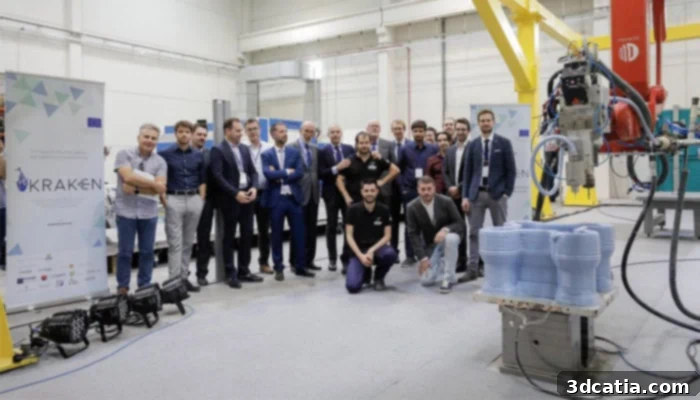
The dedicated team members behind the KRAKEN project, bringing innovation to large-scale hybrid manufacturing.
The ambitious scale and technological complexity of the KRAKEN project would not have been realized without the substantial financial backing secured through the Horizon 2020 research framework programme. This crucial European Union initiative is designed to foster innovation, stimulate market growth, and enhance global competitiveness across various sectors. KRAKEN emerged from a collaborative synergy between fifteen leading specialists in the industrial manufacturing and research sectors. This prestigious consortium included eminent organizations such as the British firm TWI, renowned for its expertise in materials joining and engineering; the Spanish construction and infrastructure giant ACCIONA; and CECIMO, the influential European association of machine tool manufacturers, representing the pinnacle of industrial machinery innovation. Their collective goal was extraordinarily ambitious: to engineer a single, versatile machine capable of producing parts up to 20 meters in length, utilizing a diverse range of high-performance materials including thermosetting polymers, aluminum, or combinations thereof. Beyond the technical achievements, the project also carries a significant socio-economic objective: to generate approximately 750 new jobs across the European Union, thereby contributing to regional development and specialized workforce growth.
Unpacking KRAKEN’s Advanced Capabilities: A Closer Look at the Hybrid System
The KRAKEN solution stands out due to its modular design, which incorporates several highly specialized and interchangeable manufacturing heads, ensuring unprecedented versatility and adaptability for a wide range of industrial applications. Among these, one head is dedicated to high-rate resin extrusion, enabling the precise deposition of advanced polymer materials. Another head facilitates the innovative deposit and fuse of metal rods, operating on the principles of the Wire Arc Additive Manufacturing (WAAM) process, ideal for creating large metal structures. A third sophisticated head is designed for metallization, applying metallic coatings to parts using an electric arc, thereby enhancing surface properties or material composition. Finally, the fourth head provides comprehensive subtractive manufacturing functions, offering cutting, sanding, and polishing capabilities essential for achieving the required final dimensions and surface finish. This integrated approach ensures that parts can be produced and refined within a single, continuous workflow.
Delving deeper into the additive manufacturing processes, the resin extruder demonstrates remarkable efficiency, depositing a specialized polyurethane paste at an impressive rate of 120 kg/h. This high deposition rate is crucial for rapidly building large polymer or composite structures, offering significant advantages in terms of speed and material economy for applications ranging from custom molds to large prototypes and end-use components. KRAKEN’s implementation of the WAAM process is equally impressive, engineered to 3D print robust aluminum parts at a speed of 15 kg/h. WAAM is particularly valued for its ability to produce large-scale metal components with high material integrity and reduced waste, making it suitable for aerospace, automotive, and heavy industry sectors. Furthermore, the system integrates thermal spray metallization, a cutting-edge technique designed to add a durable metallic coating over polymer parts. This process can impart enhanced mechanical properties, electrical conductivity, corrosion resistance, or aesthetic finishes to polymer components, effectively creating hybrid material parts. All these sophisticated capabilities are housed within a remarkably compact footprint for a machine of its capacity, occupying a floor area of 20 x 8 x 6 meters, a testament to intelligent engineering and spatial optimization.
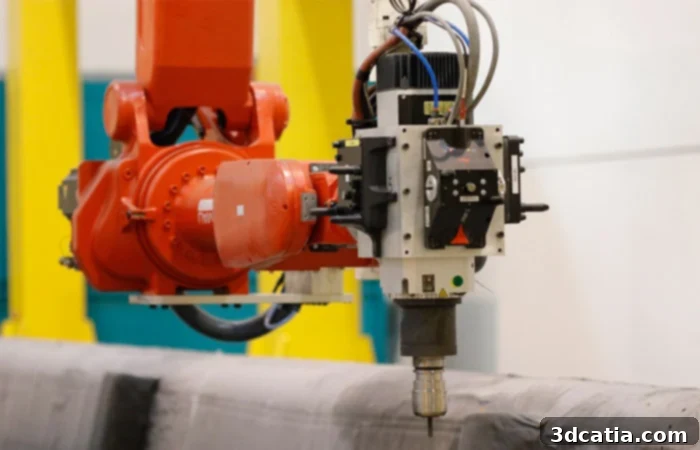
The interchangeable extruders on the KRAKEN system highlight its adaptability and multi-material processing capabilities.
José Antonio Dieste, a principal researcher and the dedicated coordinator of the KRAKEN project, expressed immense satisfaction with the system’s readiness for commercial deployment. He affirmed, “The machine is ready to be commercialized, it has been tested in a real manufacturing environment and the project demonstrators have been validated by employees under real conditions. We can now deliver parts or install KRAKEN systems as requested by customers.” This statement underscores the thorough validation process and the confidence in KRAKEN’s operational integrity and performance. In terms of tangible benefits and efficiency gains, the project leaders proudly report that the KRAKEN hybrid system represents a significant leap forward in manufacturing capabilities. Comparative analyses indicate that KRAKEN is an astounding 40% faster in overall production cycles, boasts a 25% increase in productivity, and achieves a remarkable 30% reduction in manufacturing costs compared to conventional methods. These impressive metrics are attributed to the seamless integration of additive and subtractive processes, minimizing material handling, reducing waste, and optimizing complex geometries that are often challenging or impossible with traditional techniques.
Transformative Applications Across Industries: KRAKEN’s Project Demonstrators
To thoroughly validate the KRAKEN manufacturing system’s capabilities and prove its industrial viability, the project partners undertook a series of rigorous case studies, demonstrating its potential across diverse sectors. For example, CRF (Centro Ricerche Fiat) successfully utilized the KRAKEN system to manufacture advanced metal frames for both the front and rear sections of an Alfa Romeo 4C. This application highlights KRAKEN’s capacity to produce complex, high-strength metal components for the demanding automotive industry, potentially offering benefits such as weight reduction and enhanced structural integrity through optimized designs. In another impressive demonstration, ACCIONA leveraged KRAKEN to create innovative waterproof tunnel lining panels that incorporated integrated electrical wiring. This showcases the system’s potential for revolutionizing large-scale civil engineering projects, enabling the production of customized, multi-functional components with embedded functionalities, streamlining construction processes and improving durability.
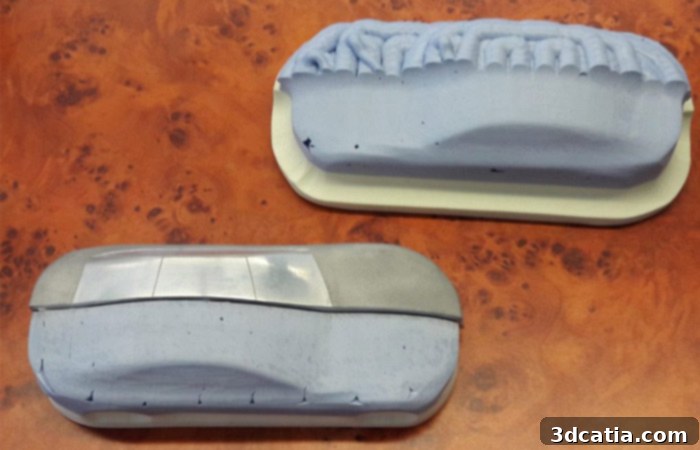
A detailed car model prototype created using KRAKEN’s resin extrusion (top) and then enhanced with metal coating (bottom), showcasing multi-material capabilities.
Further validating its utility in the automotive design and prototyping sphere, a full-scale model of one of the latest Pininfarina car models was produced using KRAKEN, specifically to validate its intricate design and aesthetic appeal. This substantial part, measuring 2.2 x 1 x 0.6 meters and weighing 250 kg, demonstrates KRAKEN’s exceptional capability for rapid, large-scale prototyping, significantly accelerating design iteration cycles for high-end automotive manufacturers. The profound impact of the KRAKEN system has not gone unnoticed by major industrial players. The aerospace giant Airbus, for instance, has already expressed significant interest and plans to commission the KRAKEN machine for the manufacture of specialized tooling parts. This signals a pivotal adoption in a sector where precision, material performance, and the ability to produce large, complex geometries are paramount. The automotive sector’s continued interest, particularly for designing production models and manufacturing composite components, further underscores KRAKEN’s transformative potential. It is readily apparent how this innovative machine could profoundly impact various industries, enabling the efficient production of large quantities of complex composite parts, optimized in terms of both geometry and weight, while simultaneously delivering superior performance. While the exact commercial price of such a cutting-edge solution has not been publicly disclosed, further detailed information about the project and its capabilities can be found HERE.
The KRAKEN machine represents a monumental step forward in large-scale hybrid manufacturing, offering unprecedented capabilities for diverse industrial applications. Its ability to seamlessly integrate additive and subtractive processes for creating enormous, complex parts from a variety of materials positions it as a key enabler for the next generation of industrial innovation. We are excited to see the long-term impact of this technology across aerospace, automotive, civil engineering, and beyond, fostering greater efficiency, design freedom, and cost-effectiveness in manufacturing processes worldwide.
What are your thoughts on the revolutionary KRAKEN machine and its potential to shape the future of industrial production? Feel free to share your comments and insights in the section below, or engage with us on our Facebook and Twitter pages! Don’t miss out on the latest advancements and news in the world of 3D printing; sign up for our free weekly Newsletter to receive all the essential updates directly in your inbox.