
Transforming Manufacturing: The Breakthrough of Self-Folding 4D Printed Origami
Traditional 3D printing, while revolutionary, often demands a considerable degree of patience. Large-scale, intricate constructions can necessitate countless hours for completion, with industrial 3D printing processes sometimes extending even longer. Yet, the unparalleled convenience and automation inherent in additive manufacturing frequently position it as the most advantageous and efficient solution for diverse applications. The drive to enhance the speed and efficiency of 3D printing machines is a continuous global endeavor, with ongoing studies and tests pushing the boundaries of what’s possible. Amidst this innovation, a remarkable breakthrough has emerged from a team of researchers at the University of Tokyo in Japan. They have achieved a unique synergy, marrying ancient tradition with cutting-edge progress, in the form of 3D printed origami that self-folds. While this isn’t the first instance where origami and 3D printing have intersected, this latest development powerfully highlights the often-underestimated creative and utility potential embedded within origami constructions and smart materials.
Unveiling “4D Printing”: Instantaneous Self-Folding Technology
The research team has coined their groundbreaking creation process “4D printing.” This nomenclature stems from the dramatic reduction of the fourth dimension, commonly associated with time, after the initial printing phase. What sets this innovation apart is its ability to produce a final creation that can self-fold into its predetermined, complex 3D shape almost instantaneously. Professor Koya Narumi, a pivotal member of the University of Tokyo research team and the Department of Electrical Engineering and Information Systems, eloquently describes the process: “Essentially, we’re creating flat sheets with origami patterns on them, and these patterns can be complex, taking even a skilled origami artist hours to form. But thanks to our special process, you can pour hot water over these flat sheets and watch as they spring into complex 3D shapes in a matter of seconds.” This ability to transform a flat, inert sheet into a dynamic, intricate object in mere moments represents a paradigm shift in rapid prototyping and material design, moving beyond static 3D printing to dynamic, programmable matter.
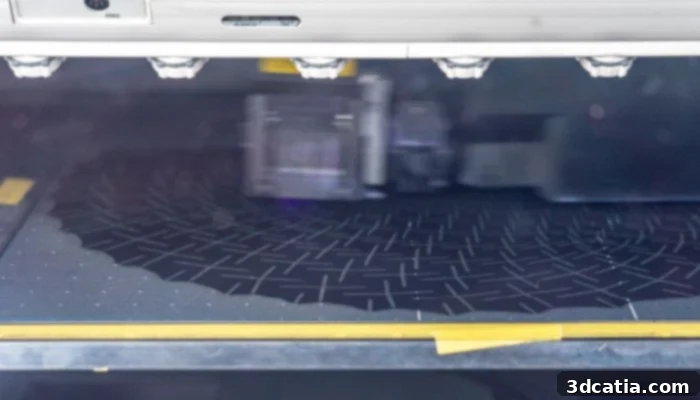
The design layers are printed onto a heat-sensitive plastic sheet which is treated by UV light. (Photo credits: Koya Narumi)
From Digital Design to Dynamic Form: The Innovative Production Process
The Algorithmic Foundation and Inkjet UV Printing
The journey of these self-folding structures begins in the digital realm, meticulously mapped out by an advanced algorithm developed specifically by the University of Tokyo research team. This algorithm translates complex origami patterns, traditionally requiring intricate manual folding, into a flat, 2D printable layout. Once the digital blueprint is finalized, it enters the production phase as a flat sheet. This sheet, conceptually similar to paper awaiting an origami artist’s touch, is designed to be bent and folded into its desired shape, but through a programmed material response rather than manual manipulation.
The designs are precisely printed onto a heat-sensitive plastic sheet using a process that bears a strong resemblance to material jetting in conventional 3D printing. The researchers refer to their methodology as ‘Inkjet UV Printing,’ a technique characterized by its ability to deposit multiple material layers with high precision. A key feature of this process is that the printed materials react specifically to UV light, which plays a critical role in curing and setting the different layers. The intricate print consists of several distinct material layers: first, a primer layer ensures optimal adhesion to the base substrate; then, the crucial base ink layer, which forms the pattern; and finally, a clear, protective top layer that is not only robust but also waterproof, safeguarding the delicate underlying structure and enabling its interaction with water without degradation.
The Mechanism of Instantaneous Self-Folding
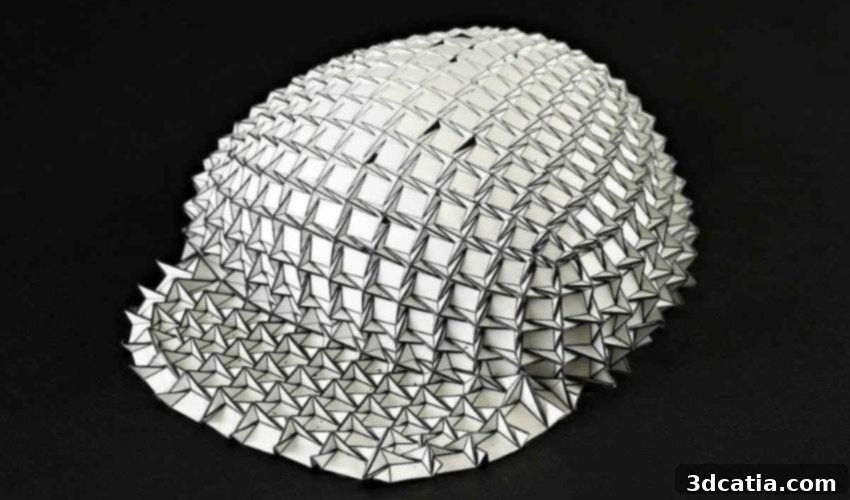
The ingenious design of the print is what enables its phenomenal self-folding capabilities. The printing process strategically creates microscopic gaps or exposed lines within the flat sheet where folding is intended to occur. These precisely defined areas leave the heat-sensitive plastic exposed underneath a layer of heat-resistant ink. The heat-resistant ink acts as a barrier, preventing the underlying plastic from reacting prematurely or in unintended areas. The magic happens when the printed sheet is exposed to hot water. As the warm water comes into direct contact with the reactive, exposed heat-sensitive plastic, a rapid and localized material change occurs. This change causes the plastic to soften, shrink, or expand along the predefined lines, forcing the sheet to immediately fold along these preplanned creases. The result is a stunningly fast transformation from a flat, two-dimensional sheet into a complex, three-dimensional object. This allows for the instantaneous formation of intricate designs, whether it be a delicate rabbit, a geometrically precise globe, or even a functional, wearable cap, all springing into existence in a matter of seconds.
Transformative Potential and Future Horizons of 4D Origami
Although the research into this innovative 4D printing technology is still in its nascent stages, the team harbors ambitious hopes for its future applications. A primary goal is to expand the range of available materials, which would inherently broaden the spectrum of possible applications. Fundamentally, the team envisions this technology as a powerful tool to significantly reduce waste across various production chains, contributing to more sustainable manufacturing practices. They have already identified the fashion industry as a major target sector, where custom, on-demand, and self-assembling garments could revolutionize production and consumption patterns. Beyond apparel, the medical field stands to benefit immensely, with potential applications ranging from self-deploying medical devices and drug delivery systems to custom prosthetics and minimally invasive surgical tools that can transform inside the body. Furthermore, the technology holds immense promise for disaster relief efforts, enabling the rapid deployment of self-assembling shelters, emergency medical supplies, or communication devices in critical situations. The ability to quickly and easily create complex, functional structures on-site could be a game-changer in humanitarian aid.
Looking further ahead, the implications of self-folding 4D printed origami extend to areas like soft robotics, where robots can change shape and function in response to environmental stimuli; smart packaging that adapts to its contents; and even deployable aerospace components that unfold in space. The computational power required to design these intricate folding patterns, combined with the precision of Inkjet UV Printing, opens up a new frontier for engineering programmable materials. This synergy of tradition, computation, and advanced manufacturing positions 4D printing as a cornerstone for the next generation of smart products and sustainable production. For those eager to delve deeper into the team’s pioneering research and discover more about their vision, additional information is available HERE.
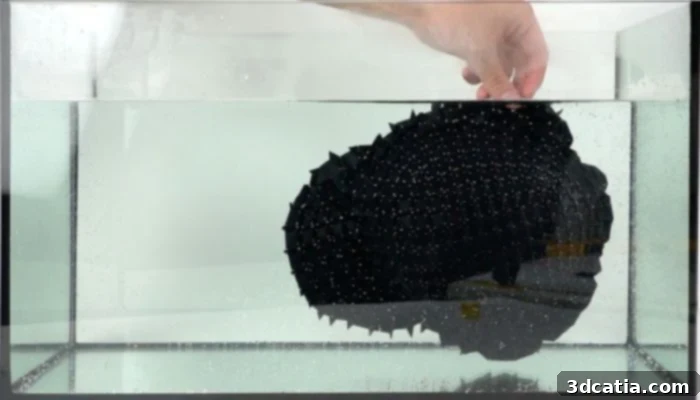
The material instantly reacts after coming into contact with warm water and folds along the predetermined lines to form its shape. (Photo credits: Koya Narumi)
What are your thoughts on this incredible development in “4D” origami and its potential to revolutionize manufacturing and beyond? Share your insights and predictions in a comment below, or engage with us on our social media platforms: LinkedIn, Facebook, and Twitter! Don’t miss out on the latest advancements in additive manufacturing by signing up for our free weekly Newsletter here, delivering the freshest 3D printing news directly to your inbox. You can also explore all our videos and in-depth content on our dedicated YouTube channel.
*Cover Photo Credits: The Yomiuri Shimbun