
Unlocking Nano-Optical Potential: TU Graz Perfects 3D Nanostructure Production with Unprecedented Precision
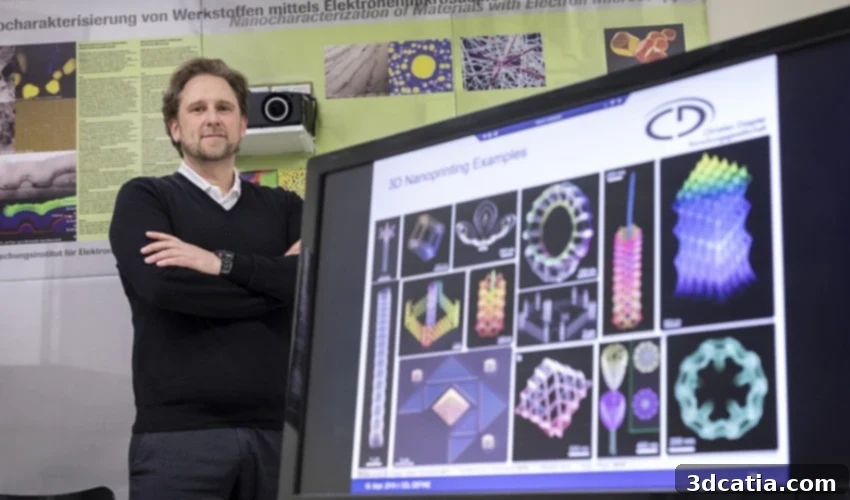
In a groundbreaking development that promises to reshape the landscape of nanotechnology, researchers Harald Plank, Verena Reisecker, and David Kuhness from Graz University of Technology (TU Graz) have achieved a significant milestone in the fabrication of 3D nanostructures. Their innovative approach ensures the precise control over the shape and size of these minuscule architectures, a critical factor for attaining desired optical properties. This breakthrough is not merely an incremental improvement but a leap forward, underpinned by meticulous simulation of these nanostructures (often referred to as nanoarchitectures), which served as the foundational blueprint for their physical realization. Furthermore, the team successfully addressed a long-standing challenge by effectively eliminating chemical impurities that frequently arise during the manufacturing process, all without compromising the structural integrity or delicate morphology of the nanostructures. These optically active nanostructures are poised to play a transformative role across various cutting-edge applications, including enhancing the efficiency of solar cells and developing highly sensitive chemical and biological sensors.
The fundamental objective driving nanoparticle production has always been their strategic application to surfaces. By precisely placing and controlling these particles, scientists aim to concentrate, manipulate, or even initiate specific reactions of light. While this field of study and application has been evolving for over two decades, the continuous goal remains to expand the potential applications of this sophisticated methodology. The ability to precisely tailor nanostructures for specific optical responses opens doors to advancements previously confined to theoretical discussions, enabling novel functionalities in optical devices and advanced material science.
A Decade of Pioneering 3D Nanoarchitectures at TU Graz
For more than ten years, dedicated researchers at the Institute of Electron Microscopy and Nanoanalytics at Graz University of Technology, in collaboration with the Center for Electron Microscopy (ZFE), have been at the forefront of this ambitious vision. Their concentrated efforts have focused on pioneering the development of intricate, self-supporting 3D architectures at the nanoscale. This direction marks a significant departure from the more conventional, flat two-dimensional structures that have predominantly characterized nanotechnology development thus far. The shift to true three-dimensional forms introduces an entirely new dimension of complexity and functionality, allowing for properties unattainable with flat designs.
The technology perfected by these researchers at TU Graz is presently recognized as the sole method globally capable of producing such minute and intricate 3D structures on a remarkably diverse array of surfaces, all with unparalleled control and precision. To put this into perspective, the form elements of these advanced 3D architectures measure less than ten nanometers. This incredibly small scale means these structures surpass even the smallest known viruses, which typically measure around 20 nanometers in size. This unprecedented level of miniaturization opens up vast possibilities for integration into micro- and nano-systems.
Crucially, the researchers’ latest innovation represents a paradigm shift in the fabrication process itself. They have successfully eliminated the previously time-consuming and often inefficient “trial-and-error method” that plagued earlier attempts at nanostructure optimization. This significant improvement drastically reduces the time and resources required to achieve the optimal optical properties for the produced 3D structures, accelerating research and development cycles and bringing potential commercial applications closer to reality. The ability to predict and precisely control optical behavior at the nanoscale without extensive empirical testing is a monumental achievement for the field.
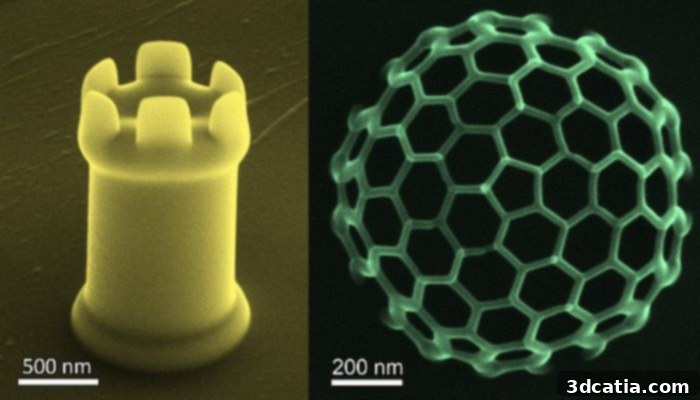
Structures manufactured using 3D nanoprinting technology; Left: Miniature chess tower, Right: Ball made of nanowires (Photo Credit: CDL DEFINE/TU Graz)
Reflecting on the magnitude of this achievement, Harald Plank, one of the lead researchers, emphasizes the culmination of years of dedicated effort: “The hard work of the last few years has finally paid off. The biggest challenge in recent years was to transfer the 3D architectures into high-purity materials without destroying the morphology. This development leap enables new optical effects and application concepts thanks to the 3D aspect. Nanoprobes or optical tweezers with sizes in the nanometer range are now within reach.” His words highlight the dual challenge of achieving both structural fidelity and material purity at such an incredibly small scale, underscoring that this breakthrough is as much about material science as it is about fabrication technique. The implications of this capability are profound, paving the way for advanced tools and devices that operate at the fundamental limits of light and matter interaction.
The Science Behind the Structures: Focused Electron Beam-Induced Deposition (EBID)
At the heart of this innovative production process at TU Graz is the focused electron beam-induced deposition (EBID) technique. EBID is a versatile direct-write fabrication method that allows for the creation of intricate nanostructures with exceptional precision. The process begins within a vacuum chamber, where the targeted surface, destined to host the 3D nanostructures, is meticulously coated with specific precursor gases. These gases contain the atoms or molecules that will form the desired solid material.
Once the surface is appropriately coated, a highly focused electron beam is directed onto specific portions of the gas molecules. The energy from this electron beam initiates a chemical reaction, causing the gas molecules to decompose. Crucially, this decomposition leads to the conversion of the gas molecules into a solid state, which then adheres precisely to the targeted positions on the surface. By carefully controlling where the electron beam strikes and for how long, researchers can “draw” patterns and build up structures layer by layer, or rather, atom by atom.
Harald Plank further elaborates on the exquisite control achieved with this method. By precisely controlling parameters such as the electron beam shift – which dictates the beam’s movement across the surface – and the exposure time – determining how long the beam interacts with the precursor gas at each point – the researchers are able to achieve the production of highly complex nanostructures. These structures can feature intricate lattice-like or sheet-like structural elements, all fabricated in a single, continuous step. This single-step capability significantly streamlines the manufacturing process and reduces potential defects. To achieve the desired three-dimensional nanostructures, these infinitesimally small nanovolumes, each precisely deposited, are meticulously stacked atop one another. This iterative deposition and stacking process allows for the creation of truly volumetric structures with custom designs and functions, pushing the boundaries of what is possible in nanoscale engineering.
Future Applications and Horizons
The advancements made by the researchers at Graz University of Technology herald a new era for numerous technological applications. The ability to produce optically active 3D nanostructures with such precision has immediate and significant implications. In the realm of energy, these nanostructures could be integrated into next-generation solar cells, potentially enhancing their light absorption capabilities and overall efficiency by better capturing and manipulating photons at the nanoscale. For sensing applications, both chemical and biological, the finely tuned optical properties of these structures could lead to the development of ultra-sensitive sensors capable of detecting minuscule quantities of target molecules, revolutionizing diagnostics and environmental monitoring.
Beyond these immediate applications, the long-term vision includes the creation of advanced nanometric devices. Thanks to these breakthroughs, the production of highly sophisticated tools such as optical tweezers or nanoprobes on a nanometric scale is now within tangible reach. Optical tweezers, for instance, are devices that use a highly focused laser beam to hold and manipulate microscopic dielectric objects. Shrinking these tools to the nanometer scale would allow for unprecedented control and interaction with individual cells, molecules, or even quantum dots, opening new avenues in biophysics, quantum computing, and advanced materials research. Nanoprobes, similarly, could offer unparalleled resolution for imaging and interacting with biological systems or material surfaces at the atomic level, pushing the frontiers of scientific discovery.
To delve deeper into this remarkable breakthrough achieved at TU Graz and understand the full scope of their research, interested readers can click here for more information.
What are your thoughts on these recent developments in 3D nanostructure production and their potential impact on future technologies? Let us know in a comment below or on our LinkedIn, Facebook, and Twitter pages! Don’t forget to sign up for our free weekly newsletter here, the latest 3D printing news straight to your inbox! You can also find all our videos on our YouTube channel.
*Cover photo credits: TU Graz