

XJet Unveils State-of-the-Art Additive Manufacturing Center to Propel Metal and Ceramic 3D Printing Forward
In a significant stride for the additive manufacturing industry, XJet, a pioneering Israeli manufacturer, officially inaugurated its new, expansive additive manufacturing center in Rehovot, Israel, last Monday. This facility stands as one of the largest of its kind, housing an impressive fleet of nine cutting-edge 3D metal and ceramic printers. The strategic investment behind this center underscores XJet’s unwavering commitment to accelerating research and development, ultimately aiming to deliver comprehensive, high-performance solutions to industries worldwide.
3Dnatives had the privilege of attending the grand inauguration, offering a firsthand glimpse into XJet’s ambitious vision and the innovative minds driving it. During the event, representatives met with key members of the XJet team, a robust group now comprising 110 dedicated employees, alongside esteemed clients and crucial investors. This convergence of talent, technology, and strategic partnerships highlights XJet’s growing influence and its dedication to pushing the boundaries of what’s possible in additive manufacturing.
Pioneering NanoParticle Jetting Technology: A Closer Look at XJet’s Innovation
The foundation of XJet’s innovative approach was solidified in 2016 when the company successfully closed a substantial $25 million investment round. This capital injection was specifically earmarked for the advanced development and refinement of its proprietary NanoParticle Jetting (NPJ) technology. This groundbreaking method represents a significant departure from conventional additive manufacturing techniques that predominantly rely on fusing powders. Instead, XJet’s NPJ technology harnesses the precision of liquid droplets, each meticulously engineered to contain ultra-fine nanoparticles of either metal or ceramic material.
The operational principle of NPJ is elegantly simple yet incredibly effective. During the printing process, these specialized liquid droplets are precisely deposited onto the printing plate. Within mere seconds, the liquid carrier component of these droplets evaporates, leaving behind a dense, uniform layer of the desired nanoparticles. Through this layer-by-layer deposition and subsequent evaporation, the intricate geometry of the intended part is gradually formed. This unique approach allows for exceptional material density, superior surface finish, and unparalleled accuracy, setting XJet apart in the competitive landscape of 3D printing.
XJet has meticulously designed two flagship models embodying this revolutionary technology: the Carmel 1400 and the Carmel 700 3D printers. These systems are primarily distinguished by their print volume capabilities, offering flexibility to accommodate diverse industrial needs. The Carmel 1400, as its name suggests, boasts an expansive print volume of 1,400 cm², catering to larger, more complex components, while the Carmel 700 provides a more compact yet equally precise solution for smaller-scale applications. Both machines leverage the full power of NPJ to deliver high-quality, high-detail metal and ceramic parts.

The inauguration of the new additive manufacturing center brought together several market players, underscoring its industry significance (photo credits: 3Dnatives)
The Advanced Capabilities of XJet’s Additive Manufacturing Center
The new additive manufacturing center in Rehovot represents a significant $10 million investment, specifically earmarked for expanding XJet’s operational and developmental capabilities. Within this state-of-the-art facility, nine sophisticated NanoParticle Jetting machines are actively running, demonstrating the robust capacity and advanced functionality of XJet’s technology. Dror Danai, XJet’s Chief Business Officer (CBO), provided fascinating insights into the intricate engineering of these machines. Each XJet printer is equipped with 24 high-precision print heads, and each print head, in turn, features an astonishing 512 individual nozzles. This design means that a single machine operates with over 12,000 nozzles simultaneously, each capable of ejecting an incredible 20,000 drops per second.
This level of granular control and deposition speed is critical to achieving the ultra-high resolution and fine detail that XJet’s technology is known for. The company has ambitious plans to further expand this impressive fleet, with three additional machines slated for installation by the beginning of 2019, further enhancing the center’s capacity for innovation and production. Hanan Gothait, CEO of XJet, articulated the strategic mission of this new facility, stating, “We will use our Additive Manufacturing Center to develop and demonstrate specialized applications, print test pieces for our customers worldwide, and test new ceramic and metallic materials.”
Gothait emphasized that the primary objective of this center is not to mass-produce finished parts for commercial marketing. Instead, it serves as a dynamic hub dedicated to advancing and evolving XJet’s core technology. This includes pushing the boundaries of material science, exploring new ceramic and metallic compounds, and optimizing both the final structural integrity and the efficiency of the print support media. By focusing on research, development, and customer-specific application testing, XJet aims to continually refine its offerings, ensuring its technology remains at the forefront of the additive manufacturing revolution. This commitment to continuous innovation is what truly distinguishes XJet in the global market.
Streamlined Post-Processing and Continuous Production for Enhanced Efficiency
One of the most significant advantages touted for XJet’s NanoParticle Jetting technology lies in its remarkably simplified post-processing capabilities and the seamless continuity it offers in production workflows. An XJet engineer at the center meticulously demonstrated how the print tray, once removed from the machine after a build, can be effortlessly immersed in water. This simple yet ingenious step facilitates the easy removal of the soluble support material, leaving the intricately formed workpiece pristine and intact. Unlike traditional powder-based methods that often require abrasive and time-consuming post-processing steps like depowdering or extensive manual labor, NPJ’s water-soluble supports drastically reduce labor, mess, and potential damage to delicate parts.
Following the support removal, the workpiece is then transferred to a sintering furnace, a standard procedure for metal and ceramic additive manufacturing to achieve final material properties. However, the innovation doesn’t stop there. Crucially, while one print tray and its parts are undergoing post-processing, the machine operator can immediately replace it with a new, empty tray. This ability to rapidly swap print trays ensures virtually continuous production, maximizing machine uptime and significantly boosting overall manufacturing throughput. This design philosophy directly addresses a key industry challenge: improving efficiency and reducing bottlenecks often associated with additive manufacturing. The ease of post-processing combined with continuous operation makes XJet’s NPJ technology particularly attractive for industrial applications seeking higher productivity and a cleaner, more streamlined workflow.

One of the cutting-edge 3D printers operating within XJet’s new additive manufacturing center (photo credits: 3Dnatives)
Achieving Unprecedented Part Quality and Micro-Level Detail with NPJ
The visit to XJet’s new center also provided invaluable insights into the exceptional final quality of the 3D printed parts produced by their NanoParticle Jetting systems. The machines are engineered to achieve an incredibly fine layer resolution, ranging from an astonishing 9 to 10 microns. This micro-level precision translates directly into parts that exhibit an extraordinarily high level of detail, intricate geometries, and remarkably smooth surface finishes. Such an advantage could simply not be achieved through the use of conventional powder-based additive manufacturing methods, which often struggle with fine features and require extensive post-processing to improve surface quality.
XJet proudly asserts that the layers deposited by their NPJ technology are up to 10 times thinner than those achieved by many current market solutions. This claim highlights a critical differentiator: the ability to produce parts with unparalleled accuracy and fidelity to the original design. For industries where precision, miniaturization, and intricate internal structures are paramount—such as medical devices, aerospace components, and luxury goods—this level of detail is a game-changer. It enables the creation of functional prototypes and end-use parts with complex internal channels, sharp edges, and fine textures that were previously impossible or extremely difficult to achieve through additive manufacturing. The superior resolution not only enhances aesthetic appeal but also contributes to improved functional performance, opening up new design possibilities for engineers and product developers across various sectors.
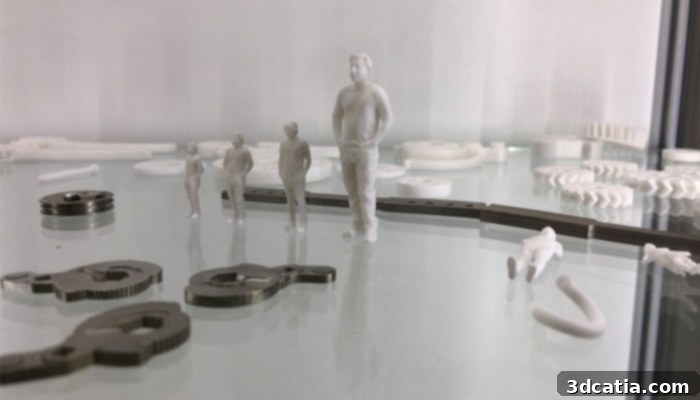
3D printed parts produced by XJet’s NanoParticle Jetting technology showcasing an exceptional level of detail (photo credits: 3Dnatives)
XJet’s Global Expansion and Strategic Partnerships
Leveraging the momentum of its new center’s inauguration, the Israeli manufacturer also seized the opportunity to announce a crucial new fundraising initiative. This strategic funding round is specifically designed to bolster XJet’s aggressive expansion plans into international markets, extending its innovative reach far beyond its domestic base. XJet has already demonstrated significant success in captivating not only local Israeli companies but also prominent industrial players from Switzerland, Italy, Germany, Russia, and the United States. This broad appeal underscores the universal demand for high-quality, precise metal and ceramic additive manufacturing solutions. Among their rapidly growing roster of early adopters and satisfied clients are renowned industry leaders such as Oerlikon, Syqe Medical, and AB Universal, each leveraging XJet’s technology to push their own boundaries of innovation.
Further solidifying its global footprint, XJet proudly introduced its first XJ3D distributor: the Carfulan Group from England. This partnership marks a pivotal moment in XJet’s distribution strategy. Dror Danai, XJet’s CBO, eloquently articulated the significance of this collaboration, stating, “This is very exciting news for XJet as the designation of the world’s largest distributor marks an important step in our company’s strategy to build a world-leading distribution network.” He further confided that XJet’s advanced technology is expected to make its debut in France very soon, indicating a rapid and calculated expansion across key European markets. This methodical approach to building a robust global distribution and support network is essential for making XJet’s groundbreaking NanoParticle Jetting technology accessible to a wider array of industries and applications worldwide. The company’s commitment to strategic partnerships and international outreach positions it strongly for continued growth and market leadership in the evolving landscape of additive manufacturing. For those eager to delve deeper into the intricacies of this innovative technology, more comprehensive information is readily available on the official website of XJet.
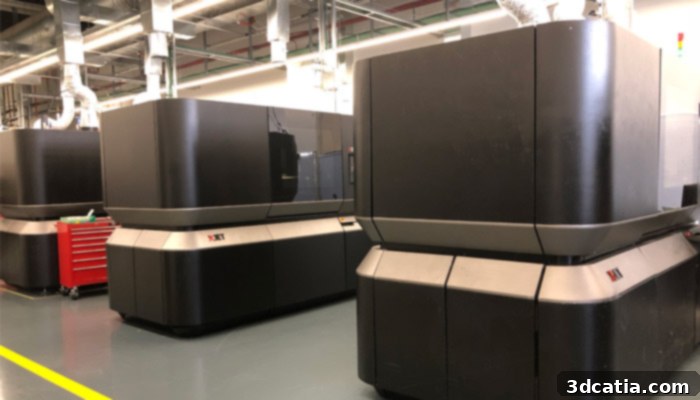
The new additive manufacturing center currently houses nine cutting-edge machines, with plans for further expansion (photo credits: 3Dnatives)
What are your thoughts on XJet’s new additive manufacturing center and its innovative NanoParticle Jetting technology? We invite you to share your perspectives and insights in the comments section below, or engage with us on our Facebook and Twitter pages! Don’t miss out on the latest advancements and news in the world of 3D printing; remember to sign up for our free weekly Newsletter, delivering all the essential updates straight to your inbox!