
Covestro’s Sustainable Revolution: Arnite® AM2001 GF (G) rPETm – Driving a Circular Economy in 3D Printing
Covestro has recently unveiled a groundbreaking innovation in the realm of additive manufacturing with the launch of Arnite® AM2001 GF (G) rPETm. This pioneering 3D printing material stands out not only for its advanced properties but primarily for its commitment to environmental stewardship, being meticulously crafted from recycled post-consumer PET waste. This introduction marks a significant milestone as Covestro’s first product specifically tailored for additive manufacturing from a recycled feedstock. The material itself is a robust, glass-fiber filled recycled polyethylene terephthalate (rPET), ideally suited for large-scale 3D pellet printing applications. This strategic move perfectly embodies Covestro’s overarching vision for a Circular Economy, aiming to transform waste into valuable resources. Furthermore, this launch highlights the powerful synergies emerging from Covestro’s recent acquisition of DSM Resins & Functional Materials. Together, these entities are pooling their extensive expertise and innovative spirit to add substantial value to both additive manufacturing processes and industrial production paradigms worldwide, establishing a new benchmark for sustainable material solutions.
Covestro’s newly introduced Arnite® AM2001 GF (G) rPETm pellet material offers a compelling proposition for manufacturers seeking to enhance their product performance while simultaneously reducing their environmental impact. By utilizing this advanced glass-fiber filled composite, industries can now produce parts that boast significantly increased structural performance, ensuring durability and reliability for demanding applications. Crucially, this material achieves these performance gains with a carbon footprint that is remarkably lower than that of virgin materials. This innovation empowers manufacturers to cultivate more circular and sustainable supply chains without needing to compromise on the critical aspects of part quality or mechanical integrity. Hugo Da Silva, Head of Additive Manufacturing (formerly of DSM), emphasized the profound implications of this development: “The introduction of this high-performing material for 3D pellet printing is an important step in creating circular supply chains. With PET packaging accounting for more than 50 percent of total plastic waste, extending its lifetime by re-using it as feedstock offers a broadly available alternative to virgin raw materials – without the need to compromise on performance or total cost of ownership.” His statement underscores the immense potential of repurposing a major waste stream into a high-value industrial resource, paving the way for a more sustainable future.
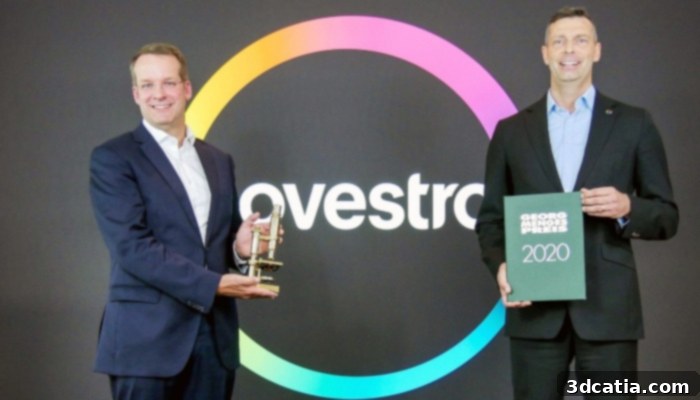
Prof. Christian Hopmann (left), Head of the Institute of Plastics Processing at RWTH Aachen University, presented Markus Steilemann with the Georg Menges Prize.
Beyond its substantial environmental benefits, Arnite® AM2001 GF (G) rPETm is engineered to deliver significant cost reductions for industrial applications. Covestro has leveraged its extensive material science expertise to optimize this recycled PET specifically for 3D pellet printing, a technology also widely recognized as Fused Granulate Fabrication (FGF). This cutting-edge FGF technology is revolutionary for its ability to enable fast, efficient, and economically viable additive manufacturing of large-size industrial parts. By facilitating direct printing of complex applications, it dramatically reduces product development timelines, which translates directly into substantial cost savings. Moreover, additive manufacturing inherently offers unparalleled design flexibility, allowing engineers to optimize geometries and create lightweight structures that use only the essential amount of material. This precision material usage not only minimizes waste but also contributes to lower overall material costs. Consequently, 3D printing, especially with a sustainable material like Arnite® AM2001 GF (G) rPETm, presents a far more environmentally friendly and economically advantageous alternative to many traditional manufacturing methods. Through the strategic development of this new material specifically for additive manufacturing, Covestro is actively propelling manufacturers towards the adoption of a truly Circular Economy, fostering innovation that benefits both industry and the planet.
The mechanical properties of Covestro’s Arnite® AM2001 GF (G) rPETm are truly impressive, making it an ideal choice for a diverse range of demanding structural applications across various industrial sectors. This material exhibits excellent stiffness, strength, and impact resistance, characteristic of high-performance engineering plastics, further enhanced by its glass-fiber reinforcement. Its robust nature ensures reliability and longevity, even in challenging environments. Furthermore, Arnite® AM2001 GF (G) rPETm boasts a broad processing window, which signifies its adaptability and ease of use in diverse 3D pellet printing systems. This wide processing latitude simplifies manufacturing processes, reduces trial-and-error, and ensures consistent quality output, making it highly attractive for industrial implementation. Such characteristics make it perfectly suited for a wide array of structural components. According to Patrick Rosso, Head of Additive Manufacturing at Covestro, “This material is the best proof point we could want to underpin the two teams’ joint ambition to bring the market a stronger materials partner that can help accelerate industrial additive manufacturing.” His statement highlights the combined strength of Covestro and former-DSM in delivering market-leading solutions that push the boundaries of what is possible in industrial additive manufacturing.
The versatility and robust properties of Arnite® AM2001 GF (G) rPETm open up a multitude of industrial applications, offering sustainable and high-performance solutions across various sectors. Consider pedestrian bridges, where the material’s inherent strength and durability, combined with the design freedom of 3D printing, can lead to lightweight yet sturdy structures that are quick to fabricate and resistant to environmental wear. For tiles used in cyclist or pedestrian tunnels, this material offers not only resilience and safety but also the potential for custom textures and anti-slip surfaces, enhancing public infrastructure. In architectural applications like cladding or partition walls, Arnite® AM2001 GF (G) rPETm enables complex, aesthetically pleasing designs with excellent structural integrity and potentially improved insulation properties, all while minimizing construction waste. The realm of in- and outdoor furniture benefits significantly from its weather resistance, robust nature, and the ability to rapidly produce customized, ergonomic designs tailored to specific consumer preferences or public spaces. For small boats and marine components, the material’s lightweight characteristic combined with its strength and resistance to water absorption can lead to more efficient and durable vessels, facilitating rapid prototyping of new hull designs. Furthermore, its application in packaging crates ensures robust, reusable containers that contribute directly to a circular economy by minimizing single-use plastics and extending product lifecycles. Finally, in tooling, Arnite® AM2001 GF (G) rPETm offers a cost-effective and rapid solution for manufacturing jigs, fixtures, and molds, significantly accelerating production cycles and reducing reliance on traditional, often more expensive, tooling methods. This broad spectrum of applications underscores the material’s transformative potential for industrial innovation and sustainable manufacturing.
The launch of Arnite® AM2001 GF (G) rPETm firmly establishes Covestro as a frontrunner in the development and provision of sustainable materials for the burgeoning additive manufacturing industry. This innovation is not merely about a new product; it represents a bold statement on the future of industrial production, emphasizing that high performance and environmental responsibility can, and indeed must, go hand-in-hand. By offering a material that utilizes post-consumer waste, Covestro is setting a new standard for responsible manufacturing and encouraging other industry players to accelerate their own efforts towards sustainability. The strategic integration of former-DSM’s additive manufacturing expertise further solidifies Covestro’s position, creating a powerhouse for material innovation. This commitment to a Circular Economy, driven by advanced material science, will undoubtedly inspire further research and development into new recycled and bio-based feedstocks for 3D printing. The versatility and economic advantages offered by FGF technology combined with sustainable materials like rPETm are poised to unlock unprecedented opportunities for customized, on-demand, and localized production across countless sectors. As industries increasingly seek solutions that reduce their ecological footprint without compromising on quality or efficiency, Covestro’s Arnite® AM2001 GF (G) rPETm stands as a pivotal advancement, propelling the additive manufacturing landscape towards a more sustainable and resource-efficient future. This continuous innovation underlines Covestro’s dedication to providing cutting-edge materials that address the pressing global challenges of waste management and climate change, fostering a truly circular economy for generations to come.
For those interested in delving deeper into this transformative innovation, the full press release offers comprehensive details and further insights into Covestro’s strategic vision and technical specifications of this pioneering material. You can access the complete press release by clicking HERE. We are keen to hear your thoughts on Covestro’s new material for additive manufacturing and its potential impact on sustainable industrial practices. Please share your perspectives and comments below, or engage with us on our social media platforms. You can find us onFacebook,Twitter andLinkedIn. To stay abreast of the very latest developments and breaking news in the exciting world of 3D printing, remember to sign up for our free weeklyNewsletter here, ensuring that all the essential 3D printing news is delivered directly to your inbox every week!