
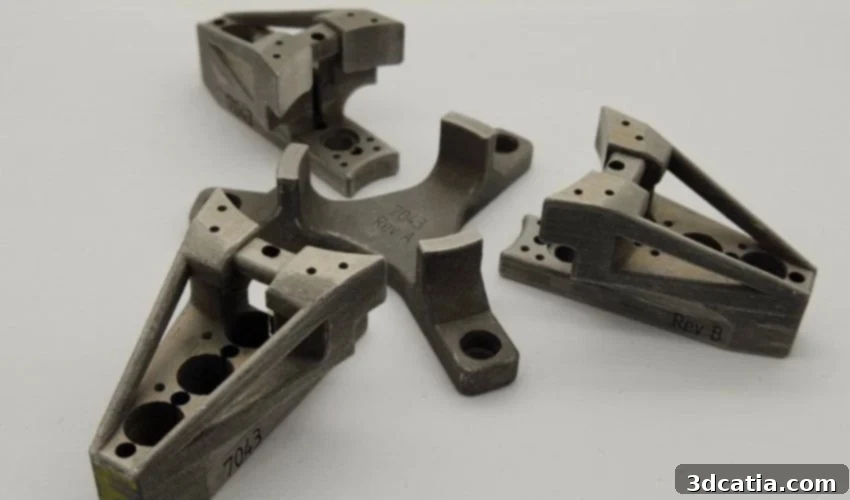
Revolutionizing Manufacturing: APG Achieves Unprecedented Weight Reduction in Lathe Chuck Jaws with Tritone MoldJet 3D Printing
The landscape of modern manufacturing is being continually reshaped by innovations, and at the forefront of this transformation is 3D printing, or additive manufacturing (AM). One of its most celebrated and widely recognized advantages, cherished across diverse industrial sectors, is the unparalleled freedom of design it offers. While specific engineering constraints and material properties always dictate certain limitations for any produced part, the principles of Design for Additive Manufacturing (DfAM) empower engineers to conceive and realize geometries and performance characteristics that are often unattainable through conventional manufacturing processes. Techniques such as generative design and topological optimization are increasingly being integrated with 3D printing workflows. This powerful synergy allows companies to radically reimagine the design of critical components, leading to parts that are not only lighter and more optimized but also exhibit superior performance and functionality.
A compelling real-world example of this transformative potential comes from U.S.-based Alpha Precision Group (APG). As a prominent supplier of precision components, specialty valves, and powder metal components, APG sought a breakthrough solution for a persistent manufacturing challenge that traditional techniques had failed to resolve. The company strategically leveraged the power of 3D printing for this very purpose: to overcome a seemingly intractable problem. By intelligently redesigning and 3D printing lathe chuck jaws – components traditionally produced via CNC machining – APG successfully enhanced its production process, yielding significant operational improvements. But how exactly did they accomplish this impressive feat?
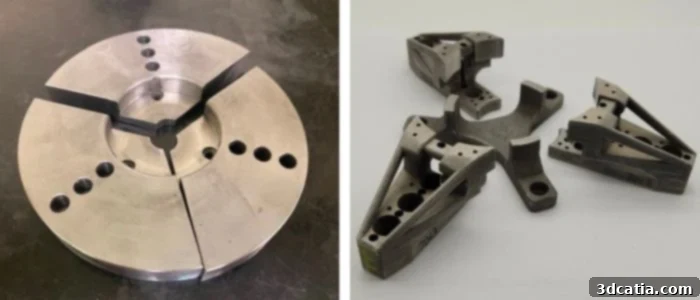
On the left, the original CNC-produced chuck design. At right, the new lightweight chuck jaw produced with Tritone’s MoldJet additive technology.
Leveraging Design for Additive Manufacturing to Achieve Lighter and More Efficient Spindle Jaws
With over 50 years of operational excellence, Alpha Precision Group has established itself as a leader by uniting pioneering companies in materials science and process improvement technologies under its esteemed brand. Today, APG employs a sophisticated array of manufacturing techniques, including advanced processes like metal injection molding (MIM) and additive manufacturing. Their commitment to innovation and continuous improvement drives their exploration of cutting-edge solutions for complex industrial challenges.
A recent and exemplary application of APG’s prowess in metal additive manufacturing for producing high-performance end-use parts involved the 3D printing of innovative lathe chuck jaws. The decision to adopt additive manufacturing stemmed from a critical and persistent problem encountered at one of the company’s metal powder plants. The core issue revolved around the excessive weight of the existing conventional chuck jaws. This disproportionate weight directly compromised the ability to maintain critical manufacturing tolerances during the precision machining of parts, leading to inconsistencies and material waste.
The problem was multifaceted: the standard mild steel jaws, traditionally used to securely hold gears during the machining process, were simply too heavy. When the lathe spindle operated at the high rotational speeds required for efficient production, these heavy jaws generated significant centrifugal forces. This phenomenon necessitated an extremely high clamping force to prevent the part from slipping or vibrating, which, paradoxically, often resulted in the undesirable distortion of the workpiece. Despite numerous attempts to mitigate the issue by reducing jaw weight through conventional CNC machining techniques, satisfactory results remained elusive. The limitations of subtractive manufacturing made it impossible to achieve the radical design changes needed for substantial weight reduction without compromising structural integrity or functionality.
Recognizing the impasse with traditional methods, the project was escalated to APG’s dedicated Additive group. This specialized team was tasked with exploring innovative approaches to improve the crucial chuck mechanism. Leveraging their expertise, APG’s Additive group envisioned a complete redesign of the jaws, strategically exploiting the inherent advantages of 3D printing. A key enabler for this groundbreaking approach was the vastly superior design freedom offered by DfAM. This philosophy allowed them to move beyond traditional design constraints and consider novel internal and external geometries that were previously impossible to manufacture, paving the way for a truly optimized solution.
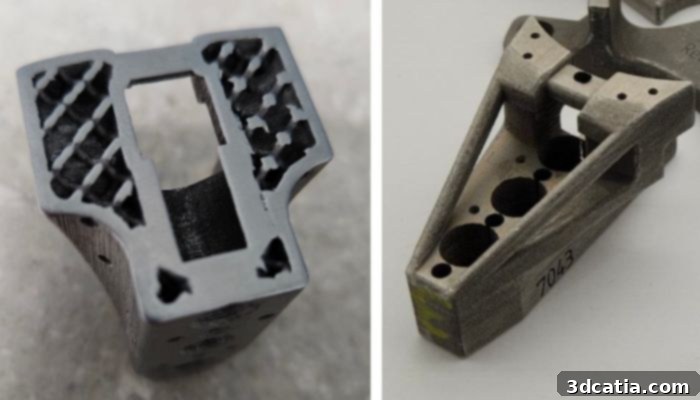
Left, the cross section of the new spindle jaw with internal lattice design. At right, the detail of the new outer jaw design.
To achieve the ambitious goal of minimizing the weight of each component within the chuck system, APG’s engineers embarked on a comprehensive redesign of both the exterior and interior structures. A pivotal decision was the integration of complex internal lattice structures. These intricate designs, a hallmark of advanced DfAM, enable significant material reduction while maintaining or even enhancing mechanical properties like stiffness and strength-to-weight ratio. For the critical task of fabricating these highly complex internal lattice geometries with precision and efficiency, the company selected Tritone’s innovative MoldJet metal additive manufacturing process.
Tritone’s MoldJet Additive Technology: A Game Changer for Complex Metal Parts
Tritone’s MoldJet technology stands out as a revolutionary additive manufacturing process for producing both metal and ceramic parts. Unlike many conventional metal 3D printing systems that rely on fine powders, MoldJet utilizes a paste-based material, offering distinct advantages in terms of safety, material handling, and throughput. This innovative approach facilitates the production of intricate, high-density parts at industrial scale and impressive speeds, making it ideal for medium-volume manufacturing scenarios. Developed by the Israeli manufacturer Tritone, MoldJet was specifically engineered to address the growing demand for complex geometries and robust mechanical performance in additive components. For APG’s chuck jaw project, Tritone’s Dominant system, a flagship machine leveraging MoldJet technology, was employed to bring the redesigned jaws to fruition.
The MoldJet process is a sophisticated, multi-stage operation, benefiting from multiple print trays that operate in parallel and independently, optimizing production efficiency. The first crucial step involves the precision printing of polymer molds, which act as temporary containers for the metallic material. Following this, the second stage entails the accurate deposition of a high-viscosity metal paste into these pre-printed molds. The third phase is a thermal process, where hot air is utilized to solidify the material within the molds, creating a green part. Critically, the system incorporates real-time quality control throughout the layer deposition, employing cameras equipped with advanced artificial intelligence (AI) for automated correction, ensuring unparalleled accuracy and consistency in every layer.
One of the most compelling benefits of MoldJet technology is the remarkable flexibility it offers to manufacturers. This flexibility manifests in several ways: it allows for the effortless exchange of material cartridges, enabling rapid transitions between different metals or ceramics. Furthermore, it supports the simultaneous production of parts with varying layer thicknesses or entirely different geometries within a single build process, maximizing machine utilization and efficiency. Beyond the printing stage, MoldJet significantly simplifies the post-processing workflow. The polymer molds are designed to be completely dissolved after the green part is formed, leaving behind ready-to-sinter components with minimal manual intervention. This streamlined post-processing drastically reduces labor costs and lead times.
For Alpha Precision Group, these inherent advantages of MoldJet technology were absolutely instrumental in achieving their core objective: substantial jaw weight reduction. The technology uniquely facilitated the creation of APG’s proprietary internal lattice geometry for all components. This intricate design, critical for weight savings, was made possible because, during the MoldJet printing process, all the void spaces within the lattice structure were precisely filled by the soluble mold material. This temporary support material ensured the structural integrity of the complex lattice during the green part stage. Subsequently, Tritone’s hands-free post-processing effectively eliminated this soluble mold material, leaving behind an incredibly light and robust metallic structure. This outcome demonstrated MoldJet’s distinct superiority over competing technologies, which often struggle to produce such complex internal geometries with equivalent ease and post-processing simplicity.
Part and Manufacturing Process Optimization Through Advanced 3D Printing
The tangible results of this groundbreaking project not only met but significantly exceeded APG’s initial expectations. The application of DfAM principles combined with Tritone’s MoldJet technology led to an astounding weight reduction of the chuck jaws by 84%, plummeting from 2.13 kg (approximately 4.7 lbs) to a mere 0.336 kg (roughly 0.74 lbs). This dramatic reduction in mass directly translated into a crucial operational improvement: the clamping force required was reduced by 67% from the original design, decreasing from 30 psi to just 10 psi. This achievement directly addressed the stated goals of the project, mitigating the issues of excessive centrifugal force and part distortion that had plagued their machining operations.

The new set of jaws installed on the lathe, with the gear component in place.
The ripple effect of these improvements was extensive. The ability to use less clamping force drastically reduced the risk of deforming delicate workpieces, leading to the achievement of tighter manufacturing tolerances. This, in turn, minimized scrap rates, resulting in significant material cost savings. Furthermore, the substantial reduction in jaw weight placed considerably less stress on the lathe’s spindle and other moving parts, leading to reduced machine wear and extended equipment lifespan. Ultimately, the entire manufacturing process became more stable, reliable, and cost-effective compared to any other weight reduction alternatives previously explored.
Joe Taylor, Manufacturing Engineer at APG, expressed profound satisfaction with the outcome, stating, “We are thrilled with the results of this program. We look forward to expanding this success internally across our facilities and offering these fixtures on a ‘turnkey’ basis to customers.” This sentiment underscores the transformative potential of additive manufacturing, not just for internal optimization but also as a basis for new service offerings and competitive advantages.
In conclusion, Tritone’s MoldJet technology proved to be far more than just a solution for the immediate clamping force issue. It offered a pathway to fundamentally improve overall manufacturing repeatability and throughput rates in APG’s machining processes. By enabling the creation of lightweight, highly optimized components, the technology ushered in greater operational efficiency, enhanced accuracy, and superior reliability for their critical machining operations. This case study stands as a powerful testament to how advanced additive manufacturing can unlock new levels of performance and productivity. You can delve deeper into MoldJet technology and its comprehensive benefits by exploring additional resources HERE.
This success story highlights a pivotal moment in industrial manufacturing, demonstrating how strategic adoption of 3D printing and DfAM principles can solve persistent challenges and drive innovation. How could you envision leveraging capabilities like this within your own operations? We encourage you to share your thoughts and insights in a comment below, or join the discussion on our LinkedIn, Facebook, and Twitter pages! Don’t forget to sign up for our free weekly newsletter here, for the latest 3D printing news delivered straight to your inbox! You can also find all our compelling videos and content on our YouTube channel.
*All Photo Credits: Tritone Technologies, Alpha Precision Group