
The Future of Dentistry: Exploring the Rapid Growth of the Dental 3D Printing Market to $930 Million by 2025
The dental industry is on the cusp of a profound transformation, largely spearheaded by the relentless innovation in additive manufacturing technologies. A recent and highly anticipated report from QY Research, a prominent Chinese consulting and market research firm, sheds light on the trajectory of this dynamic sector. Titled “Global Dental 3D Printing Market Analysis, 2014 – 2025,” the report paints an exceptionally optimistic picture. It reveals that the global dental 3D printing market, which was estimated at a substantial $260 million in 2018, is poised for explosive growth, with projections indicating it will reach an impressive $930 million by the end of 2025. This forecast underscores a significant paradigm shift within oral healthcare, highlighting that dental additive manufacturing has already experienced a robust 17% increase over the past six years, firmly establishing its role as a pivotal technology for modern dental practices and laboratories.
The medical market, in its broader scope, has consistently proven to be one of the most receptive and adaptable sectors for additive manufacturing technologies. This responsiveness is due to 3D printing’s inherent ability to deliver solutions that are highly customized, precise, and efficient – qualities that are paramount in healthcare. Within the dental market specifically, the applications of 3D printing are remarkably diverse and continue to expand. They range from the creation of highly accurate surgical guides for dental implants and patient-specific prostheses, to the fabrication of perfectly fitted crowns, bridges, dentures, and innovative orthodontic solutions like clear aligners. This versatility offers significant advantages over traditional manufacturing methods, enabling dentists and lab technicians to produce more complex geometries and ensure a better fit for patients. Furthermore, another respected consulting firm, SmarTech Publishing, had previously echoed these optimistic sentiments, noting the remarkable growth dental 3D printing experienced last year, citing an estimated growth rate of 35% from 2017 to 2018. Such rapid adoption naturally prompts a deeper inquiry: what are the underlying reasons for the surging demand for 3D technologies in this highly specialized industry?

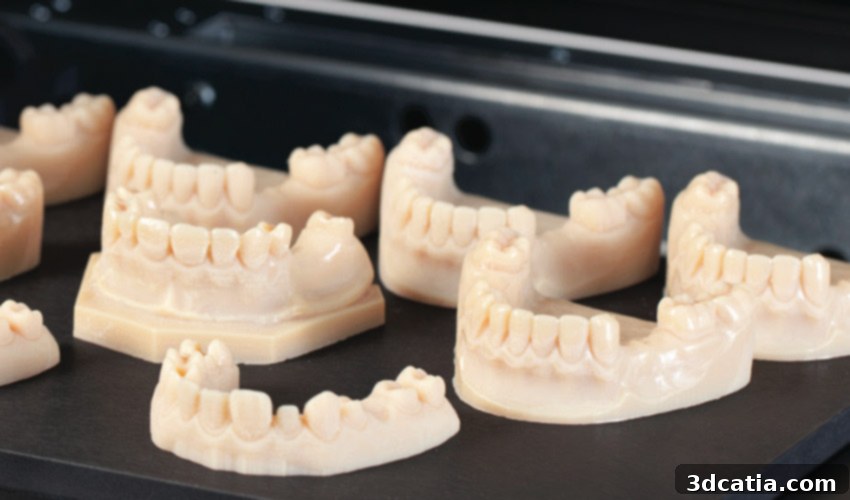
The dental sector extensively utilizes various 3D printing technologies for diverse applications, from highly accurate models to final prosthetics and surgical guides.
Key Drivers Propelling the Growth of Dental 3D Printing
QY Research’s comprehensive report meticulously identifies several critical factors that are catalyzing the vigorous expansion of the dental 3D printing market. A foremost driver is the unwavering commitment of companies within the sector to continuous technological advancement. These firms are diligently focused on developing innovations that not only elevate the quality and functional performance of end-use dental devices but also strategically aim to reduce overall manufacturing costs. This drive for efficiency and affordability makes advanced dental solutions more accessible to a wider range of practitioners and patients. As this market matures, the competitive landscape is intensifying, which, rather than hindering growth, actually stimulates further innovation and creates even more opportunities. This healthy competition propels manufacturers to continually refine their offerings, leading to more efficient, precise, and cost-effective dental 3D printing solutions.
At the very heart of this burgeoning growth, as emphasized by the consulting firm, lies the unparalleled personalization capabilities that 3D printing brings to dentistry. Traditional dental fabrication often involves laborious manual processes and is inherently limited in its capacity to create highly complex, patient-specific geometries with absolute precision. Additive manufacturing, in stark contrast, excels at producing custom-fit dental devices that are perfectly tailored to each individual patient’s unique oral anatomy. This level of bespoke customization is crucial, as it leads to a superior fit, significantly enhanced comfort, and vastly improved functionality for patients, whether they are receiving a crown, bridge, denture, or orthodontic appliance. The ability to efficiently and accurately create tailor-made solutions not only significantly reduces chair time for dentists but also dramatically boosts patient satisfaction, solidifying 3D printing’s indispensable and growing role in contemporary dentistry. Moreover, the integration of digital workflows, from intraoral scanning to CAD/CAM design and 3D printing, streamlines the entire process, making it faster and more predictable than ever before.
Furthermore, the rapid evolution and specialized development of materials specifically designed for dental additive manufacturing are playing a pivotal role in its widespread adoption. These cutting-edge resins and powders are meticulously engineered to adhere to stringent medical standards, guaranteeing biocompatibility, exceptional durability, and superior aesthetic appeal. They are formulated to be entirely safe for intraoral use and possess crucial properties such as high strength, excellent abrasion resistance, and long-lasting color stability – attributes that are vital for the longevity and performance of dental restorations. Continuous investment in research and development for new materials that comply with international regulatory frameworks, including ISO and FDA requirements, further reinforces confidence in 3D printed dental products. This rigorous adherence to medical-grade material standards ensures that every innovation in dental 3D printing technology directly translates into safe, effective, and reliable patient care, ultimately enhancing the overall quality and predictability of dental treatments.
Addressing the Hurdles: Challenges in Dental 3D Printing Adoption
Despite the undeniably positive trajectory, the QY Research study also prudently outlines several potential obstacles that could somewhat temper the market’s impressive growth. One of the primary concerns identified is the substantial initial investment required to acquire state-of-the-art 3D printing machines and their accompanying specialized software. For smaller dental practices or laboratories, this upfront capital expenditure can represent a significant financial barrier to entry. Beyond the initial purchase price, the ongoing operational costs, including regular maintenance, the purchase of specialized consumables (such as high-quality resins or powders), replacement parts, and the need for periodic technical servicing, can also place a considerable financial burden on adopters of dental additive manufacturing technologies. These factors necessitate careful financial planning, a clear understanding of potential return on investment, and robust business models for any practice or lab considering integrating these advanced systems. Furthermore, the steep learning curve associated with mastering the operation and maintenance of these sophisticated systems, as well as effectively integrating them into existing digital workflows, represents another challenge that requires dedicated training resources and time investment for dental professionals.
Regional Dynamics: A Global Perspective on Dental Additive Manufacturing Adoption
The QY Research study provides an insightful regional segmentation, which clearly reveals distinct patterns in the adoption and growth rates of dental additive manufacturing across the globe. The report emphatically states that dental 3D printing is most prevalent and is experiencing its most significant expansion within Europe, North America, and Pacific Asia. These leading regions share common characteristics, including well-developed healthcare infrastructures, a high rate of digital technology adoption across various dental disciplines, and an increasing societal emphasis on personalized, patient-specific treatment outcomes.
Specifically, Europe and North America are projected to retain their dominant positions in the global market for the foreseeable future. This sustained leadership is attributable to a confluence of crucial factors. These include a consistent stream of cutting-edge technological advancements originating from research and development hubs within these regions, a high level of public awareness regarding oral hygiene and preventive dental care, and well-established, robust regulatory frameworks that not only foster innovation but also rigorously ensure patient safety and product efficacy. Countries such as the United States, Germany, the United Kingdom, and France are at the vanguard, tirelessly driving research, development, and the commercialization of sophisticated 3D printed dental solutions. Additionally, high disposable incomes and mature healthcare insurance systems in these regions contribute significantly to the accessibility and wider adoption of advanced dental technologies, making them more attainable for a larger segment of the population.
In the Pacific Asia region, the report highlights immense growth potential, with particular emphasis on China and Japan. These two economic powerhouses are strategically positioned to play an indispensable role in shaping the future landscape of dental 3D printing. Their trajectory is fueled by rapidly expanding economies, exceptionally large and increasingly aging populations, and substantial, sustained investments in both healthcare infrastructure and cutting-edge technology. As disposable incomes continue to rise across the region and access to modern, high-quality dental care becomes more widespread, the demand for sophisticated, customized dental prosthetics and devices is escalating dramatically. Furthermore, governments in these and other emerging markets in Southeast Asia are actively supporting the integration of advanced manufacturing technologies into their healthcare systems, which is further accelerating the adoption rate of dental 3D printing. This indicates a broader, region-wide shift towards embracing digital dentistry as a standard of care.
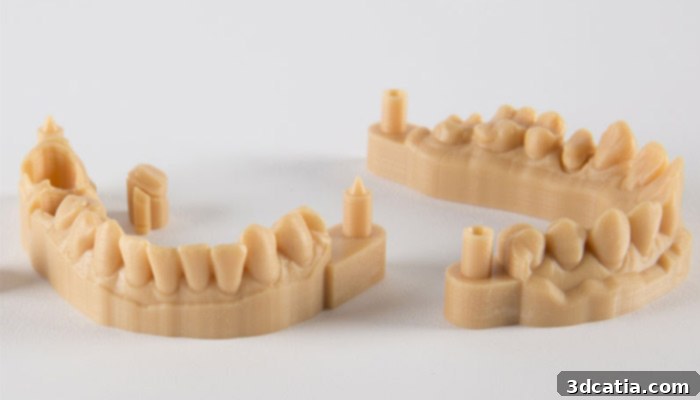
State-of-the-art dental 3D printing technologies are revolutionizing the production of custom prosthetics and other dental applications. Photo credits: Prodways
Leading Innovators and the Bright Future Ahead
The vibrant landscape of dental 3D printing is currently populated by several highly influential players who are consistently at the forefront of innovation and market development. Key manufacturers such as 3D Systems, Stratasys, EnvisionTEC, Asiga, DWS System, and Prodways are continuously pushing the boundaries of what is technologically feasible with additive manufacturing in dentistry. These industry leaders offer a comprehensive spectrum of solutions, encompassing advanced 3D printers, specialized biocompatible materials, intuitive software platforms for design and workflow management, and essential post-processing equipment. Their diverse offerings cater to a wide array of specific needs across various dental laboratories and clinical settings. For instance, 3D Systems provides an extensive portfolio of dental 3D printing solutions tailored for both labs and individual practices, covering everything from diagnostic models to removable prosthetics and surgical guides. Stratasys, renowned for its PolyJet and FDM technologies, delivers exceptional precision and multi-material capabilities for a multitude of dental applications, including incredibly realistic anatomical models and highly accurate surgical guides. EnvisionTEC stands as a pioneer in DLP (Digital Light Processing) technology, celebrated for its high accuracy and rapid production of intricate dental parts. Asiga specializes in high-performance desktop 3D printers, offering precision for smaller-scale operations, while DWS System focuses on high-resolution stereolithography solutions. Prodways, leveraging its innovative MOVINGLight® technology, is recognized for providing industrial-grade solutions capable of high-volume mass customization.
The inherently dynamic nature of this market strongly suggests that the list of influential key players is expected to expand considerably year after year. This growth will be fueled by both the emergence of agile new startups and the strategic entry of established technology firms, each bringing fresh perspectives, disruptive innovations, and novel solutions to the dental sector. This expanding ecosystem of advanced manufacturers, cutting-edge material developers, and sophisticated software providers is collectively accelerating the adoption of digital workflows throughout dentistry. The powerful synergy between continuous technological advancements and steadily increasing market demand paints an incredibly optimistic and promising picture for the future of dental 3D printing, promising even more sophisticated, efficient, and universally accessible dental care for patients across the globe. For those seeking an even more in-depth analysis and comprehensive data, a significant portion of the exhaustive QY Research study can be accessed and consulted HERE.
Are you as excited as we are about the transformative future that 3D printed dental solutions promise for oral healthcare? We eagerly await your insights and predictions! Feel free to share your comments and perspectives below, or join the ongoing conversation on our vibrant Facebook and Twitter pages. To ensure you stay completely informed about all the latest news, groundbreaking innovations, and crucial market insights in the rapidly evolving world of 3D printing, be sure to sign up for our free weekly Newsletter, delivered directly to your inbox!