
McLaren Artura: Pioneering Hybrid Supercar Performance Through Advanced Additive Manufacturing
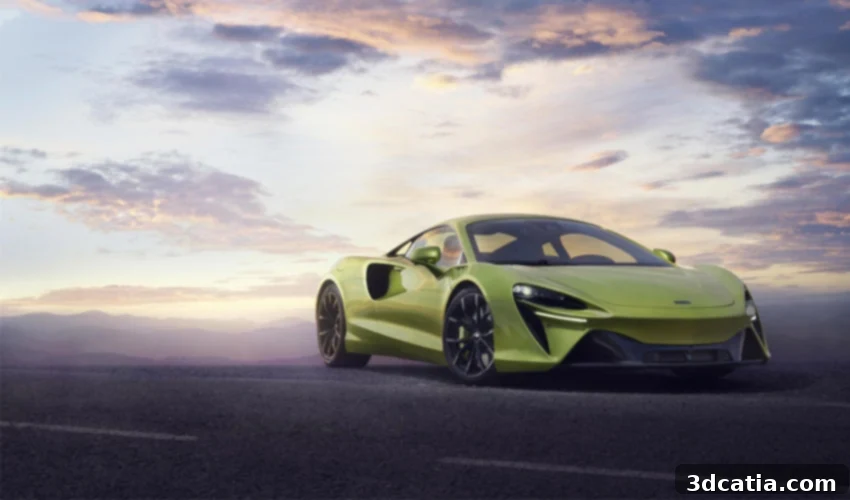
The automotive world recently witnessed a groundbreaking reveal from luxury carmaker McLaren: the Artura. This vehicle isn’t just another addition to their esteemed lineup; it marks a significant milestone as McLaren’s first high-performance hybrid supercar. Engineered from the ground up to seamlessly blend cutting-edge technology, sophisticated design, and unparalleled driving dynamics, the McLaren Artura stands as a true compendium of innovation. What makes this supercar particularly revolutionary is its strategic integration of additive manufacturing, commonly known as 3D printing. McLaren has proudly stated that 3D metal printing was employed in the design and production of critical engine components, specifically the engine block and cylinder head cores. This pioneering approach is not merely an engineering feat; it’s a deliberate choice aimed at achieving superior engine cooling, which directly translates to enhanced performance and efficiency – a testament to McLaren’s relentless pursuit of automotive excellence.
The global automotive landscape is undergoing a profound transformation, with the electrification of vehicles emerging as one of the most significant trends. This shift is driven by a confluence of factors, including increasing environmental awareness, stringent emission regulations, and a growing consumer demand for more sustainable yet equally thrilling driving experiences. Reports consistently highlight this rapid growth; for instance, the International Energy Agency (IEA) has indicated a remarkable 40% year-on-year increase in global electric car sales. Furthermore, market forecasts, such as those from Fortune Business Insights, project the electric vehicle market to skyrocket to an astonishing $985.72 billion by 2027. Within this burgeoning market, efficient hybrid cars are gaining particular favor among consumers, offering a compelling balance of electric mobility and traditional internal combustion engine reliability and range.
Car manufacturers worldwide are intensifying their efforts in this evolving market, and additive manufacturing is proving to be an indispensable tool in accelerating development and achieving previously unattainable engineering goals. The benefits of 3D printing, such as design freedom, lightweighting capabilities, and rapid prototyping, make it ideal for the complex demands of electric and hybrid vehicle design. For example, luxury sports car manufacturer Porsche successfully utilized additive manufacturing to reduce the total weight of a drive housing by approximately 10%, showcasing the direct impact of AM on performance and efficiency. Similarly, Aptera Motors has garnered attention with its innovative, partially 3D printed self-charging electric vehicle design, demonstrating the technology’s versatility across different segments of the EV market. These examples underscore a broader industry trend where 3D printing is no longer just for prototypes but is increasingly integral to final production parts, pushing the boundaries of what’s possible in automotive engineering. McLaren’s venture into 3D printed engine components with the Artura firmly places them at the forefront of this technological evolution, bringing the focus to England for this latest innovative concept.
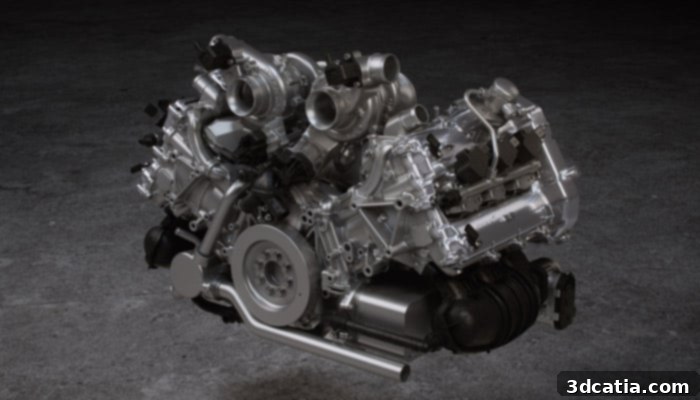
The McLaren Artura motor (Photo Credit: McLaren)
One of the core design philosophies behind the McLaren Artura was an uncompromising commitment to weight reduction, a critical factor in any high-performance supercar. To achieve this, McLaren engineers ingeniously turned to advanced materials, with carbon fiber playing a pivotal role in designing an exceptionally light yet incredibly strong frame. The Artura’s carbon fiber monocoque structure, a hallmark of McLaren engineering, boasts an astonishingly low weight of only 82kg (180.8lbs). This lightweight chassis not only contributes significantly to the car’s agility and speed but also provides a robust and secure protective shell for the integrated battery pack and other hybrid components. In fact, the total weight added by the entire hybrid powertrain system, including the battery, electric motor, and associated electronics, is a mere 130kg (286.6lbs) – an impressive feat of packaging and material science. Beyond its lightness, carbon fiber also offers superior impact resistance and torsional rigidity, enhancing both safety and dynamic performance. The heart of the Artura’s powertrain is its all-new V6 twin-turbocharged engine, seamlessly integrated with a powerful axial flux E-motor. This electric motor is remarkably compact, smaller, and denser than conventional radial-flow E-motors, contributing to optimal weight distribution and packaging efficiency. Weighing a mere 15.4 kgs, this potent combination allows the Artura to sprint from 0-100 km/h (0-62 mph) in a blistering 3 seconds flat, with its top speed electronically limited to 330 km/h (205 mph). This performance profile is a clear demonstration that hybrid technology, when engineered by McLaren, sacrifices nothing in terms of exhilaration.
The true engineering marvel within the Artura’s powertrain lies in its engine block and aluminum cylinder heads, which incorporate sophisticated 3D printed cores. While McLaren has kept specific details of the additive manufacturing technology under wraps, it is highly probable that these intricate cores were produced using aluminum alloys, given the material’s excellent thermal properties and lightweight characteristics crucial for performance engines. In such high-performance applications, a laser powder bed fusion (LPBF) process, also known as selective laser melting (SLM), is the most likely candidate for the 3D printing processes. LPBF works by precisely melting layers of fine metal powder with a powerful laser, building the part layer by layer directly from a digital design. This method allows for unprecedented geometric freedom, enabling the creation of internal structures that would be utterly impossible to achieve with traditional casting or machining techniques.
McLaren’s decision to leverage additive manufacturing was driven by the desire to design components with far greater complexity and integrate intricate details that conventional manufacturing methods simply cannot replicate. A prime example of this advanced design is the inclusion of a micro-compact cooling passage, precisely 2 mm in diameter, strategically placed between the cylinders within the engine block. This incredibly narrow and complex channel is designed to optimize the flow of coolant, ensuring highly localized and efficient heat dissipation. The ability to route coolant passages so precisely and densely within the core of the engine block significantly improves the overall engine cooling system’s effectiveness. Enhanced cooling is paramount for a high-performance hybrid supercar like the Artura, as it helps manage the immense thermal loads generated by both the powerful V6 twin-turbo engine and the integrated electric motor, preventing overheating and ensuring consistent, maximum performance even under extreme driving conditions. This meticulous thermal management not only contributes to the engine’s power output and efficiency but also extends its longevity and reliability, underscoring the transformative potential of 3D printing in modern automotive engineering.
Photo Credit: McLaren
Geoff Grose, Chief Engineer for the McLaren Artura, eloquently articulates the philosophy behind this extraordinary vehicle: “From the very beginning of the project, designing and engineering the Artura has been all about challenging ourselves to innovate, pushing and pushing to achieve everything we knew a next-generation, high-performance Hybrid McLaren supercar had to be. As a result, the Artura is all-new; the carbon fiber monocoque, electrical architecture and the body and interior are new. So too is the V6 engine, the transmission – which also integrates a new type of electric motor for the industry – as well as the rear suspension concept and our first-ever electronic differential.” Grose’s statement perfectly encapsulates the holistic and ambitious approach McLaren took with the Artura. It’s not just an update; it’s a complete reimagining of the supercar concept for the electrified era. Every single element, from its foundational carbon fiber monocoque that provides unparalleled rigidity and safety, to its advanced electrical architecture powering its hybrid capabilities, to the aesthetic and ergonomic perfection of its body and interior, has been meticulously developed from scratch. The V6 engine, a marvel in itself with its compact design and high output, is paired with an innovative transmission system that houses a novel electric motor – a testament to McLaren’s engineering ingenuity. Further enhancing its dynamic capabilities are a completely redesigned rear suspension concept for superior handling and ride comfort, and McLaren’s first-ever electronic differential, which precisely controls torque distribution for optimal traction and stability. This comprehensive overhaul signifies McLaren’s commitment not only to integrating cutting-edge technologies like additive manufacturing but to delivering an entirely new, exhilarating, and sustainable driving experience.
Beyond the strategic integration of additive manufacturing, the McLaren Artura truly embodies a compendium of innovation across all its facets. It represents a paradigm shift in how luxury performance vehicles can leverage advanced materials and manufacturing processes to achieve unprecedented levels of performance, efficiency, and sustainability. The Artura is a powerful statement about the future of high-performance automobiles – a future where electrification and digital manufacturing play a central role in shaping the driving experience. For those eager to delve deeper into the myriad features and engineering breakthroughs of this remarkable machine, the official press release HERE offers a wealth of additional information and technical specifications. It’s a testament to McLaren’s enduring legacy of pushing boundaries and setting new benchmarks in the supercar world.
What are your thoughts on McLaren’s groundbreaking new hybrid supercar and its innovative use of 3D printing for critical engine components? We invite you to share your insights and opinions in a comment below, or engage with us on our LinkedIn, Facebook, and Twitter pages! For the very latest updates in the world of 3D printing, remember to sign up for our free weekly Newsletter here, delivering all the essential news straight to your inbox.